Dominoes All Threes Calculator
Score an All Threes domino board from open-end pips, spinner state, counted ends, current score, hand pips, target score, player count, and round bonus or penalty.
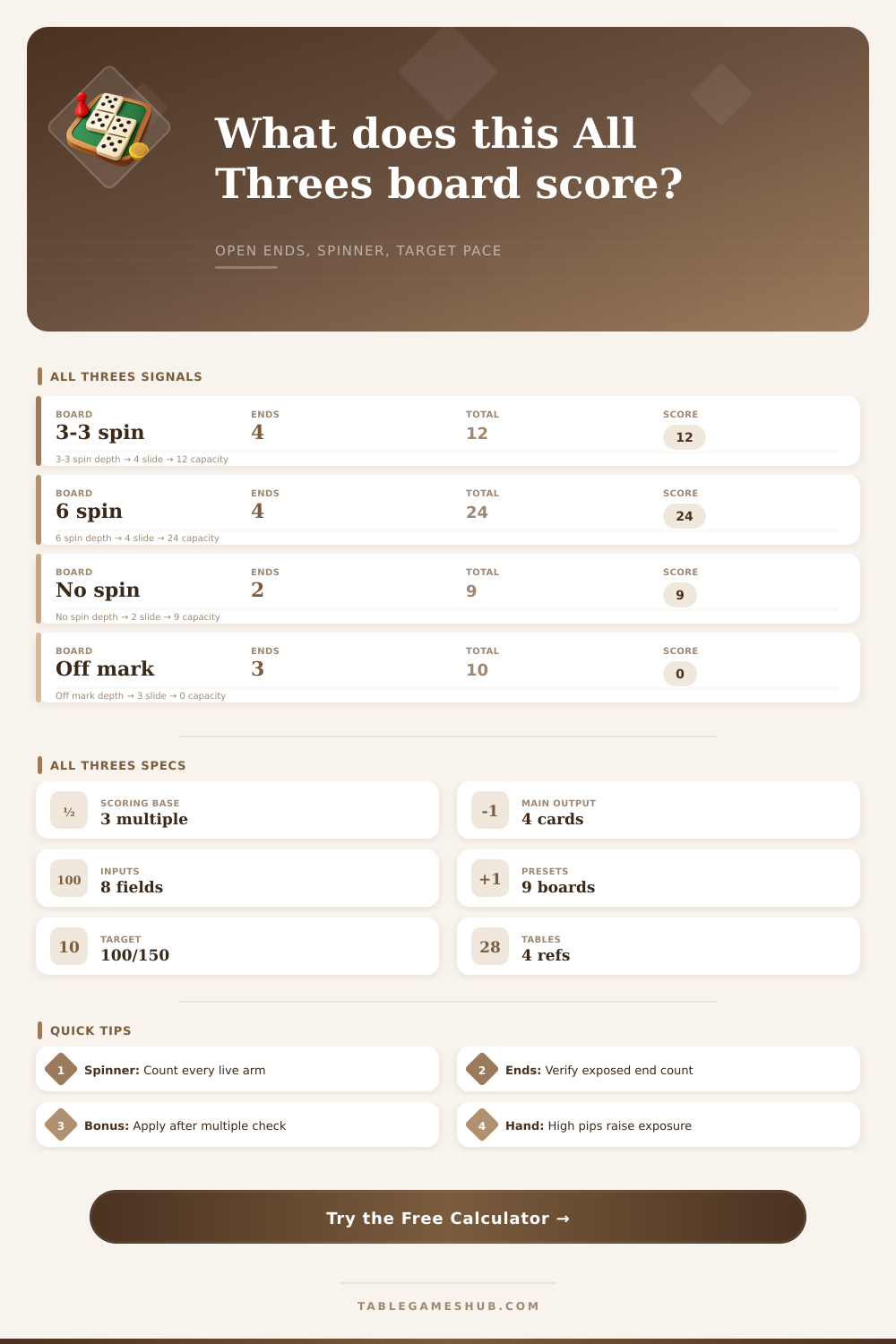
The board total is divisible by 3, so the open-end total scores before the round adjustment is applied.
Live multiple-of-three ladder
| Open-end total | Board score | Remainder | Table reading |
|---|---|---|---|
| 12 | 12 | 0 | Clean scoring board |
Common open-end totals
| Total showing | Scores? | Points | Typical board source |
|---|---|---|---|
| 3 | Yes | 3 | Low two-end starter such as 1 + 2 |
| 6 | Yes | 6 | Balanced low board or blank spinner support |
| 9 | Yes | 9 | Two-end board such as 4 + 5 |
| 12 | Yes | 12 | Double-3 spinner with two counted arms |
| 15 | Yes | 15 | Three-end board built around 5s |
| 18 | Yes | 18 | High three-end or double-3 plus support |
| 24 | Yes | 24 | Double-6 spinner with two arms or high four-end board |
| 30 | Yes | 30 | Rare high four-end scoring state |
Spinner contribution guide
| Spinner state | Counted arms | Added pips | Score impact |
|---|---|---|---|
| No spinner counted | 0 | 0 | Only outside line ends count |
| Double blank open | 2 or 4 | 0 | Changes end count but not pip total |
| Double-3 two arms | 2 | 6 | Often turns 6 into 12 |
| Double-3 four arms | 4 | 12 | Scores by itself when isolated |
| Double-5 four arms | 4 | 20 | Needs support pips to hit a multiple |
| Double-6 four arms | 4 | 24 | High-value scoring platform |
Player count and target pace
| Players | Target style | Pace pressure | Calculator note |
|---|---|---|---|
| 2 players | 100 or 121 | Direct race | Every scoring board changes the gap sharply |
| 3 players | 100 | Cutthroat swing | Hand pips expose more end-round risk |
| 4 players | 150 | Partnership pace | Bonus and penalty entries help track table rules |
| 2 teams | 150 or 200 | Long race | Target gap matters more than a single small score |
Practicing consistantly and using the All Threes calculator tool can help remove any guesswork from the game. Precision is also more highly valued in this game then hanging onto powerful tiles; so correct counting becomes the primary focus.
If the board appears to be messy and you’re feeling shaky, just know that math isn’t complicated, as long as you’re familiar with the rules. Add the exposed ends of the dominoes. Score if it’s a multiple of three. Sounds simple but under pressure, lots of people gets their sums wrong. With the calculator, those totals is done for you in an instant. Forget about doing maths and concentrate on your strategy.
How to Count Scores Correctly
Any contribution from the spinner tile get added to the open-end pips on the table. Now there’s one thing that confuses people who are just starting to learn: the spinner. Each time it lands on a double, it opens up additional line where you can play. Some people count each arm radiating from that middle tile as they count. Others only count four arms or don’t bother until the very end. Until you understand what your own house rules say about this, don’t bother trying to count at all.
If you’re with a group that counts all four arms when landing on a double six spinner, then the spinner add twenty-four pips to the total. This is why you should of be able to select this particular state and maintain accuracy in your mathematical calculations based off how you really do play. Keep an eye on your exposure as well (the number of pips left in your hand). If the game ends abruptly, the more high-value tiles you’re holding, the worse off you’ll be, since those pips count against you.
There’s a field for it on the calculator so that you can know how exposed you are with what you’ve got now. Then you can choose to go for a big score chance or play it safe with a low tile.
Turns also play differently based off the size of your table. When it’s just you and another player, each turn is critical. There are no other players to thin out the momentum. On the other hand, if there are four people playing as a team, the game slows down a bit and there’s room for larger swings and more strategically adjusting moves. The tool comes with some handy reference tables that illustrate the point distribution for certain board positions in different circumstances. You can immediately see that 12 pips is always good, whereas 13 is always bad; that takes the guessing work out of score debate.
Beyond this, regions bring their own set of bonuses and penalties. Some reward extra points if you finish with no tiles remaining (going domino). Others penalize players who draw too many times or leave behind too many high pips. These changes can be entered in the calculator to see what happens at the end of the round. That way, the score truly represents the agreed-upon rules among friends, not just some generic standard.
Threes is very much a balance of skill and luck played in a closed feedback loop. You are drawing what you draw, but playing to some degree with pattern recognition and probability. If you know that pips is distributed over the double six set in such-and-such way then you can anticipate what’s likely to appear next. There is less about memorizing combinations than there is about picking up a feel for the game’s flow.
“I don’t keep my focus solely on what’s in my hand, but instead look at the board as a whole,” he said. I try to notice which numbers seem stuck in the middle and which ones are no longer being used. It changes how I play each turn. I feel like I’m holding back a double three that’ll open up a spinner to benefit someone else more then me.
But the more you get over being afraid of the math, the less difficult scoring is. You can create that intuition while the tool has your back. Then one day you’ll look up from a haphazardly arranged board and know immediately if it’s good or bad without even touching anything. Until that time though, knowing you’re right takes some of the sting out of keeping things rolling along and making everybody happy.
Next time you’re looking down at your messily laid out puzzle where four different ends are visible, slow your breathing and count them off. The goal is not just to score points but to stay in control of the rhythm. Win or lose (for money or for pride), the difference between a comfortable victory and defeat on a technicality depends upon those careful details. And that precision transforms what would otherwise be a casual pastime into a true test of wits.