World of Darkness Dice Pool Calculator
Model d10 dice pools with difficulty numbers, target successes, botch handling, 10-again explosions, rote rerolls, and exact probability distributions.
| Net successes | Exact chance | At least this many | Meaning |
|---|---|---|---|
| 0 | -- | -- | Failure after cancellation |
| Target successes | Chance to meet | Miss chance | Typical reading |
|---|---|---|---|
| 1+ | -- | -- | Basic success |
| Option | What the calculator does | Common use | Probability effect |
|---|---|---|---|
| Difficulty | Success on d10 result at or above the number | Classic variable target number | Higher difficulty lowers success odds |
| 1s cancel | Each rolled 1 subtracts one success before the final floor at zero | Classic World of Darkness pools | Raises zero-success outcomes |
| 10-again | A qualifying 10 rolls another d10, up to the cap | Chronicles-style exploding dice | Adds a long high-success tail |
| Rote | Failed original dice reroll once and keep the reroll result | Practiced or rote actions | Improves low and middle outcomes |
| Preset | Pool | Difficulty | Target | Notes |
|---|---|---|---|---|
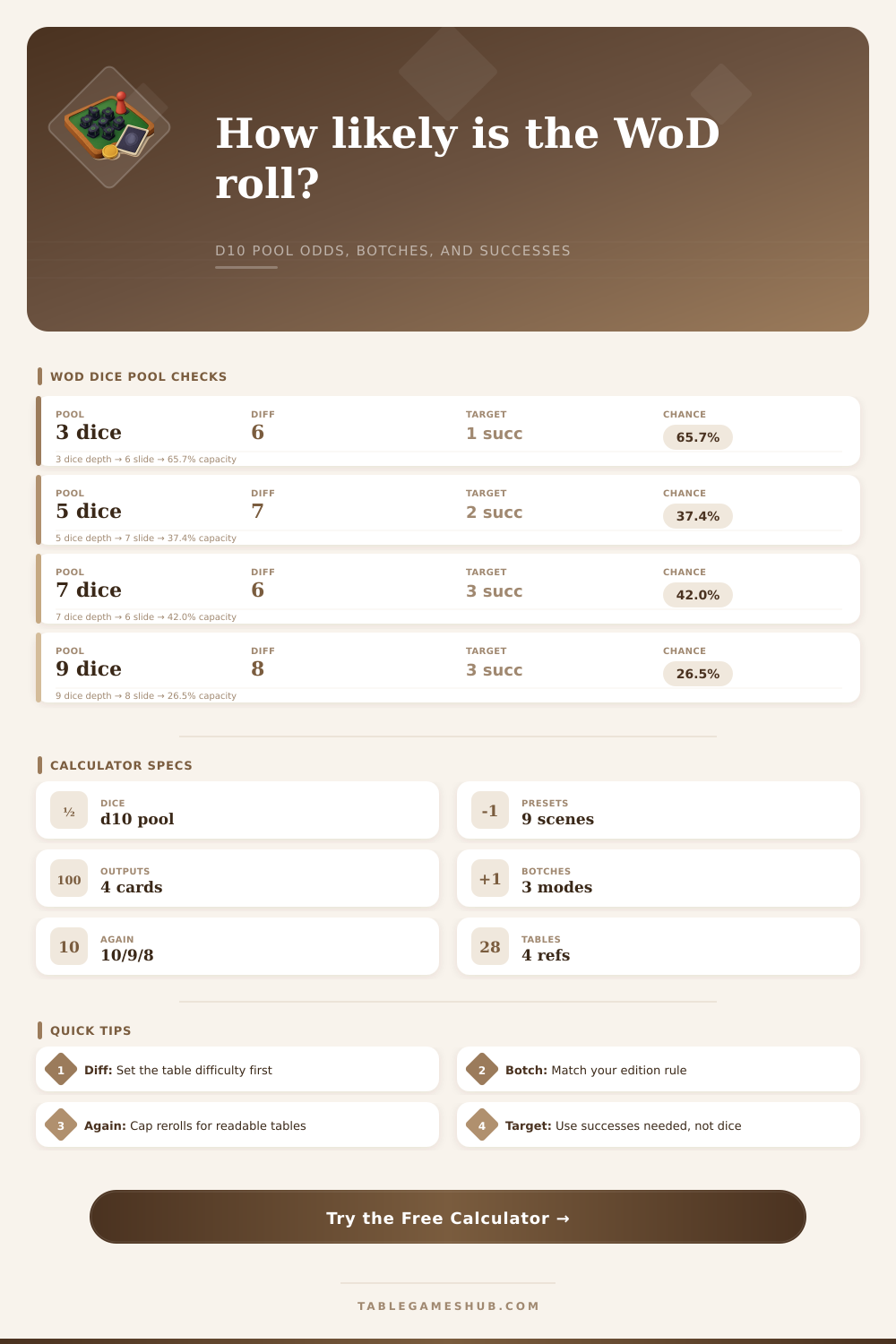
| Basic Difficulty 6 | 3 dice | 6+ | 1 | Classic single success check |
| Trained Action | 6 dice | 6+ | 2 | Competent character task |
| Hard Difficulty 8 | 5 dice | 8+ | 2 | Difficult action under pressure |
| 10-Again Power | 7 dice | 8+ | 3 | Exploding success tail enabled |
A dice pool calculator are a tool that you can use to determine the mathematical probability of specific outcome when playing a game of World of Darkness. In games of World of Darkness, players uses dice to determine whether they succeed or fail at the tasks that they attempt to perform with their characters. A dice pool calculator will turn the results of the dice roll into readable data for the players, and will also show how often a given set of character trait will result in the outcome that the players require for success at their tasks.
The tool will respect the rules of the specific game that is being played, as it is able to track the different edition of the games and any house rules that may be in effect within the specific game session. Many players will utilize a dice pool calculator to understand the impact that different rules has upon the probability of success and failure for the players’ characters. To calculate the probability of success for the players’ characters, the calculator require that each player enters specific information about their characters and their tasks.
How a Dice Pool Calculator Works
This information includes the number of ten-sided dice (often referred to as “d10” dice) that are to be rolled, the difficulty number for the task, and the target number of successes for that task. If the number of ten-sided dice is changed, the probability of success for the character will change. If the difficulty number is changed, the probability of success will also change.
Some editions of the game state that rolling a one with a ten-sided die will subtract from the number of successes that are rolled, while other editions of the game treat rolls of one as neutral in regard to success. A dice pool calculator allows players to choose which rules to apply to their games, so that they can view the impact of those rules upon the calculated probability of success for the players’ characters. The difficulty number will impact the probability of success for a given task.
If the difficulty number for a task is increased, the difficulty number will decrease the likelihood of success of each die roll for the character. Thus, increasing the difficulty number will increase the likelihood that a character will roll low numbers of successes with their dice rolls. Storytellers that use high difficulty numbers are indicating to the players that the character should experience some degree of difficulty in performing that task.
Storytellers that use low difficulty number are indicating to the players that the character should experience little difficulty in performing that task. The rule for how the game handle rolls of one with the ten-sided dice will also impact the probability of success for the players’ characters. When the rules state that any roll of one with a ten-sided die will cancel any successes for that character’s roll, the probability of rolling zero successes with the dice will increase.
A dice pool calculator will display this increased probability of failure by the player’s character. As such, the dice pool calculator is useful in that players may otherwise ignore the risk of rolling a one with any ten-sided die; the calculator will reveal the way in which such rolls increase the risk of failure by the character. Finally, the game may contain rules regarding the rerolling of dice rolls (such as the use of “ten-again” rules) that will increase the probability of high numbers of successes for the characters’ dice rolls.
A ten-again rule allow a player to roll extra dice if they roll a ten, and each die will provide the potential for another success. A dice pool calculator allows players to set a cap on the explosions a player can have. A cap is used on explosions to show the rarity of long explosions.
By setting a cap on how many explosions a player can have, a dice pool calculator will show how this affects the chance of rolling a high number of successes. Automatic successes are entirely different than rolling the dice. Automatic successes dont rely on the players’ rolls to provide successes.
Instead, automatic successes add to the player’s total number of successes. These successes are often used to describe a character’s willpower or the gear that the character has. Adding to the total number of successes shifts the curve of the dice pool’s probabilities.
It also allows characters with few dice to succeed as often as characters with high dice pools. Automatic successes are simply added to the total number of successes rolled, which is how most tables apply automatic successes. There are different rules regarding botching in different editions of the game.
A botch is considered a catastrophic failure of the players’ dice pool roll. When rolling a botch, the player rolls specific combinations of failure and ones. Some editions of the game require the player to roll only failures and at least one one to botch.
In other editions, rolling a net total of zero successes and at least one one will botch the player’s dice pool roll. A dice pool calculator allows players to switch between these two rules to see how often a botch will roll in a scene. Another benefit of using a dice pool calculator is that it will generate a series of reference tables for the game.
These tables will show the chance of any given number of successes being rolled. If a player want to know the chance of rolling a high number of successes, these tables will show that information. A storyteller can use these tables to determine if a scene will use one or multiple dice pool rolls.
These tables will show how much variance will be in the scene’s successes. A dice pool calculator cannot calculate the effects of social factor or narrative descriptions in the game. However, it does provide a mathematical baseline for the player.
For instance, a player may earn a bonus die for including vivid narration about the scene. A character may earn a penalty die for being under emotional stress. If the mathematical calculations show that a roll will not succeed, a player may decide to give the player an extra die to account for this.
In the other instance if the calculations show that a roll will succeed, a player may decide to complicate the scene for that character. Using a dice pool calculator ensure that a group understands the game mechanics and the way that each game element interacts with the others.