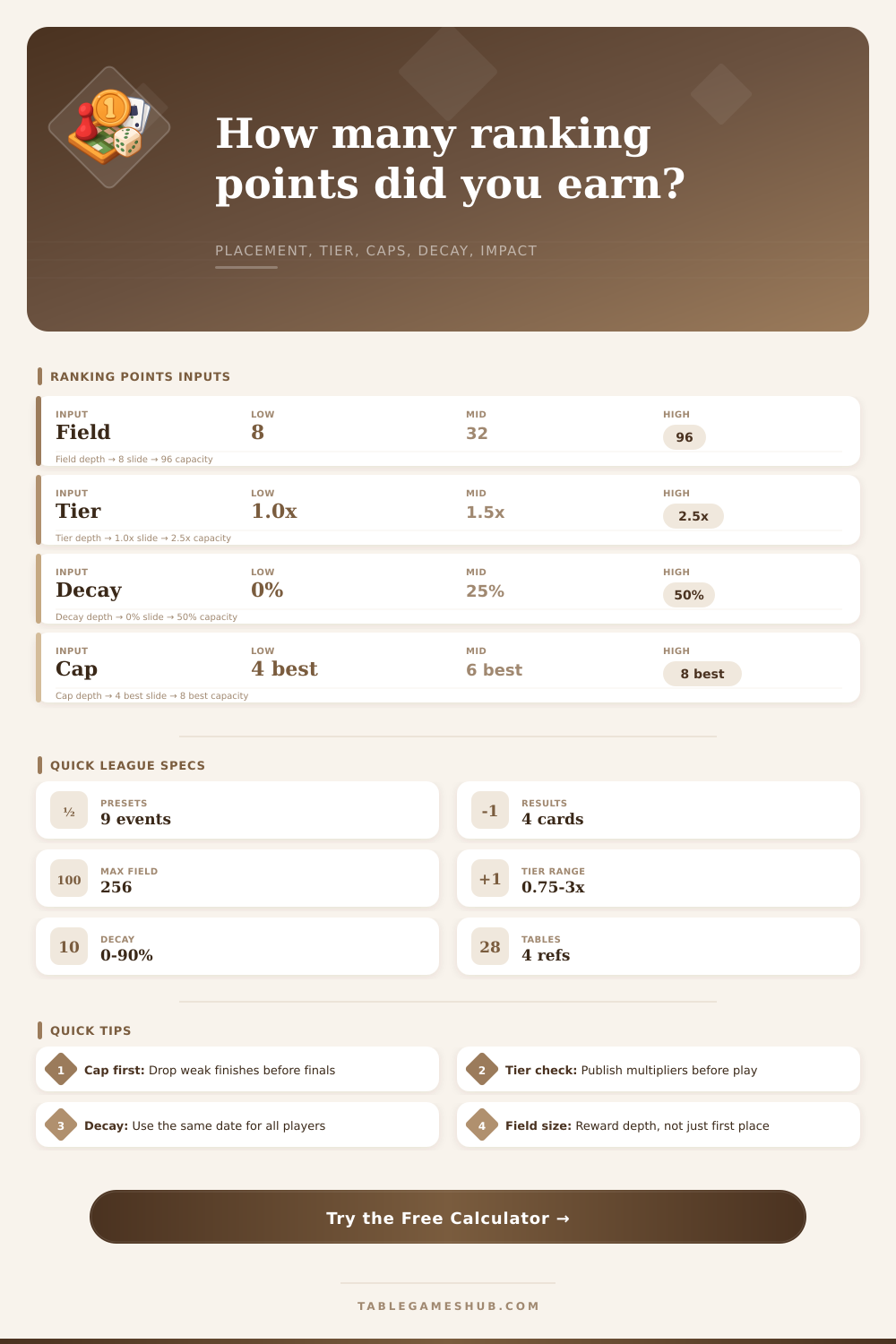
🏆 Ranking Points Calculator
Score tabletop league results from placement, field size, event tier, participation credit, bonus awards, seasonal decay, best-results caps, dropped scores, and leaderboard movement.
Choose a preset or enter event data to calculate ranking points.
Placement, field size, tier, participation, bonus, cap, drops, decay, and season weight will appear here.
Use the same published formula for every player in the same standings cycle.
| Placement band | Placement base | Common use | Standings signal |
|---|---|---|---|
| Winner | 100 points | Event champion | Maximum finish value |
| Top 10% | 80-99 points | Final table, cut, or pod winner | Major upward movement |
| Top 25% | 55-79 points | Strong winning record | Reliable contender result |
| Middle 50% | 25-54 points | Even or slightly positive record | Useful with attendance credit |
| Lower finish | 0-24 points | Learning round or rough pairing | Often dropped by cap policy |
| Event tier | Multiplier | Typical tabletop use | Publish before event? |
|---|---|---|---|
| Casual meetup | 0.75x | Open game night, demo league, friendly ladder | Yes |
| Weekly league | 1.00x | Regular board game, card game, or miniatures round | Yes |
| Club monthly | 1.25x | Monthly standings event with fixed pairings | Yes |
| Store championship | 1.50x | Local season event with playoff cut | Yes |
| Regional qualifier | 2.00x | Invitational qualifier or travel event | Yes |
| Major convention | 2.50x | Large multi-round convention tournament | Yes |
| Season final | 3.00x | Final championship or crown event | Yes |
| Field size | Depth bonus | Why it matters | Calculator behavior |
|---|---|---|---|
| 2-7 players | 0-6% | Small ladder or head-to-head pod | Light boost only |
| 8-15 players | 6-10% | Single-store meetup or small club | Moderate depth reward |
| 16-31 players | 10-15% | Full local event or monthly cup | Strong field credit |
| 32-63 players | 15-18% | Championship-sized tabletop field | Near maximum depth reward |
| 64+ players | 18-20% | Regional, convention, or online league final | Depth bonus capped at 20% |
| Season policy | Best cap | Dropped scores | Best fit |
|---|---|---|---|
| Short sprint | Best 4 | 0 | Four-week league or demo month |
| Monthly league | Best 5 | 1 | One missed or weak event protected |
| Standard season | Best 6 | 1 | Balanced attendance and performance |
| Long season | Best 8 | 2 | Many events with travel conflicts |
| Grand ladder | Best 10 | 3 | Large community standings cycle |
Separate event strength from finish quality
Placement should reward performance, while field size and tier should reward the difficulty of earning that finish. Keeping those layers separate makes standings easier to audit.
Apply caps after decay and season weighting
Use one timing rule across the league. This calculator shows the event's cap exposure so organizers can decide whether it enters a player's best-results list.
Every time someone finishes better in a local tournament then someone else who lost more matches, they ask the exact same question: “Why did you beat me? You’re lower than I am on the leaderboard.” Rarely is answer as simple as placement. More often, it’s a combination where a cap on the best results protects one player’s poor finish while penalizing another. Or maybe it’s seasonal decay. Or it might be event tier multipliers. It might even be field depth.
That’s why rank matters and why leagues should tries to balance opportunity cost with pure performance. That’s basic placement. But without any context, that doesn’t tell half the story. A third place finish in a sixty-four person convention field is not equal to winning a three player meetup (despite having a similar number of matches).
How League Scoring Works
Once you plug your event into the calculator above, the math are done for you and you don’t have to hand tweak numbers for each type of tournament. It separates finish quality from event strength and awards organizers for making their competition difficult instead of just rewarding the result. That allows standings to remain fair when players decides to compete at different events on different schedules or when they travel to more challenging events.
Depth Bonus: Size of field is a depth bonus because beating more opponents statistically proves higher skill variance. If you are in a tiny ladder, you can be the weak link and boost your early standings; if your field is big, you has to perform consistently over multiple rounds. To make this clear we show the near max-depth reward that happens when there’s a big crowd. That way, no one cheated the system by only showing up for weak-night events that paid a huge number of points for little work. And everyone who went all-in on some crazy weekend convention got properly rewarded for making the trip and putting in the hours.
Now I’ll add another twist: Tier multipliers. These can be mind benders for newcomers. While a meet up may have a zero point seven five multiplier, a Regional Qualifier may be two times or more. These are not tied to table count but instead recognize weight and importance of the tournament itself. To ensure players buy into the system, you must announce this before pairing begins. If a player believes the points got bumped after the fact, they won’t participate going forward. Long term, this is essential for health of the league. Be transparent about it.
Seasonal decay policies reflect that older results fade over time. The current form should be weighted more towards the end of standings. That benefits newer contenders, while holding back veterans who ruled the roost a couple of years back. And it allows for wildcards like late-season stumbles to not inflict too much long-term harm, enabling thrilling turnarounds that maintain fan interest right through the last round. Most organizers aim for 15-30% decay, a compromise between what was done in the past vs. This is what has been done lately.
Caps and dropped scores protects against inevitable scheduling issues and bad luck. If someone misses an event, they can drop their worst result and still be in contention on the leaderboard. Real life routinely impacts game time, which is why retention is so important. One work trip or cold could wipe out months of effort and cause someone to quit in frustration if there wasn’t at least some margin of error. It’s about recognizing that no one is perfect over the course of a long season and rewarding both good performance and consistency.
Add flavor with bonuses for undefeated rounds or sportsmanship, but make them modest enough to avoid distorting main metrics. Give participation credit for just showing up (even if you’re going to get smoked), keeping things lively in the community while keeping tables full. Use season weight adjustments so playoff pushes/finals has additional significance versus preseason warmup games. All this interacts to make a changing leaderboard instead of a static one, with a sense that it’s alive.
The bottom line, however, is that numbers on paper are nothing without how they relate to forward motion towards a goal. It might be moving up in the ranks. It might be getting some respect. It might even be winning a trophy. But it has to respond to skill level and effort. If it does, the math will blend into the background and all you see is the thrill of competing. That’s what good league design looks like.