Qwixx Locked Row Calculator
Check a Qwixx row lock, count the lock symbol, look up the row score, subtract penalties, and total the score sheet.
| Scoring marks | Row score | Lock included? | Counting note |
|---|---|---|---|
| 0 | 0 | No | No marked boxes in the row. |
| 1 | 1 | Optional | One crossed box scores 1 point. |
| 2 | 3 | Optional | Two scoring marks use the printed table value. |
| 3 | 6 | Optional | Triangular score lookup, not a flat rate. |
| 4 | 10 | Optional | Still below the five-mark lock gate. |
| 5 | 15 | Optional | Minimum mark count needed before a lock can be taken. |
| 6 | 21 | Possible | Often five numbers plus a lock symbol. |
| 7 | 28 | Possible | Count all crossed numbers and any lock symbol. |
| 8 | 36 | Possible | Use the row score table value directly. |
| 9 | 45 | Possible | Nine scoring marks are worth 45 points. |
| 10 | 55 | Possible | Ten scoring marks are worth 55 points. |
| 11 | 66 | Possible | Eleven scoring marks are worth 66 points. |
| 12 | 78 | Possible | All eleven numbers plus the lock symbol. |
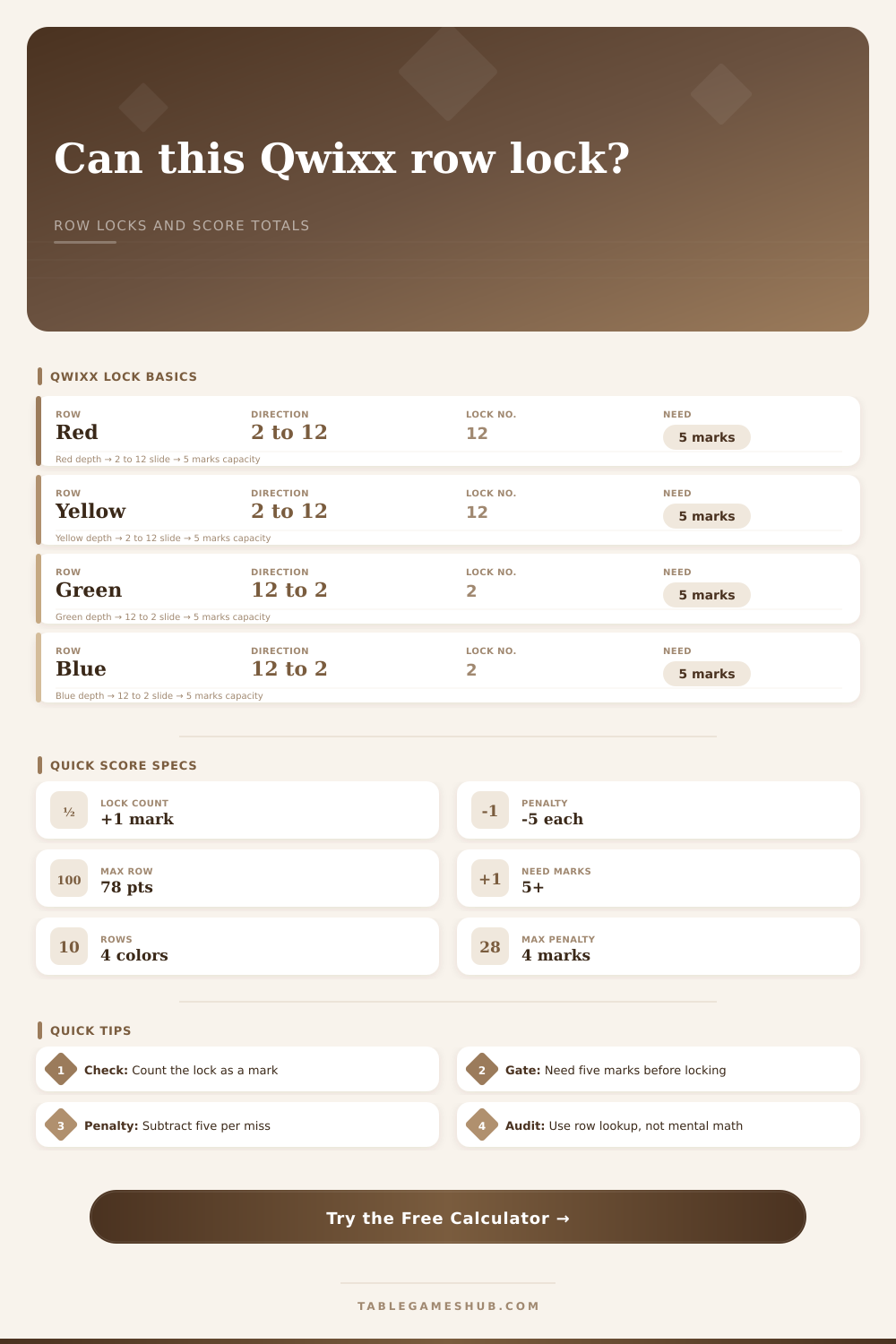
| Row color | Normal direction | Lock-end number | Lock symbol count |
|---|---|---|---|
| Red | Ascending, 2 through 12 | 12 | Counts as 1 extra scoring mark. |
| Yellow | Ascending, 2 through 12 | 12 | Counts as 1 extra scoring mark. |
| Green | Descending, 12 through 2 | 2 | Counts as 1 extra scoring mark. |
| Blue | Descending, 12 through 2 | 2 | Counts as 1 extra scoring mark. |
| Check | Required count | Calculator field | Scoring effect |
|---|---|---|---|
| Minimum numbered marks | 5 or more | Numbered marks in selected row | Unlocks the possibility of scoring the lock. |
| Far-end number | Marked | Lock-end number is marked | Confirms 12 or 2 was crossed for that row. |
| Lock symbol | 0 or 1 | Lock symbol marked | Adds one scoring mark only if recorded. |
| Penalty marks | 0 through 4 | Penalty marks | Subtracts 5 points for each mark. |
| Score item | Formula | Example | Where it appears |
|---|---|---|---|
| Selected row marks | Numbered marks + lock symbol | 5 + 1 = 6 | Snapshot cards and breakdown |
| Selected row score | Score table lookup | 6 marks = 21 | Result card 1 |
| Penalty deduction | Penalty marks x -5 | 2 marks = -10 | Result card 4 |
| Sheet total | Row score + other rows - penalties | 21 + 49 - 5 = 65 | Result card 3 |
4 marks, end crossed
Score is 10. The row is still not lock eligible because the five-mark minimum is not met.
5 marks, no end
Score is 15. The row has enough marks, but the lock-end number is not recorded.
5 marks plus lock
Score is 21. The lock symbol becomes the sixth scoring mark after eligibility is satisfied.
11 marks plus lock
Score is 78. All number boxes plus the lock symbol produce the maximum row score.
A round of Qwixx may be silent, but it’s more likely the quiet resignation of a player who realized he locked a row too soon or failed to notice a penalty deduction. On face of things, scoring this dice strategy game seems easy enough, but it’s littered with mathematical traps that will wreck a good score. When you enter your mark counts into the calculator above, the math’s done for you… No need to do mental math with tricky triangular number sequences and penalty subtractions. What might of became an argument-starter becomes a speedy confirmation step.
The biggest thing people don’t understand when they is starting out is how exactly the lock works. You have to mark the actual end number that matches where you want the row to go, before you can say that the row is closed. So for rows that go up (yellow, red) you’ll have to get across 12. Rows that go down (blue, green) will be for 2. That’s why getting across the last number is so important, if you try to lock a row before you’ve crossed the last number, you won’t earn anything on the lock itself. It just matters that you have that last number checked off. If you have that last number unchecked, you are not eligible to lock that row and the tool will check that for you.
How to Score in Qwixx
However, after that row becomes eligible, scoring change to a triangular system, something where many casual guessers will stumble. One mark is one point, two marks together equal three points, etc. Every subsequent mark gets you another point beyond the last. So if you’ve got your head down for all eleven numbers plus the lock symbol, then you’re looking at a big score jump. Ten marks equal 55 points, according to the reference table on the page. That’s a pretty steep curve, meaning that if you miss one late-game mark with a high value, it’ll hurt a lot more then if you missed it early on.
The second part of the score equation comes in form of penalties. Anytime one or more of the dice colors does not correspond with an open row, you’ll need to apply a mark to the “penalty” column. A single mark will result in five fewer points for your total. Until you get several of these penalties, it doesn’t sound like much. Four penalties remove 20 points which is about the same as getting a completely filled-in row. I’ve seen many player obsess over accumulating marks in rows and completely overlook the penalty column. This calculator lets you enter number of penalties individually, so it can be correctly included in the sheet total.
You must decide whether to risk locking a row or wait to gain more points based off how many marks are in it, which adds strategic depth to the game. Fifteen points isn’t too shabby, but waiting until you’ve collected seven or eight marks increases the points to twenty-eight or thirty-six. On one hand, there’s always the chance that the dice won’t cooperate long enough for you to collect enough marks to lock a row. On the other hand, if you’re reading the board well enough, you know when the dice are going to stop playing along so you can take advantage of that. There’s a judgment call here where no tool can tell you what to do, but the calculator can let you run some simulations about whether to leave a row unlocked or not.
Scoring mistakes happen a lot in the end game, when players scramble to add up their points, losing track of how many penalty marks have been added or not marking the lock symbol as another mark. This friction is removed with a process for checking scores. Enter your marks so far, verify if you are locked and let it do the math for you. It will show the total score, which points contribute that number, and where the deductions is taking away from the score.
Qwixx isn’t really about chance; it’s a game of careful accounting. It’s all about knowing precisely what every mark on the sheet is worth, and how those penalties will affect you. There are only two rules for scoring: five points off at any time if you do so (that’s why there’s no penalty for rolling 6s), and adding up the triangle, which is easy once you get used to it. If you keep track of your score sheet properly, then whatever number comes out in the end is exactly what you were trying to achieve. And when every point matters, keeping your head clear is almost as important as getting lucky.