Canasta Going Out Bonus Calculator
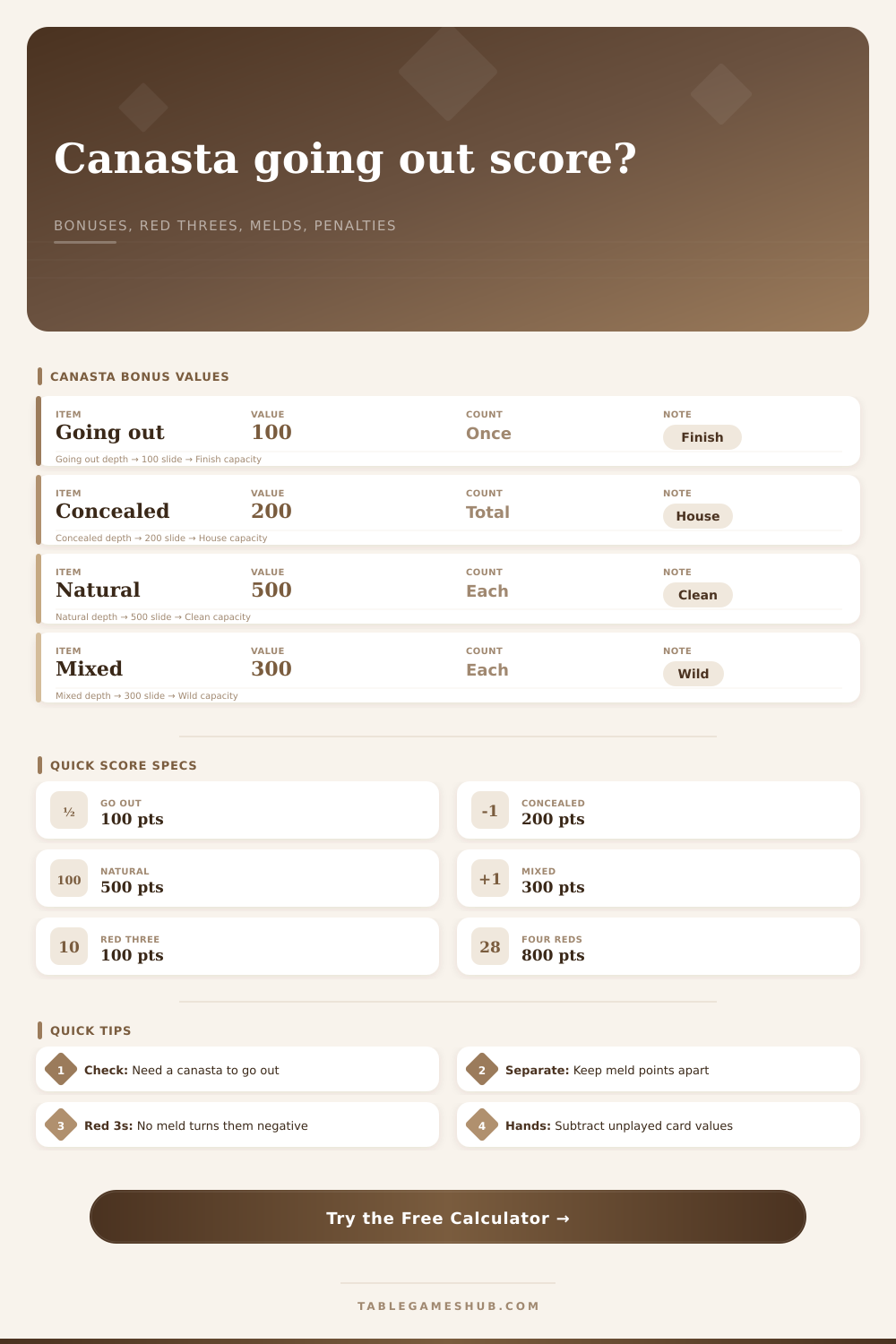
Total a Canasta hand ending with regular going out, concealed out, canasta bonuses, red threes, meld-card points, and leftover-card penalties for one team.
Use one team at a time. Enter meld-card points separately from canasta, red-three, and going-out bonuses so the score sheet stays auditable.
This calculator counts scoring only. It does not decide strategy, table stakes, or any gambling-related outcome.
| Ending type | Regular out | Concealed premium | Scoring note |
|---|---|---|---|
| Regular going out | 100 | 0 | Team ends the hand after meeting the table's canasta requirement. |
| Concealed, classic | 100 | 100 | Calculator shows this as 200 total for concealed out. |
| Concealed, house | 100 | 200 | Some tables score a larger 300-point going-out package. |
| Did not go out | 0 | 0 | Use this for the opposing team or for a mid-hand score check. |
| Component | Score | Count method | Common caution |
|---|---|---|---|
| Natural canasta | 500 each | Seven-card canasta with no wild cards. | Card values in the canasta still count in meld points. |
| Mixed canasta | 300 each | Seven-card canasta that includes allowed wild cards. | Do not replace the card-value count with the bonus. |
| One to three red threes | 100 each | Count the team red threes after the hand ends. | Penalty instead of bonus if the team never melded. |
| All four red threes | 800 total | Use 800, not 400, in many Canasta scoring sheets. | Confirm house rules before using a different value. |
| Card held | Penalty value | Count example | Score entry |
|---|---|---|---|
| Joker | 50 | 2 jokers left in hand | Subtract 100 |
| Two or ace | 20 | 3 aces left in hand | Subtract 60 |
| Eight through king | 10 | 5 middle or high cards | Subtract 50 |
| Four through seven | 5 | 4 low cards | Subtract 20 |
| Black three | 5 | Usually deadwood when held | Subtract 5 each |
| Scenario | Must include | Watch for | Calculator field |
|---|---|---|---|
| Legal regular out | At least one canasta | Permission to go out may be table-specific. | Ending status plus canasta count |
| Concealed out | Entire final meld at once | House scoring may differ by 100 points. | Concealed scoring selector |
| Red threes with no meld | Red threes collected | They become negative if no meld was made. | Red-three condition |
| Opponent count | Melds and cards in hand | No going-out bonus unless they also went out. | Ending status: did not go out |
Regular Out
Use when the team ends the hand after making the required canasta count and has no concealed-out premium.
Classic Concealed
Counts as a 200-point going-out package, shown as 100 regular out plus 100 concealed premium.
Four Red Threes
Many score sheets award 800 total when one team collects every red three and has made a meld.
No Meld
Red threes reverse into a penalty if the team never completed any meld before the hand ended.
Keep columns separate: write meld-card points, canasta bonuses, red threes, going-out points, and hand penalties on separate lines before adding the team total.
Confirm concealed scoring: some tables treat concealed out as 200 total, while others add a larger house premium.
Check the canasta count: standard scoring expects at least one completed canasta before a team can go out legally.
Count hand penalties last: leftover wild cards and aces can swing a close hand even after a clean going-out bonus.
It’s a silent competition. As cards are shuffled, a hand that could go either way starts to take shape. Your hands fill with card and you’re sitting across from your partner at table. Melds accumulate. The question isn’t just whether you can go out, but how much that moment will actualy count toward your team’s total score.
There is more to scoring Canasta than just adding up points. There are premiums, bonuses, and penalties within a complicated system that punishes sloppiness and rewards patience. It’s hard math even if you’ve memorized the table.
How to Score in Canasta
Every hand has its anchor: the going-out bonus. And most player misunderstand it. Finishing the deal with a regular out gets you a hundred points, which isn’t half-bad as bonuses go. But in many standard rulesets, there’s a secret: a concealed out gets you twice as much (or an additional premium in some house variations). You should of let the calculator do the math here, because you don’t have to figure out if you’re adding or multiplying based on where you finish.
What you have to understand is that the round doesn’t end when the last card goes down; it ends after all the cards are played. It’s not just what you play but how you plays them. Clean runs using no wild cards are natural canastas; five hundred points per canasta. Runs using twos or jokers (called mixed canastas) count as three hundred points. The point is: The card points and the canasta points are independent scores, and many people mistakenly mix up the two. They fail to realize that even if a player creates a meld with all sevens they still get base points for having those cards in their hand. Then, there are extra bonus points for creating a canasta out of those cards. These columns must be kept distinct; they’re important to keeping score accurately. Sure, it sounds like a little thing but sometimes in a close game you need to know who is in front by how much; and this will help.
The inclusion of red threes adds an element of danger which keeps players on their toes. If you’ve melded at least once, it’s worth it to pick up the red threes because they add a hundred points apiece (or eight hundred if you manage to collect all four). But, on the flip side, if your team doesn’t make any melds then those red threes can go from being an asset to a liability. In fact, they become a penalty against you and they’re taken away from your final score. That’s where the strategy comes into play and you have to make a decision fairly early on in the hand: do I hold onto these threes hoping to get a huge payoff, or do I play it safe? Because of this, calculator takes this into account and will change the value of red three from positive to negative depending on whether you’ve melded or not.
The last bit of scoring is your hand penalty. If your partner goes out and you still have cards in your hand, they will be deducted from your score. Be careful with high value deadwood; you might go for a nice canasta bonus but then get hammered with all those points by having a joker or ace or two still in your hand. That’s why Canasta games tend to get tense near the end. It’s not just about gaining points anymore but minimizing points lost. The table on the page shows everything. It tells you that a left-over four hurts less then a left-over king. A king hurts twice as hard as any other card.
The key to mastering Canasta scoring is learning to view a hand as a connected series of possibilities. Sure, laying down cards is necessary but so are assessing the value of that concealed out versus the potential risk of drawing a red three. So are monitoring your individual scores for canastas and melds. Once you grasp the role each element plays in the total score, the game will begin to make more sense. The numbers will cease to be random mysteries and instead reveal their own story, of the quality of your play. And that’s when it gets realy fun.