Euchre March Bonus Calculator
Score the hand from the maker side, defender side, tricks taken, march or sweep, euchre, lone hand, and both teams' running totals.
Hand Score
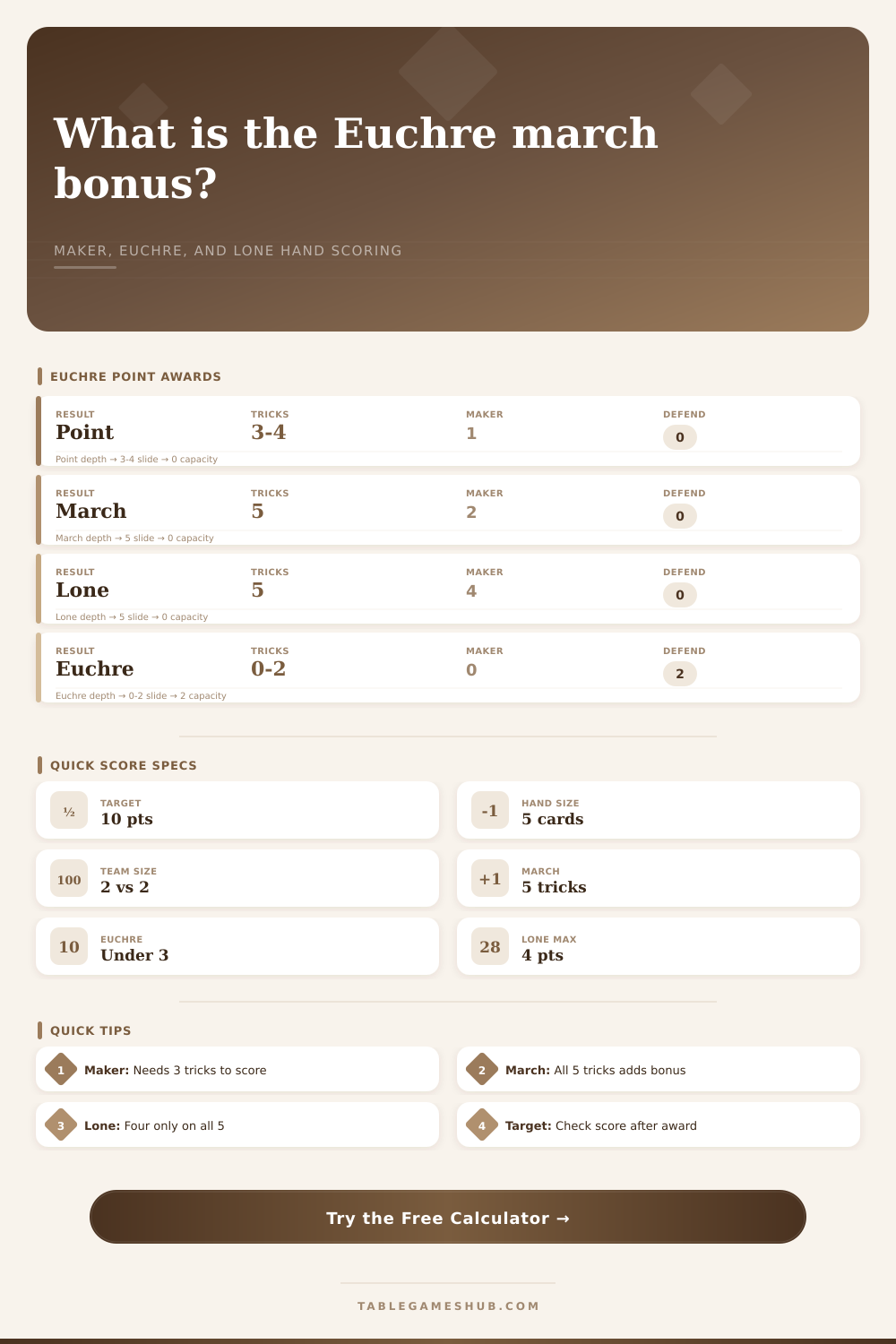
| Hand Result | Maker Tricks | Maker Points | Defender Points | Counting Note |
|---|---|---|---|---|
| Maker point | 3 or 4 | 1 | 0 | Maker fulfilled the call but did not sweep. |
| March or sweep | 5 | 2 | 0 | All five tricks taken with partner in play. |
| Lone march | 5 | 4 | 0 | Maker went alone and took every trick. |
| Euchre | 0, 1, or 2 | 0 | 2 | Defenders stopped the maker below three tricks. |
Maker Gets 3
Score 1 point. This is a successful call, but it is not a march bonus.
Maker Gets 4
Score 1 point. Four tricks still counts the same as three in standard scoring.
Maker Gets 5
Score 2 points, or 4 points if the maker was playing alone.
Maker Gets 0-2
Defenders score 2 points. With a house lone-defender bonus, this can be 4.
| Before Score | Maker | Result | Award | After Score |
|---|---|---|---|---|
| 0-0 | Team A | 3 tricks | A +1 | 1-0 |
| 4-6 | Team B | March | B +2 | 4-8 |
| 6-7 | Team A | Lone march | A +4 | 10-7 |
| 9-8 | Team A | Euchred | B +2 | 9-10 |
| Target | Common Use | One Point From | March From | Lone March From |
|---|---|---|---|---|
| 7 | Short table | 6 | 5 | 3 |
| 10 | Standard game | 9 | 8 | 6 |
| 11 | Extended card | 10 | 9 | 7 |
| 15 | Long match | 14 | 13 | 11 |
At an euchre table arguments is not always about the cards but about the score card. “The makers went alone” one side argues “and got four points.” The other side counters with, “Nope, he had a march so it’s only worth two points plus five tricks.” Debate halts the game. The friendly get-together becomes a forum for debate.
A proper scoring device eliminate that ambiguity. Let players play cards; no more need to argue over rules. But the calculator does all that math once you plug in the basics: who trumped? Who won tricks? Was it a single-handed game or a partnership?
Why You Need a Scoring Tool
The tool use basic euchre scoring rules to calculate your point award. It will also keep score of each team’s overall running total. And this is where context comes into play because euchre is also a race… Usually to ten… So it helps to know if you’re ahead 8-5 before the game gets called at seven (which would be great) or after (not as good). The tool tells you just where you stand on every hand.
In scoring, euchre is easy once you understand the cutoffs. To score at all, the maker must win at least three tricks. Winning three or four trick scores them one point. In regular play, there’s no bonus for winning four tricks. A lot of people think that there should of been some sort of reward for winning an extra trick, but rules don’t provide it.
The bonus for winning all five tricks is what really pays off. That’s where the march matters. Two points are awarded for winning all five tricks. This is the game’s double point, its engine. It rewards aggressiveness and punishes hesitation. If you have good trumps, go for the march. Yes, you run the risk of being euchred. But if you succeed, it will pay off big time.
One Hand Changes Everything: In a lone-hand situation, the maker bets they have strong cards that will win all tricks. Doing so score them four points if successful. That’s huge. One lone march can be the difference between winning and losing a game (from nine!). It can also save a team that’s behind. To compensate for this, there’s a setting on the calculator where you turn on or off whether a lone maker scores four or two points. Why? Because it’s easy to make this error in casual games.
It is scoring time for the defenders. A euchre is a defensive win and it happens when the maker take fewer than three tricks. In that case, the defenders earn two points. Being too confident gets punished. Additional scoring rules exist in some houses where the defenders can go solo. That makes things even more complicated. There’s an option for that in the tool as well. Pick whether you want the standard scoring method or one different than where the lone defender scores higher.
Make sure to settle those house rule differences before dealing the cards for very first time. House rules debates are the fastest way to ruin a game night.
There’s no way that writing it down can be done without error. This is especially true if you’re drinking and there’s a fast-paced game going on. Humans aren’t very good at maintaining temporary variables when shuffling through cards. Having the running total displayed on paper or even better, a screen is far more accurate.
On the page, we’ve laid it all out in the reference table. It details what points are for each trick count. For the new players, it provides a clear visual aid to the value of each outcome. For the veterans, it allows them to double check their mental math.
Another helpful option is the target score setting. Ten is most common, though some teams play as low as seven for a fast game and up to fifteen for a long one. You enter that number and calculator updates its “game over” logic to match. So you don’t accidentally play an extra hand. And it lets you plan ahead. If you’re at eight points and need two to win, time to march. One won’t be enough.
It is time to start passing on the call more frequently and praying they fall short. Knowing the math of the score makes you think about cards differently. Luck becomes strategy. There are big swings and small margins. One point makes all the difference in this game. Two points can be the deciding factor. Getting euchred or making it can turn tide for a full session.
Integrity is everything when it comes to the score. It keeps things fair. Getting the score right ensures that the winner truly earned their victory. When the score is called there’s no question. You know what to do next. You know where to pay attention. You’re back in the cards.
Nothing beats being able to forget about the math and just focus on the game. Forget all of that and let tool take care of the numbers. Play the game. That’s how you have a good time playing euchre.