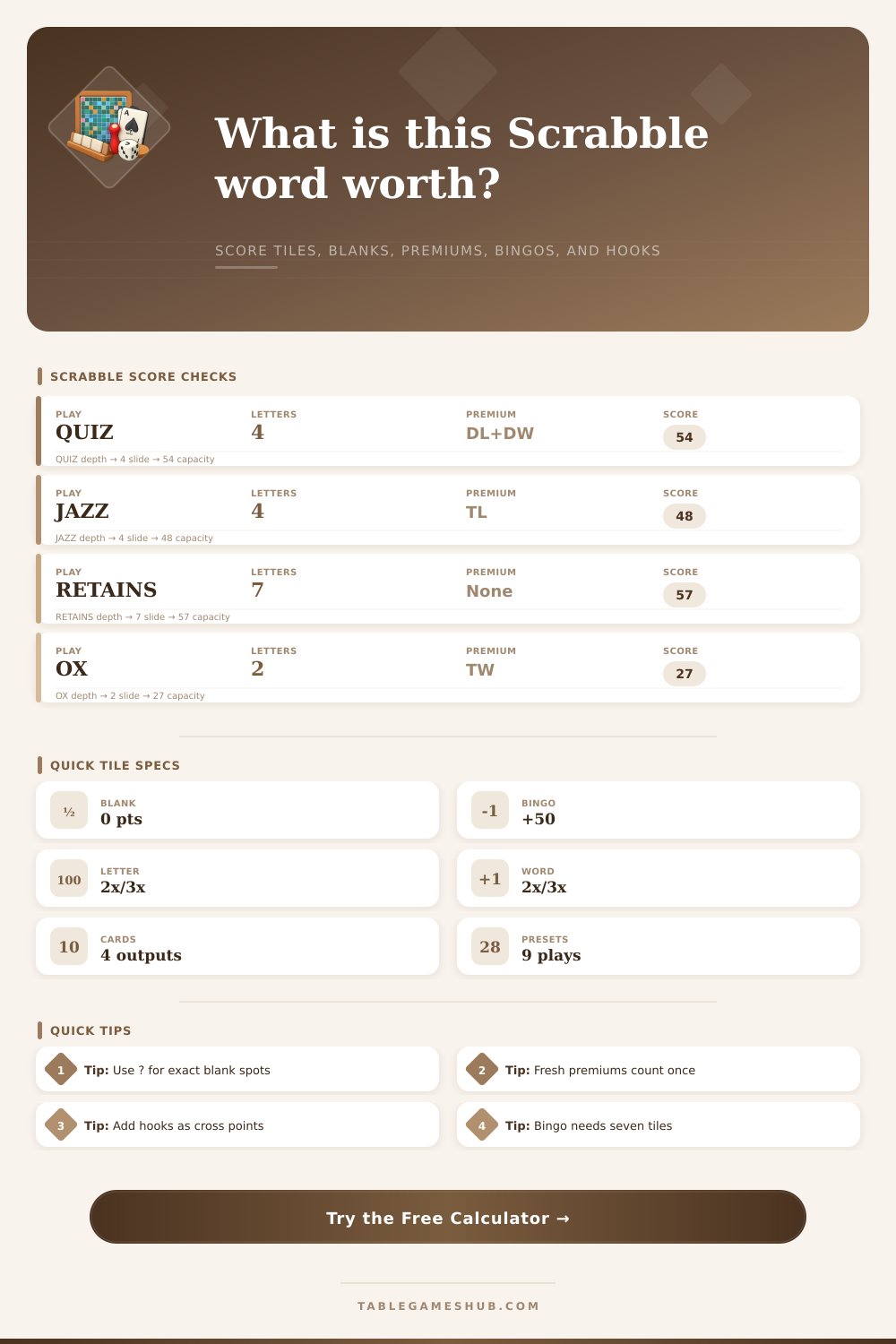
Scrabble Word Value Calculator
Total a Scrabble play from tile letters, blank tiles, letter multipliers, word multipliers, bingo bonus, cross-word points, premium status, and tile set.
Fresh premiums apply to the tiles played this turn; reused premium squares score as normal letter squares.
| Points | Letters | Tiles | Note |
|---|---|---|---|
| 1 | A E I O U L N S T R | Common | Base rack |
| 2 | D G | 7 total | Small lift |
| 3 | B C M P | 8 total | Mid value |
| 4 | F H V W Y | 10 total | Hooks well |
| 5 | K | 1 tile | Single K |
| 8 | J X | 2 tiles | High value |
| 10 | Q Z | 2 tiles | Top value |
| Set | Tiles | Blanks | Highest |
|---|---|---|---|
| English | 100 | 2 | Q Z |
| Super English | 200 | 4 | Q Z |
| French | 102 | 2 | K W X Y Z |
| Spanish | 100 | 2 | Z |
| German | 102 | 2 | Q Y |
| Input | Meaning | Example | Tile math |
|---|---|---|---|
| 1,1,1 | No fresh letters | CAT | 3+1+1 |
| 2,1,1 | First on DL | JAW | 16+1+4 |
| 1,3,1 | Middle on TL | AXE | 1+24+1 |
| 1,1,3,1 | Third on TL | QUIZ | 10+1+3+10 |
| Score item | Fresh? | Input | Applied |
|---|---|---|---|
| Double word | Yes | 2x | Main word |
| Triple word | Yes | 3x | Main word |
| Used premium | No | Flag used | Ignored |
| Bingo | Seven tiles | +50 | After word |
| Cross word | Hook total | Number | Added last |
In Scrabble, the board displays your move while the score sheet reflect your results. Sometimes, a creative move generates three word, yet the points are determined by the placement of those tiles across premium space. Before long, you’re concentrating on the form rather then the mathematics.
Enter the board configuration into the calculator above and let it do the heavy lifting. This way, you won’t grow fatigued when playing at home or in tournaments. Knowing how the tool work out the digits will allow you to abandon guesswork and calculate with accurasy.
How to Score Points in Scrabble
Blank tiles (the white squares that is worth nothing but can be used to represent any letter), I think this is the single biggest mistake people makes with this game. Blank tiles force you into the possibility of having to waste one of your highest point letters in order to complete a word as quickly as possible. By defaulting to lowest score possible when you don’t tell us how the blank should go in the input field, we avoid optimism inflation. Before you commit to putting something on the board, you’d like to know whether or not it’s realy going to get you ahead. Instead of hoping that the blank falls into a low-valued slot, you’ll now be forced to consider this tradeoff direct.
Add in the details of premium squares and even veteran players gets tripped up. Only the initial tile placed on those premium squares count as a double- or triple-letter multiplier. Even if they’re located underneath tiles you’ve extended from and crossed over three turns back, that double-word square won’t help you right now.
It’s important enough that there’s a toggle for this in the calculator. A fresh premium square can change a decent seven-letter play into something much more game changing. Reused, though? It is just wasted space. Disregarding this mean big miscalculations: Players will treat multipliers as stacking across turns. They don’t. Each new placement reset the math.
Scrabble Strategy: Aiming for Bingos
The big goal of scrabble strategy are bingos, scoring a fifty-point bonus when you manage to use all seven of your tile on one turn. That bonus is added, after applying any word bonuses/penalties and letter values. That alters everything about how much you care about long words. A normal-scoring seven-letter word may well lose out to a shorter word that sets yourself up for a possible bingo down the road. Or vice-versa.
These options vary depending on what set of tiles you’re working with, as the distribution tables on this page indicate. If you’re playing with the Spanish or French sets (which drastically change the frequency of certain letters), some of those valuable letter becomes easier to get, changing the risk of each play. Depending on your tile set and dictionary, you need to rethink the perceived value of JAZZ or QUIZ in your mind. The same can hold true for hooks.
Adding a single letter to an existing word to create a new perpendicular word doesn’t seem like much, but it can make all the difference. You can plug those x-word points right into the calculator individually so that they’ll get added to the equation in the proper place when you’re totalling things up. Why does this matter? Your main word score is multiplied first, and then your hooks and bonuses is added on. Get them out of order and you’ll realy throw off your totals. Again, a little thing but makes all the difference between getting that big ending number and having to content yourself with a middling end.
Knowing what words go into the dictionary isn’t enough; you need to understand how to score them in the proper order, too. To put it simply: Your mission isn’t just to make words, but to make the most valuable words possible given your rack and the current state of the board. While the calculator doesn’t force you to do anything, it does shows you what’s going on so that you can clearly see how each move affects your score. Down to the penny (or bonus point).
So if you’re wondering if a high-risk play is worth the risk, you can see for yourself. Suddenly you’re no longer looking at a grid of random letters; you’re seeing an ever-changing landscape of opportunity and multiplier. It becomes less about shooting in the dark and more about acting on instinct once you know the rules of the game and what’s happening with your score.
Yes, the board tells a story, but thanks to the calculator, you know exactly what the price tag is, and the prize.