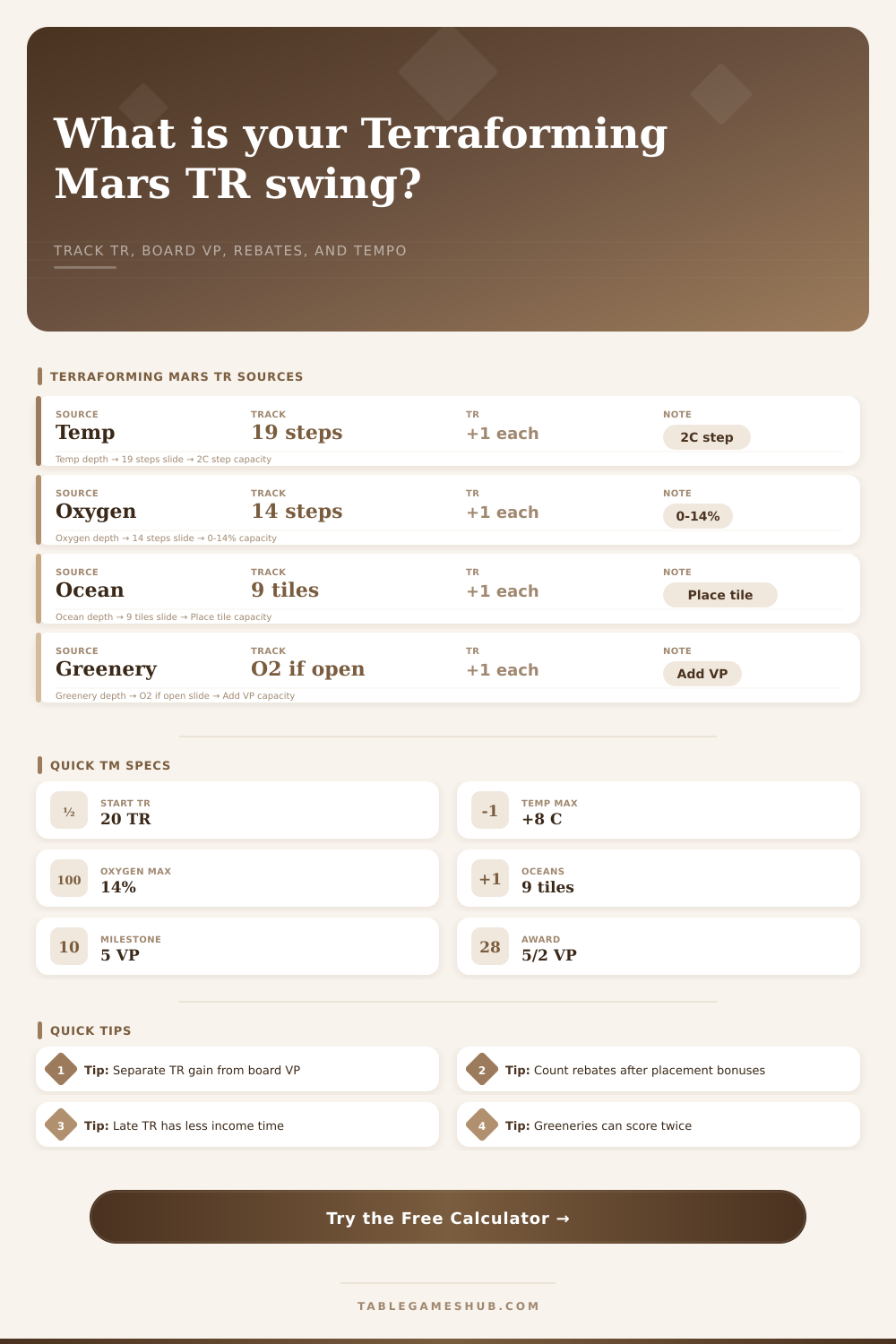
Terraforming Mars Terraform Rating Calculator
Total your global-parameter TR gain, board VP, milestone or award points, and rebate tempo before the next production phase.
| Parameter | Track range | Step size | TR effect |
|---|---|---|---|
| Temperature | -30°C to +8°C | 2°C per raise | +1 TR per step |
| Oxygen | 0% to 14% | 1% per raise | +1 TR per step |
| Ocean | 9 total tiles | 1 tile placed | +1 TR per ocean |
| Greenery | Board tile | Raises oxygen if open | +1 TR only when oxygen rises |
| Track point reached | Bonus | Typical input | Counting note |
|---|---|---|---|
| -24°C | +1 heat production | Temperature step | TR already counted by the temperature raise |
| -20°C | +1 heat production | Temperature step | Add only income value outside TR if desired |
| -8°C | Place one ocean | Temperature plus ocean | Count both if you place the ocean |
| +8°C | Temperature complete | Final temperature step | No more temperature TR after max |
| Action or threshold | Immediate TR | End scoring | Counting note |
|---|---|---|---|
| Raise oxygen 1% | +1 TR | TR is also end VP | Enter in oxygen steps |
| Reach 8% oxygen | Temperature rises 1 step | Extra TR if temp rises | Add one temperature step when triggered |
| Place greenery | +1 TR if oxygen rises | 1 VP for the tile | Add tile VP to greenery/city swing |
| City next to greenery | No TR | 1 VP per adjacent greenery | Add adjacency VP to greenery/city swing |
| Scoring item | Standard VP | Input field | Calculator treatment |
|---|---|---|---|
| Claimed milestone | 5 VP | Milestones and awards VP | Add direct score, no TR |
| Award first place | 5 VP | Milestones and awards VP | Add direct score, no TR |
| Award second place | 2 VP | Milestones and awards VP | Add direct score, no TR |
| TR at game end | 1 VP per TR | Starting TR plus gains | Shown as projected TR |
Because the mechanics is so visible, most people think only about card combos and resources. Draw a card. Spend megacredits. Play the card. Watch the board change. The global parameters seem like background noise. You might raise the temperature or oxygen without thinking about how they affects your final score. Your mistake will cost you points.
Terraforming rating isn’t merely a spot on a track. It’s a multiplier of your income each generation until end of game. Getting two terraform rating early is worth more than getting it later, you’ll gain that extra income for much longer. After inputting your expected steps and board swings, the calculator will do the rest. You won’t have to do math in your head while making tricky turns.
Why Terraform Rating Matters Most
It also separates victory points you get from cities and greenery from points you get by increasing your terraform rating. Players frequently mix up their short term gain/score with long term engine building. When you raise your oxygen, that gives you some terraform rating right now AND a point at game’s end. If you place a greenery tile, that may provide one point right away if it boosts your oxygen, then an additional point at game’s end for the tile itself. By keeping things separate like this, you’ll be able to audit your approach. How much of your improvement is due to board placement vs. Raw rating increase?
The catch with all of this is timing. A lot of players are eager to throw as many megacredits at something as possible so that their track fills up (like “maxing out” oceans or temperature). But if you spend 20 megacredits on an ocean boost late in the game and you only get three more generations… you probably wasted that money. Sure, you got the terraform rating, but you lost out on what income those points could of provided you throughout the mid-game. That’s why there’s a field called generations remaining in the calculator. It takes into account the timing of your actions. It lets you know whether a late game surge pays off in megacredits different than simply scoring those victory points straight away.
Take, for example, the oxygen track. Every time you go up a step on this track, you get a point towards your terraform rating. However, when you put down something that causes oxygen to rise (e.g., certain greenery), you’re achieving two goals at the same time. You’ll be getting the rating point and maybe earning yourself some kind of award or milestone position. The reference tables included with the tool explain all these interactions, pointing out where increasing a given value will cause other benefits such as increased heat production or free placement of oceans. This changes how affordable future actions become, establishing chains which if not managed carefully can spiral out of control. Add that to milestones and awards and it starts getting complicated.
Milestones cost nothing in terms of megacredits but will lock you into one particular strategy (which earns five victory points). Awards rely on final values of influence or terraform rating. You can enter those anticipated scores into the calculator and it will show you the overall swing in each area of scoring. In solo mode, it may make sense to try really hard early on to hit some terraform rating goal. In multi-player, though, sometimes blocking your rival from reaching their award is worth just as much.
The production track and card effects can be tempting distractions from the big picture: the foundation of your economy is your terraform rating. It’s easy to forget that. Respect it. Think about when you’re going to get terraform rating, not which cards you’ll be able to afford. Understanding this, that income is king, makes all the difference between having a good game versus a great game. One point of terraform rating gained in generation five is worth a small fortune by generation twenty. To put it simply, it is about efficiency. Spending each megacredit should produce as much bang-for-buck as possible during the game.
If you’re close to victory points, then spending now provides more immediate satisfaction. However, if there are still several rounds remaining, then spending now can provide delayed satisfaction through income. Before locking down a strategy, run the numbers. How well does a heat sprint compare with an oxygen push? What kind of tempo value do you expect if you take this route versus that route? Are you 5 generations out? How many are left? Let the math determine whether your plans is grounded in reality or simply costly vanity. Watch that rating track, and let everything else fall into place. That’s how the contenders separate themselves from the also-rans at the end of the day.