🏆 Winning Percentage Calculator
Calculate win percentage, points percentage, needed target records, projected finish, and streak impact from wins, losses, and ties.
| Measure | Value | Formula | Note |
|---|
| Current item | Record value | Percentage | Meaning |
|---|
| Target path | Needed record | Finish record | Finish pct |
|---|
| Streak tested | New record | New win pct | Change |
|---|
| Benchmark | Win pct | Example record | Quick read |
|---|---|---|---|
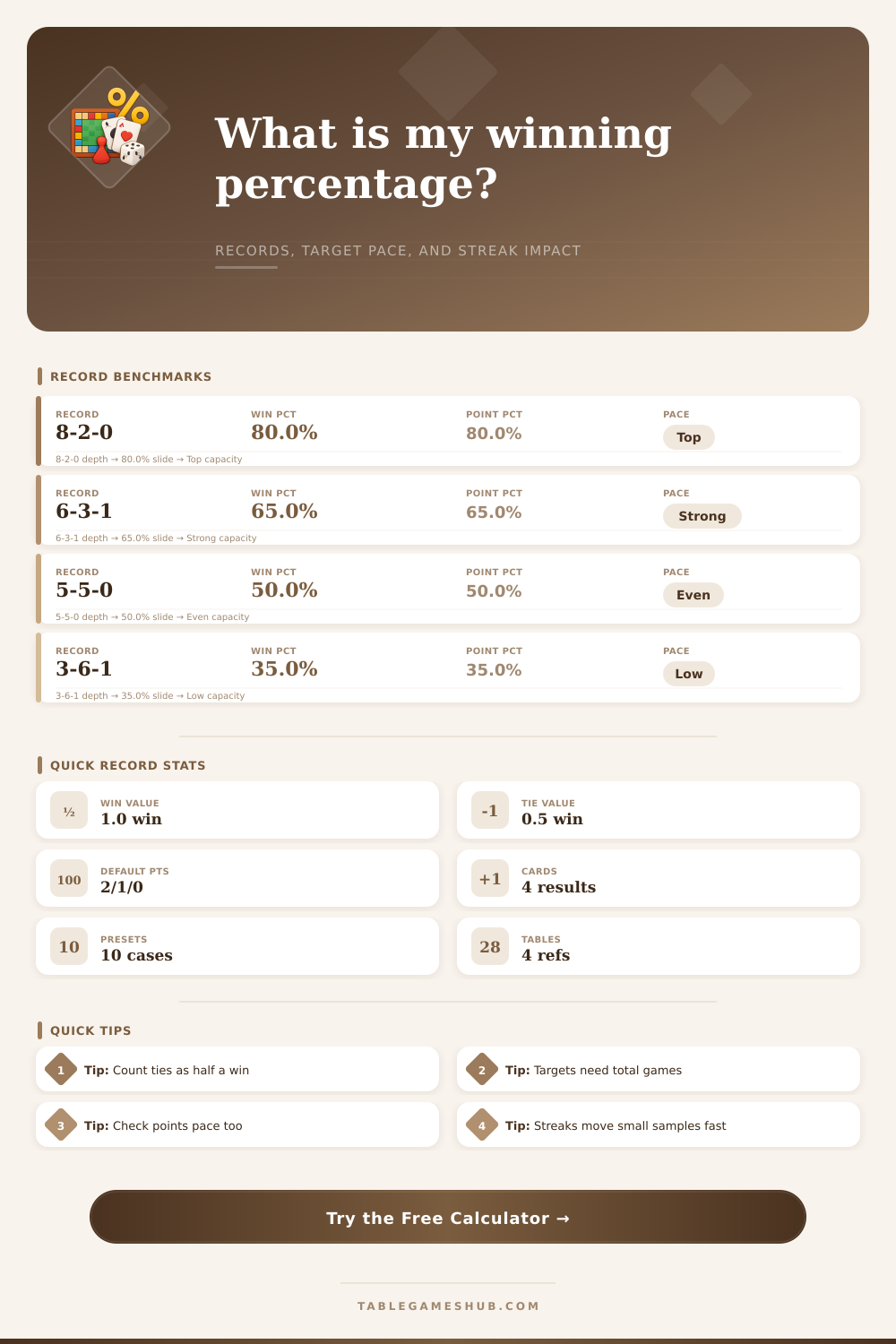
| Dominant pace | 75%+ | 9-3-0 | Strong lead or top seed profile |
| Contender pace | 60-74% | 7-4-1 | Usually above the cut line |
| Even pace | 50-59% | 6-6-0 | Useful for tiebreak tracking |
| Chase pace | 40-49% | 5-7-0 | Needs a positive run soon |
| Recovery pace | Under 40% | 4-8-0 | Target math gets tight quickly |
| Points system | Win | Tie | Best use |
|---|---|---|---|
| 2-1-0 system | 2 pts | 1 pt | Simple league tables |
| 3-1-0 system | 3 pts | 1 pt | Rewards outright wins more |
| Match win only | 1 pt | 0 pt | No draw credit standings |
| Custom table | Any | Any | Use the input values above |
Use the total games denominator
Target records can look easier than they are if you only compare the remaining stretch. Always calculate the final percentage across current plus remaining games.
Separate win percentage from points percentage
A tie-heavy record may have the same winning percentage as another record but a different standings outcome when your table gives custom points.
Use the winning percentage calculator to compare current record, points pace, needed target results, projected finish, and streak impact for league tables, tournaments, and game-night standings.
Winning percentage is a mathematical measurement of team standings; however, winning percentage can also be misleading because it dont always reflect how a team perform on the field. A team may appear to be dominating opponents in a specific game, but a low winning percentage could be present for the team if they do not win enough game during the season. Conversely, a team may be struggling with their winning record, but they may be mathematically relevant in the league because of the points earned from team tie.
The mathematical value of wins, losses, and ties is based on the rule of the league. Because the rules impact the winning percentage calculation, many people attempt to calculate the winning percentage of a team based only on wins and losses for that team during the season. However, this is not an appropriate method of calculating winning percentage for league that use ties to award points to teams.
How to Calculate Winning Percentage
Instead, the fraction of games earned through ties should also be calculated in addition to the wins a team earn. For example, if a league changes from a two-point winning system to a three-point winning system, the value of ties will change, and the teams strategy will need to change to reflect the new value of ties. The specific inputs that must be recognized to calculate winning percentage include the number of games remaining in the season, the point system of the league, and the target percentage of winning percentage that must be earned for the team.
The number of games remaining during the season will impact the winning percentage calculation because teams need to win a certain number of remaining games to reach their target percentage. Additionally, the target winning percentage can also be based on total points earned during the season instead of wins alone. Without knowing these specific detail about a team or a league, there could be two different interpretations of winning percentage calculations that provides different conclusions regarding the number of wins that are required to reach the target percentage.
The target percentage for a team is not an unchanging figure. For example, a percentage target of.600 may be easy to achieve early within a season for a team; however, the same percentage target may be difficult to achieve later in the season due to the injuries that might impact a teams ability. A calculator can help to calculate the winning percentage input by the user; however, a winning percentage calculator will not account for the projected winning rate of a team, which the user must determine.
A teams streak of wins or losses can have a significant impact on its winning percentage. Streaks affect only a few games for a team, yet they have a significant and rapid impact on the winning percentage of that team. For instance, a three-game win streak will increase the winning percentage of a team quick.
The same is true for a losing streak for that same team. A winning percentage calculation should of been performed prior to a teams winning or losing streak to determine how much winning or losing margin remains for that team. Many use benchmarks created through the use of reference tables for winning percentage calculations to determine the winning percentage of teams.
A winning percentage that is above.75 is considered a dominant position for a team. A winning percentage between.60 and.74 is still considered a winning percentage that place a team in contention for playoff positioning. A winning percentage that is under.40 indicates that a team must win a significant number of games to improve its standing in the league.
A winning percentage that is under.40 will create a very steep path to improve that percentage. One of the most common mistake in calculating winning percentage is to focus only on the remaining games that a team has left to play during the season. However, winning percentage is calculated for the entire season.
A strong finish to the season will not fix a winning percentage that is too low for a team during the early part of the season. A great start to the season will help a team if the remainder of the teams games has mediocre standings. A winning percentage calculation will show the final record for a team based off various path that they could take during the remaining portion of the season.
Points percentage is a separate calculation from winning percentage. However, points percentage is an essential statistic to determine the winning percentage calculations for a team. For many league, a tie awards a team one point, while a win awards a team two points.
Thus, a team can earn a significant number of points throughout the season while maintaining a low winning percentage. It is essential to use a winning percentage calculator to enter the point value that are used for the league to which the team belongs. Calculating the projected finish for the season requires the user to enter the expected win and tie rate for the remainder of the season for each team.
Thus, a projected finish for the season is only as accurate as the win and tie rates that are entered into the calculator. If the win and tie rates that are entered are too high for the projected season for a team, the user will feel false comfort in the abilities of that team to win its games. The same is true for entering a too-low win and tie rate for the remainder of the season for a team.
Although a winning percentage calculator can determine the winning percentage calculations for a team, the variable of the schedule are difficult to account for in the calculators required inputs. However, the winning percentage and projected finish calculations can be adjusted based on the strength of the opponents that remain in a teams schedule. It is important for each user of a winning percentage calculator to develop the habit of inputting the variables for the calculation prior to the occurrence of an urgent situation.
Additionally, calculating the winning percentage for each team prior to the start of each new season can allow the user to determine the number of games that they need to win to reach their target percentage. If the team calculation is performed while the team is still above their target winning percentage line, the target record that must be set for the remainder of the games will be modest. However, if the winning percentage calculation is performed after their margin for error has dissapears, the winning percentage target will be difficult to achieve for that remainder of that season.
By calculating winning percentages for each season early in the year, each user can plan the remainder of the season rather than simply reacting to the outcome of each game played.