Archery Trajectory Calculator for Flight Path
Estimate flight arc, drop, drift, apex, and point-on distance from your setup in seconds.
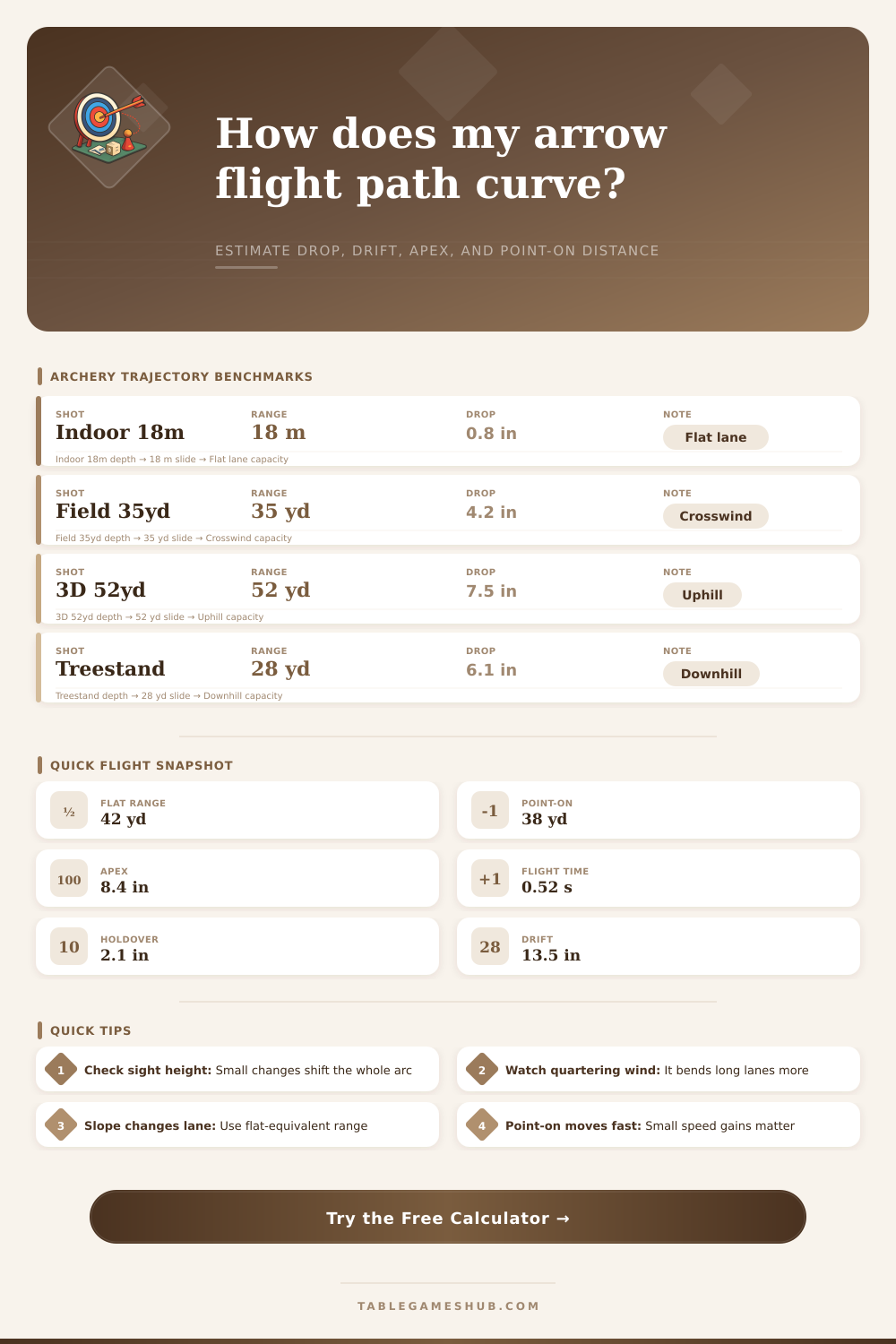
| Shot | Range | Drop | Note |
|---|---|---|---|
| Indoor 18m | 18 m | 0.8 in | Flat lane |
| Field 35yd | 35 yd | 4.2 in | Crosswind |
| 3D 52yd | 52 yd | 7.5 in | Uphill |
| Treestand | 28 yd | 6.1 in | Downhill |
| Speed Band | Arc | Time | Read |
|---|---|---|---|
| Fast lane | Low | 0.45 s | Flat |
| Balanced | Mid | 0.53 s | Stable |
| Hunting | High | 0.61 s | More hold |
| Barebow | High | 0.66 s | Slow arc |
| Wind | Exposure | Drift | Use |
|---|---|---|---|
| 2 mph | Quarter | 1.5 in | Indoor |
| 6 mph | Half | 6.2 in | Field |
| 10 mph | Full | 12.0 in | 3D |
| 14 mph | Full | 18.3 in | Brisk |
| Mode | Bow | Range | Read |
|---|---|---|---|
| Target | Compound | 18-70m | Clean line |
| Field | Recurve | 25-45yd | Mixed arc |
| 3D | Barebow | 30-55yd | Brush gap |
| Treestand | Compound | 20-35yd | Angle shot |
Archery trajectory are the path that an arrow take through the air after it is released from the bow. The arrow follow a curved path due to the force of gravity that pulls upon the arrow while it is in flight from the bow. The curved path that the arrow take is referred to as an arc of the arrow.
A variety of factor that include the speed of the arrow, the impact of the wind, and the angle at which the arrow is shot form the arc of the arrow. If an archer understands the mathematics of the arc, the archer can make more accuratly shots by understanding how much the arrow will drop as it approaches the target. One of the factor that impacts the trajectory of the arrow is the speed at which the arrow is shot from the bow.
What Affects an Arrow’s Flight
Factors like arrow speed impact how long the arrow is in the air. The faster the arrow, the less time it spend in the air. As a result, faster arrow speeds will experience less drop from gravitys pull then slower arrow speeds.
For instance, an arrow shot from a compound bow at 285 feet per second will travel further and have a flatter arc then an arrow shot from a traditional bow at 190 feet per second. Furthermore, faster arrows will also experience less drift from the wind. Wind drift is the movement of the arrow in a direction other than the direction in which the archer intend for the arrow to travel.
For instance, if the wind is traveling at a speed of seven miles per hour, an arrow will drift 10 to 15 inch to the side of the target at 50 yards. The angle of the terrain also impact the distance from which the archer must shoot the arrow. If the archer aims at an uphill angle, the effective distance of the arrow are shortened.
If the archer aims downhill, the angle of the downhill slope allow for the arrow to drop due to gravity over a longer distance. Consequently, the archer should of calculate the flat equivalent distance from the archer to the target. The flat-equivalent distance is the distance that the arrow actualy travel over the ground.
For instance, if the archer is shooting from a treestand and the angle to the target is 12 degree below the horizontal, the archer will travel the same distance as if the archer was standing on the ground and aiming at a target that was higher than the archer. Sight height is another factor that will impact the trajectory of the arrow. Sight height is the distance from the center of the arrow to the sight pin.
If the archer raises the sight pin, the point-on distance will shift closer to the archer. The point-on distance is the distance at which the sight pin and the arrow will meet. If the archer lowers the sight pin, the archer will have more range to the target before the archer must account for the drop of the arrow.
Holdover is the technique that an archer apply to compensate for the drop of the arrow at various distances. Because sight height is a small measurement, even a small adjustment to sight height will have a great impact upon the arrows point of impact on the target. Arrow design also has an impact upon archery trajectory.
Low drag carbon arrows will drift less from the wind than arrows with more drag. Furthermore, arrows with more mass, such as hunting arrows, will experience more resistance from the air and will follow a higher arc than arrows with less mass. Air resistance are less at high altitudes, such as in the mountains.
The thin air at high altitudes will allow the arrow to travel at a faster rate in the mountains than at sea level. In order to accurately aim an arrow at a target, the archer must account for a variety of factor. The archer must account for the speed at which the arrow is shot from the bow, the drift of the arrow due to the wind, and the angle at which the archer is aiming at the target.
If the archer does not account for the drift of the arrow due to the wind, the wind will move the arrow away from the target. If the archer does not account for the angle at which the arrow is shot, the drop of the arrow due to gravity may be more or less than the archer expects. A variety of reference table can provide information to the archer of the trajectory of the arrow at different speeds and with different wind speeds.
Furthermore, practicing at various distance will allow the archer to understand the arc of the arrow.