Nusfjord Score Calculator
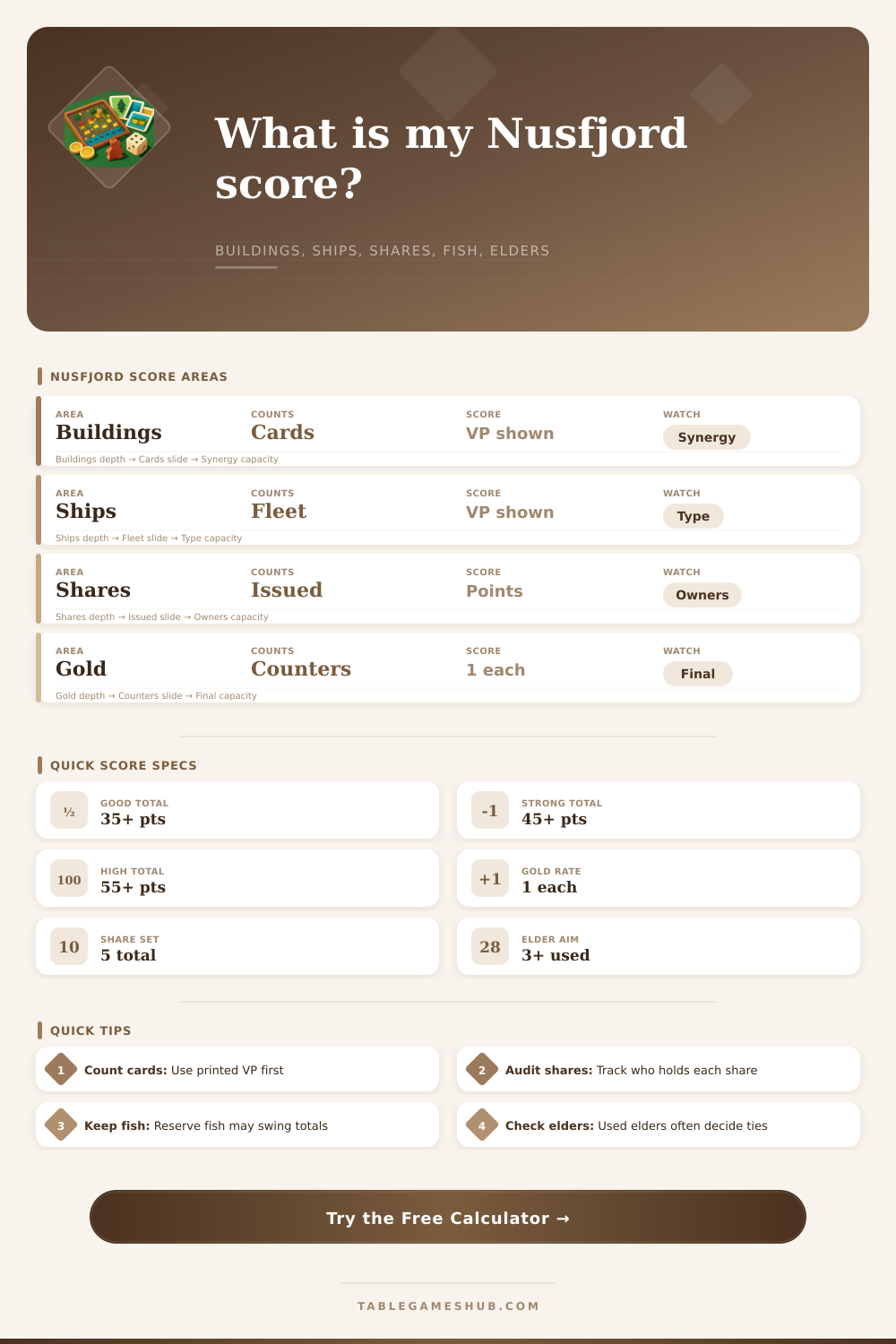
Total your fishing village score from buildings, ships, shares, fish reserves, elders, forest spaces, gold counters, and endgame bonuses.
Use the printed victory points on your cards and boards, then enter the final state of your village. This worksheet keeps every Nusfjord scoring lane visible so missed shares, elder fish, and gold counters are easier to catch.
| Score Area | Entry Method | Calculator Formula | Audit Note |
|---|---|---|---|
| Buildings | Printed VP plus condition bonuses | building VP + bonus VP | Check all built cards, not hand cards |
| Ships | Printed VP from fleet | ship VP total | Count every ship in your harbor |
| Shares | Owned shares minus leakage flag | owned shares points | Compare owned certificates to issued shares |
| Fish Reserves | Selected reserve scoring mode | none, per fish, pair, or capped | Keep reserve fish separate from elder fish |
| Elders | Elder count and fish on elders | elders + floor(elder fish / 2) | Marks used elders without duplicating printed VP |
| Forest Spaces | Occupied forest spaces | floor(forest spaces / 2) | Useful for forest-heavy boards and bonus cards |
| Gold Counters | Remaining gold | gold x 1 | Gold stays as an in-game counter |
| Fleet Profile | Typical Ship Count | Expected VP Band | Endgame Reading |
|---|---|---|---|
| Lean Fishing Harbor | 1 to 2 ships | 2 to 5 VP | Needs building points or gold to compensate |
| Balanced Working Fleet | 3 ships | 6 to 10 VP | Usually supports steady fish reserve scoring |
| Shipwright Focus | 4 to 5 ships | 10 to 16 VP | Strong if shares and elders are not neglected |
| Fleet Plus Engine | 5 or more ships | 16+ VP | High ceiling when building bonuses also fire |
| Share Situation | Owned Certificates | Issued to Others | Calculator Signal |
|---|---|---|---|
| Protected Company | 4 to 5 | 0 to 1 | Advantage |
| Balanced Company | 3 | 1 to 2 | Even |
| Leaky Company | 1 to 2 | 3 or more | Pressure |
| Open Market Push | Varies | High table spread | Check certificates before totals |
| Preset Scenario | Main Strength | Watch Item | Target Score |
|---|---|---|---|
| Building Engine | Printed card VP | Unresolved penalties | 48 to 56 |
| Shipwright Fleet | Ships plus fish | Share leakage | 42 to 52 |
| Elder Council | Elder fish tempo | Low gold counters | 40 to 50 |
| Gold Harbor | Gold and bonus cards | Fleet depth | 45 to 55 |
Nusfjord is a game that requires the tracking of many different component of the game in order to calculate the score for each player. There are components of the game that score points based off the printed values on the buildings, the ships in a player’s fleet, and the number of share a player owns. Additionally, there are other components of the game that contribute to the player score, such as the number of fish in reserve, the number of elder that contain fish, the number of forest space a player controls, and the number of gold counter a player controls.
Each of these components contribute to a final score for each player, and the final score is only calculated accurately if each of these components are accounted for in each player’s score calculation. The different group of players may use different methods of calculating each of these components of the game. For instance, one group of players may award one point for each leftover fish in the game, while another group of players only award points for each pair of fish.
How to Count Points in Nusfjord
Additionally, elders may score based upon their printed values, or the number of fish that players place upon each elder. The same is true of forest spaces; they may convert to fish at a half point rate, or there may be no conversion of forest spaces to fish at all. Because these components may alter the total score that is calculated for each player, it is essential that each player utilize a scoring worksheet to calculate such a score.
The calculator provided online will mathematically determine the total score of each player after the players manually enter each of the components of the game that contribute to the total score of each player. The information that each player will need to enter are the printed victory points for each of the player’s buildings, the ships in their fleet, the number of share that they own, the number of shares that they have issue, the number of fish that are in reserve, the number of elder in the game, the number of fish on those owners, the number of forest spaces that they control, the number of gold counters that they control, and any unresolved penalties. Additionally, each player will need to select a specific method for scoring fish for the game that their group utilize; different groups may have different methods of calculating the score for leftover fish in the game.
By selecting one of the methods for calculating fish scores, the player ensures that they dont use two different system to calculate their total score. One of the components that is often ignored in the game is the management of shares. Players that have many certificates of shares but few shares issued will score high in the game; those that increase their issued shares but maintain a low number of owned shares will score less point for their village, even with impressive buildings and fleets.
The calculator for this game consider the number of shares that each player owns compared to the total count of players in the game. This calculation determine whether or not a player’s number of shares is helping or hindering there score. The size of a player’s fleet and the number of fish in reserve are two components that interact with each other in the game.
A small fleet can score points for a player if they have a great many buildings and gold counters in their village. A large number of ships will result in the production of more fish during the game, but only if the player group select the rule that the leftover fish are scored according to. The same is true of elders with fish on them; an elder with fish on it score different than an elder used only for its printed values on the elder.
Thus, the points of these two categories are separated in the game components for players to avoid scoring the same components twice in calculating their score. The number of forest spaces and the number of gold counters that a player controls contribute to a player’s score in small amounts, but is still an important component of calculating the total score of each game. Forest spaces may convert to fish at a modest rate, or not at all.
Gold counters are awarded at the same rate to each player as the number of gold counters they control. However, because these two components contribute to the score in small amounts, the players often ignore them. Thus, it is important for players to ensure that they are account for in the score that is calculated for each player.
The purpose of this calculating tool is to separate the values that are printed on the cards in the game from the rules of the game that each group of players utilize. By separating the two components of the game, players will arrive at the true score of their village during the game.