Reversi Disc Count Calculator
Count Black discs, White discs, empty squares, legal move pressure, stable corners, phase, and komi or handicap adjustments for an Othello-style position.
Reversi Count Result
Game phase from empty squares
| Phase | Empty squares | Disc read | Useful signal |
|---|---|---|---|
| Opening | 45 to 60 | Raw discs can mislead | Mobility and tempo |
| Early midgame | 31 to 44 | Edges start to matter | Safe moves |
| Late midgame | 16 to 30 | Disc lead becomes firmer | Corners and access |
| Endgame | 1 to 15 | Count exact flips | Parity and passes |
| Final | 0 | Disc count decides | Adjustment only |
Mobility estimate guide
| Move gap | Meaning | Estimate | Count note |
|---|---|---|---|
| 0 | Balanced choices | No swing | Check corners |
| 1 to 2 | Small initiative | Light swing | Useful early |
| 3 to 5 | Clear pressure | Medium swing | Watch forced moves |
| 6 plus | Potential lock | Strong swing | Pass risk rises |
Stable corner value
| Corners held | Stability read | Disc impact | Audit cue |
|---|---|---|---|
| 0 | No anchors | Volatile | Avoid X-squares |
| 1 | One safe base | Edge access | Trace adjacent edge |
| 2 | Strong structure | Often decisive | Check opposite corner |
| 3 to 4 | Dominant anchors | Huge endgame value | Count stable edge discs |
Count sanity checks
| Check | Expected | Warning | Fix |
|---|---|---|---|
| Total squares | 64 | Over or under | Recount empties |
| Legal moves | 0 to 32 | Both zero early | Verify flips |
| Corners | 0 to 4 each | Total above 4 | Count shared board corners |
| Final board | 0 empty | Moves still listed | Set legal moves to 0 |
At first glance, Reversi looks like an easy game where current disc count determines who’s winning, but what those pieces actualy become by move sixty-four is what really matters. However, few new players realize how structure impacts the game and get spooked if they has fewer pieces than their competitor. Instead of worrying about the math, let calculator do it for you. Mobility, stability, here you come.
So what does it look like? The inputs are multiple layers of board control which is important to view. First, you’re entering the number of discs on the board and then you’re entering the legal moves of both players.
How to Use the Reversi Calculator
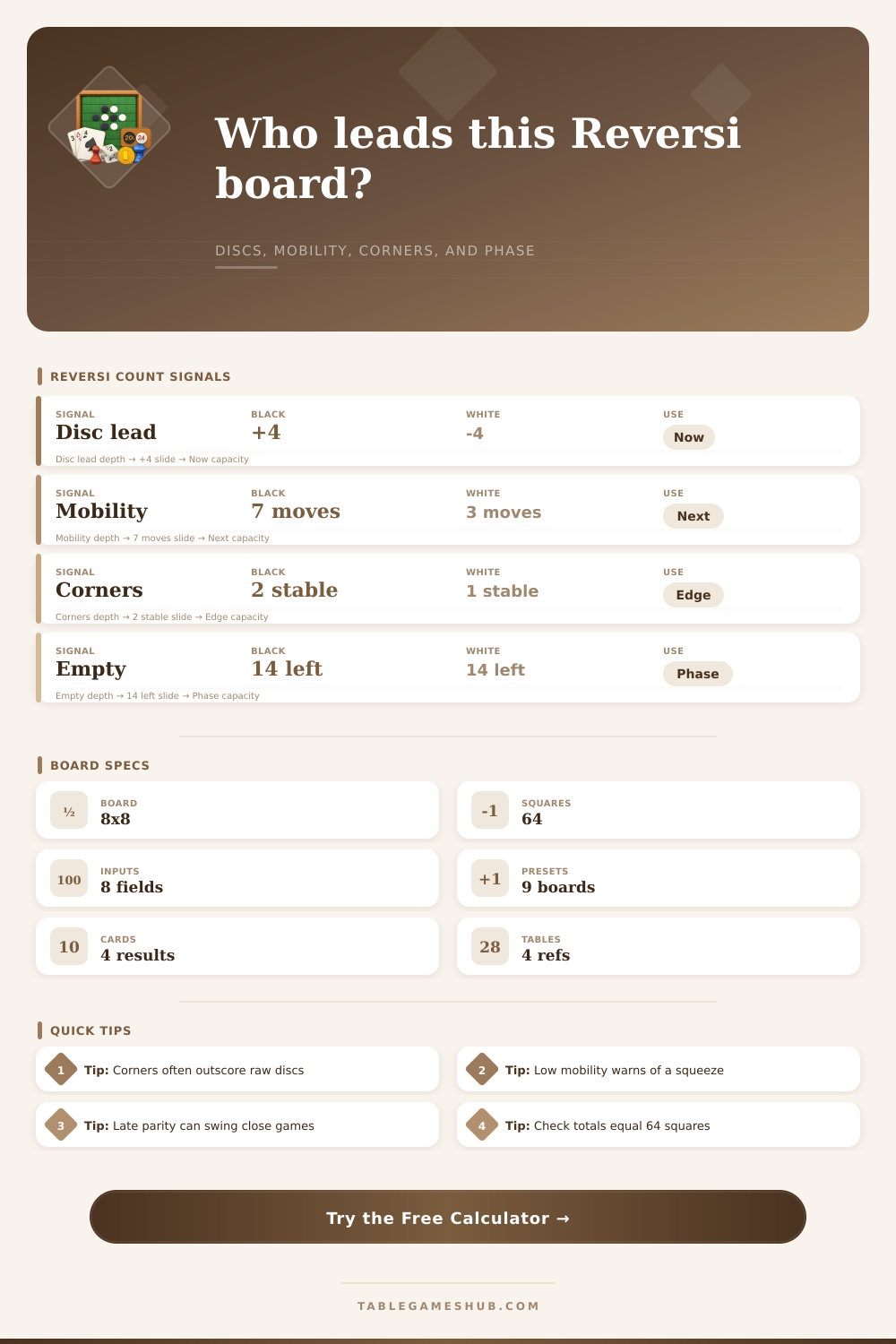
First, any mobility is considered immediate pressure. If there’s a player with far more legal moves than their opponent, they sets the pace. The opposing player must react to how they want the game play out. The tool will consider not only the mobility but the disc lead as well. Sometimes a tiny disc disadvantage can be okay if you have lots of mobility and your opponent doesn’t, since that’s generally a winning position hiding in plain sight.
A corner makes all the difference. Holding one is an unshakeable anchor that rarely flips. It also exposes you to surrounding edges (typically safer areas than the unstable center). Why does this matter? This happens because calculator gives extra weight to corner-held discs. If you can grab two corners early on, you’re guaranteed to win even if your discs fluctuates momentarily. Otherwise, your spot is unsafe and any action threatens to turn several disc against you. This eats away at your lead gradually but persistently.
The other important factor that static counting fails to account for is the phase of the game. Because players throw away discs in order to move into corners and get more mobility, early counts doesn’t reflect relative strength as well. If your inputs do not sum to sixty-four, the projection becomes unreliable because it assumes all squares are filled. If forty squares remain and one player has 4 discs and the other has none, that 4 disc advantage could be meaningless since they’re not going to make any moves. Conversely, when only eight squares remain, those four discs is critical, there’s no room for big flippy floppies anymore. Knowing that helps you avoid overestimating an early advantage and underestimating a late-game trick of even things up.
Realism increases when handicap adjustments are added. Starting from an even number of disks on both sides isn’t how all games begin. Komi can be used to level skills. Other games may have different numbers of disks placed unevenly between players. You can enter those handicaps into this tool too, so it projects the margin based off not only who’s playing but how the game started. That’s helpful if you like to play practice games where you know that certain strategies might work well under less than ideal starting conditions.
A few common errors include failing to account for total squares. There are only 64 filled squares at game’s end in Reversi, so anything you input must add up to that. Check your hand using the reference tables (page). These show the effect of corner stability on endgame value, as well as how mobility gaps becomes swing potential. Six or more legal moves between players often indicates a lock-up situation, in which one player will have to pass over and over again. That doesn’t sound good for the guy who gets locked up. However, it might give his opponent time to wait him out while stabilizing corners.
The calculator is not an oracle; it’s more like a sanity check. It takes into account the typical statistical probabilities of mobility pressure and corner value, but has no way to see how deep you can read things or even if you’re making any tactical bluffs. Think of it as something that helps you double-check if your gut agrees with reality of the board. If the tool indicates that you have a big expected margin against you when you think you’re winning, then maybe look again: What are your exposed edges? Do you lack corner access? The numbers will often expose what a casual glance does not.
To master the game of Reversi, one must consider more than just the current number of flips: the game’s structure matters. Corners are real estate. Disks are currency. Mobility is leverage. Once you grasp this dynamic, Reversi becomes less about frantically scrambling for more pieces and more like a strategic struggle over real estate. And there’s the rub: the numbers on the calculator up top give you the metrics; it’s up to you to deliver the strategy.
Begin by counting not only your discs but also your mobility. That slight mental adjustment will open your eyes to routes to winning hidden from raw counting alone. You should of seen this earlier.