Keyflower Tile Bid Calculator
Estimate whether a Keyflower tile is worth another worker by combining printed VP, color scarcity, current bid, remaining meeples, upgrade value, production yield, transport value, and table pressure.
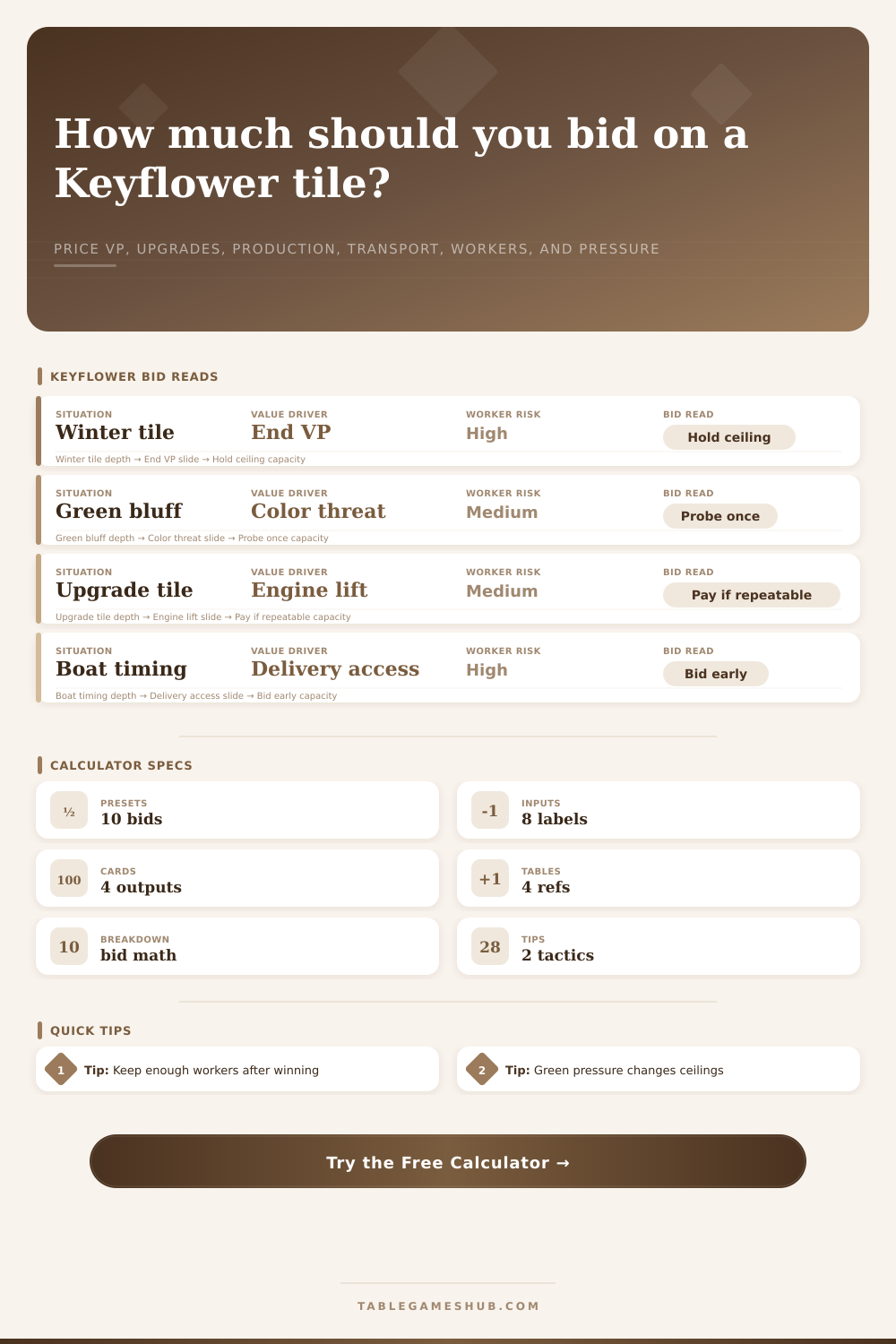
Use the presets for common Keyflower auctions, then tune the values to your village. The recommendation is a planning estimate, not a rule override for table talk, turn order, or a critical hate-draft.
1Bid Presets
2Tile Bid Inputs
3Reference Tables
Preset Value Map
| Preset | Best Use | Ceiling Mood |
|---|---|---|
| Winter Tile Fight | Direct VP or scoring condition | High but finite |
| Green Meeple Bluff | Testing scarce green access | Probe carefully |
| Upgrade Tile Value | Repeatable village improvement | Pay for engine lift |
| Boat Bid Timing | Turn order, delivery, and late arrival | Earlier pressure |
Meeple Color Pressure
| Color State | Worker Cost | Read |
|---|---|---|
| Mixed common | Normal | Bid by tile value |
| Mostly yellow | Slightly cheaper | Good filler bids |
| Red or blue | Moderate | Watch future activations |
| Green or locked | Expensive | Do not bluff too long |
Tile Timing Table
| Round | Value Source | Bid Behavior |
|---|---|---|
| Spring | Early production | Leave workers for use |
| Summer | Village direction | Contest pivots |
| Autumn | Upgrade and transport setup | Bid with final plan |
| Winter | End VP | Spend for certainty |
Bid Advice Bands
| Net Swing | Advice | Reason |
|---|---|---|
| 20+ | Press | Tile likely defines scoring |
| 10 to 19 | Compete | Good value if reserve holds |
| 1 to 9 | Cap bid | Marginal after worker cost |
| 0 or less | Pass | Activation workers matter more |
4Spec Grid
5Two Keyflower Tips
On a wanted tile, you watch as the bid ticks up and up and you hover your hand above the pool of worker. It will give you wheat, which you need, plus some victory points. Sounds like a no-brainer, right? Wrong. In Keyflower, that way of thinking get you trapped. What the tile does for you isn’t nearly as important as what it costs. Resources become a negotiation through auction mechanism, and if all you see are the tiles’ rewards, you’ll lose.
So what about the cost side of the equation? That’s where the calculator on this page comes into play. What if I told you that it doesn’t simply add up victory point numbers on a card? No, instead it factor in the cost of the workers necessary to obtain those victory points. Enter price of the tile itself, plus factor in the cost of colors of the meeples being used.
How to Use the Keyflower Calculator
Common yellow meeple are cheap. They’re easy to replace and they aren’t worth as many victory points. On the other hand, green meeples is expensive. They control access to boat and upgrades. Meeple color pressure is how much pain will you experience by losing one of those pieces? The tool measures this by requesting meeple color pressure.
Start planning tile upgrades early in the game. Upgrade tiles are not like others where they provide point benefits now; instead, they provides longer-term boosts to the engine. By using calculator, you can see whether the bid price is less than the benefit of the long-term upgrade. It’s easy to overextend, spend half your workers trying to get one upgrade tile. Sure, you may snag it, but then you’re out of resources to do it. Acquiring an auction is not enough. You also has to do it properly, and that takes the same currency as acquiring it. The tool have reference tables that detail those scenarios.
When should you go all-in for a valuable winter tile? When should you fold on a marginal increase in production? The timing makes all the difference. Early on, you are setting up basic infrastructure of your village. It is more important to keep workers in the pool so that you can move them around. It makes sense to leave some locked down, but not to lock everybody down. Later, though, once it’s fall, focus turns to getting key upgrades and transport links that’ll pay off during the winter months.
As you feel pressure from rivals, the calculator tweak its recommendation accordingly. Three other player are hammering bids? It increases the perceived cost of victory, which captures how real life works: a high bid may end up being an overpay for a tile, purely out of spite. And then consider your reserve capacity. You’ve bid. You won some tiles. Now what can you produce? What happens if you win a huge scoring tile but find yourself out of workers to take over new spaces or bring in products? That’s not such a sweet win. The calculator tells you how many worker you’ll have after the auction and leaves you with a real number for your vulnerability in the coming turns. This number is small, but it keeps you from making regrettable choices around the table.
Now, here’s another warning: Green meeples are money, but they’re also leverage. Using them to block a color, or prevent someone else from accessing boat, transforms their value, and the value of all the tiles on the board. You can tell your calculator that there’s high pressure when green enters into play and it’ll reflect that in its calculations. Remember, bluffing that your opponent has no choice but to chase your bid, even if it means using limited-color tiles, isn’t free. Your bluff will cost you more than just workers. You should of thought about that.
At its core, Keyflower is an efficient game. Every worker placement move have to pay for itself. These moves must provide points, resources, or a strategic advantage. By removing the thrill of the moment, the calculator allows you to get a look at the net impact of your actions. That doesn’t mean you won’t make emotional offers. The game is just too engaging to prevent that entirely. But when you know there are hidden costs to your choices, your emotional offers become calculated risks instead of dumb blunders. Maintain your reserve, mind the green meeple pressure, and realize that a tile is only good if you have something to do with it.