President Card Game Score Calculator
Total a President round from finishing rank, player count, leftover cards, table bonuses, rank streaks, and previous score markers.
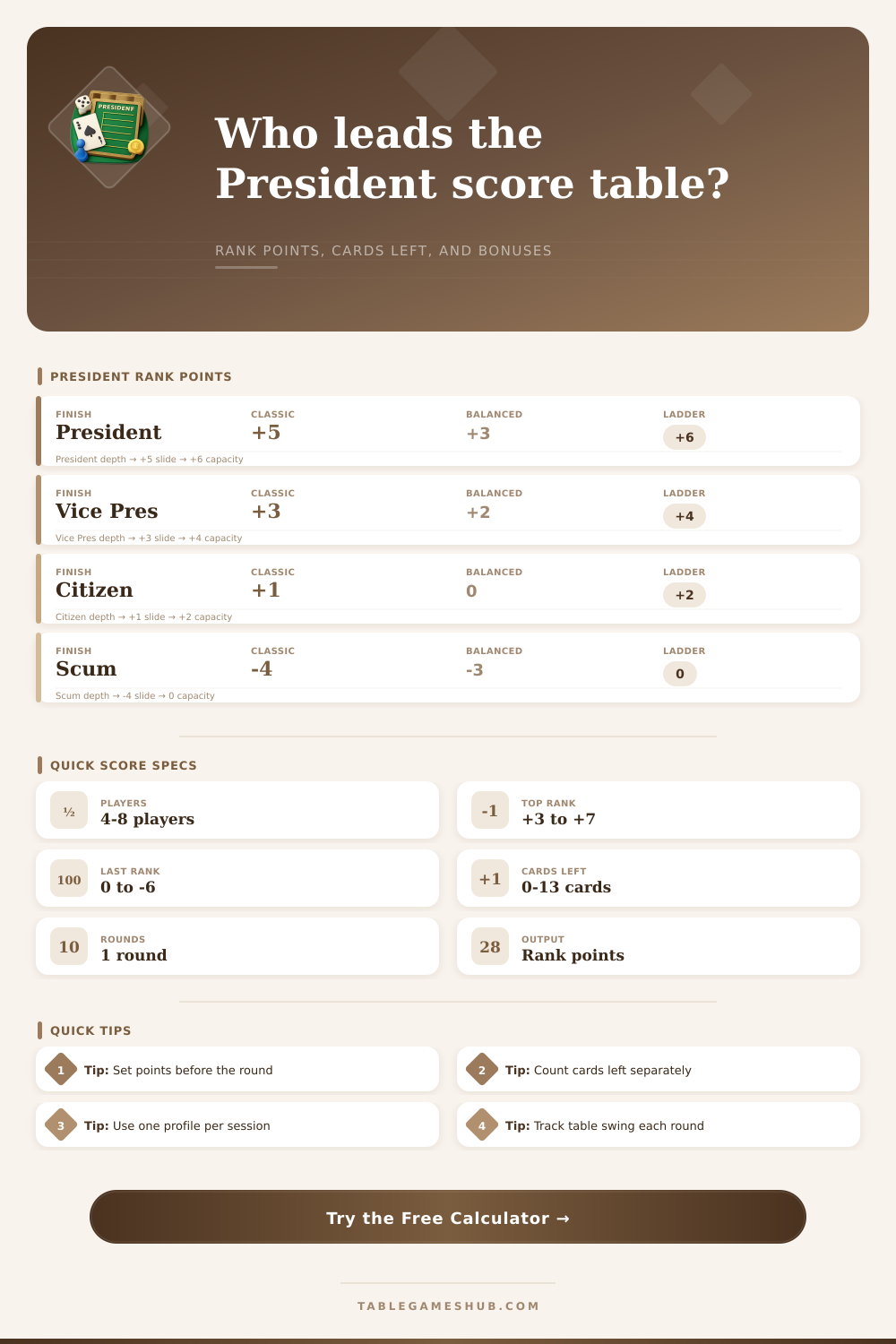
| Finish rank | Classic | Balanced | Tournament |
|---|---|---|---|
| President | +5 | +3 | +7 |
| Vice President | +3 | +2 | +4 |
| Citizen | +1 | 0 | +1 |
| Vice-Scum | -2 | -1 | -3 |
| Scum | -4 | -3 | -6 |
| Profile | Penalty unit | Penalty cap | Calculator use |
|---|---|---|---|
| Classic | 0 per card | None | Rank points only |
| Balanced | 1 per 5 cards | 3 points | Light card drag |
| Ladder | 1 per 4 cards | 4 points | Rank plus card drag |
| Leftover emphasis | 1 per card | 13 points | Heavy hand exposure |
| Tournament | 1 per 3 cards | 5 points | Moderate card drag |
| Players | President | Citizen slot | Scum slot |
|---|---|---|---|
| 3 | 1st | 2nd | 3rd |
| 4 | 1st | 3rd | 4th |
| 5 | 1st | 3rd | 5th |
| 6 | 1st | 4th | 6th |
| 7 to 8 | 1st | Middle | Last |
| Adjustment | Marker | When entered | Score effect |
|---|---|---|---|
| Clean out | Finish bonus | Zero cards and top rank | +2 |
| Revolution table | House marker | Round marked as reversed | +2 |
| Double finish | House marker | Two-card close marker | +3 |
| Late finish | Penalty marker | Table records slow finish | -2 |
| Strict cap | Round limiter | Cap selected in form | Max 8 |
What happens, though, when the other players are done with their turns and there’s only seven cards remaining? That’s a different level of chaos that’s important because it could wipe out three weeks of thoughtful gameplay in an afternoon. To control your cumulative score mercilessly, you’ve got to keep track of those games. And a good tracking system will allow you to follow how the scores change without interrupting flow of game.
Oh, and stop people from arguing over which is worse: losing two points or three points for coming in dead last. The problem is most house games lack clear score rules at shuffle time. While one person remembers something from college, someone else believe they have to hit some threshold to get credit for remaining cards. Meanwhile, another thinks the President always scores five points no matter how many people sits around the table.
Why Scoring Rules Matter
All of this means there will be disagreements. These can cause tempers to flare, which is the worst thing in a game and create an atmosphere where nobody wants to play anymore, which is also the worst thing. The calculator lets you define a set profile for your game and then sticks to it. No more arguing; everyone plays with same understanding of what’s at stake when the first ace gets played.
Scoring profile also influences your strategy around the table. With a classic profile, Scum is a huge bummer and being President are great, so you’re encouraged to be aggressive, to risk it all to avoid bottom spot. A balanced profile narrows this difference, slowing down the game and increasing its strategy content. Suddenly, it’s less about outpacing everybody else and more about keeping pace. Knowing what your crowd enjoys will determine if you is playing for survival or playing to win.
Most casual players underrate the impact of leftover cards. When the round is over and there’s only two or three card left, it seems like no big deal to hold onto them, but with heavy penalty profiles, they add up quickly. You can specify down to the exact number of leftover cards, which means even if it comes down to the wire and you come out ahead, your score will reflect leaving too many behind.
Because this punishes waiting, and this is a huge thing in this game. If you hesitate on a high card, it doesn’t just cost you the trick, it actualy takes points off of your score. The math behind bonuses and streaks cause the psychological pressure. Depending on what tables you use, there’s a multiplier effect when you’ve had consecutive finishes at the same rank. For example, a President streak makes a decent hand a dominating run, and a Scum streak only makes the hole you’re digging yourself worse.
These changes make the game dynamic and keep any one person from cruising unthreatened to a win. That’s why it allows you to mark which streaks exist now, and to account for specific table bonuses so that the running total matches how much momentum this session actualy has. Scorekeeping isn’t only arithmetic, but tension. Players will play more intently if they can see their scores updating as they play.
They’ll recall each position counts for something, and each card remaining in their hands cost something. It’s about keeping the competition sharp without making it take too long to do so. If you make keeping track of complex penalties a bit less hard, then you free them to actualy strategize. And that keeps the game quick-moving even though there are complicated systems of scoring. Nobody should of need to ask how bad it really is.