Expeditions Score Calculator
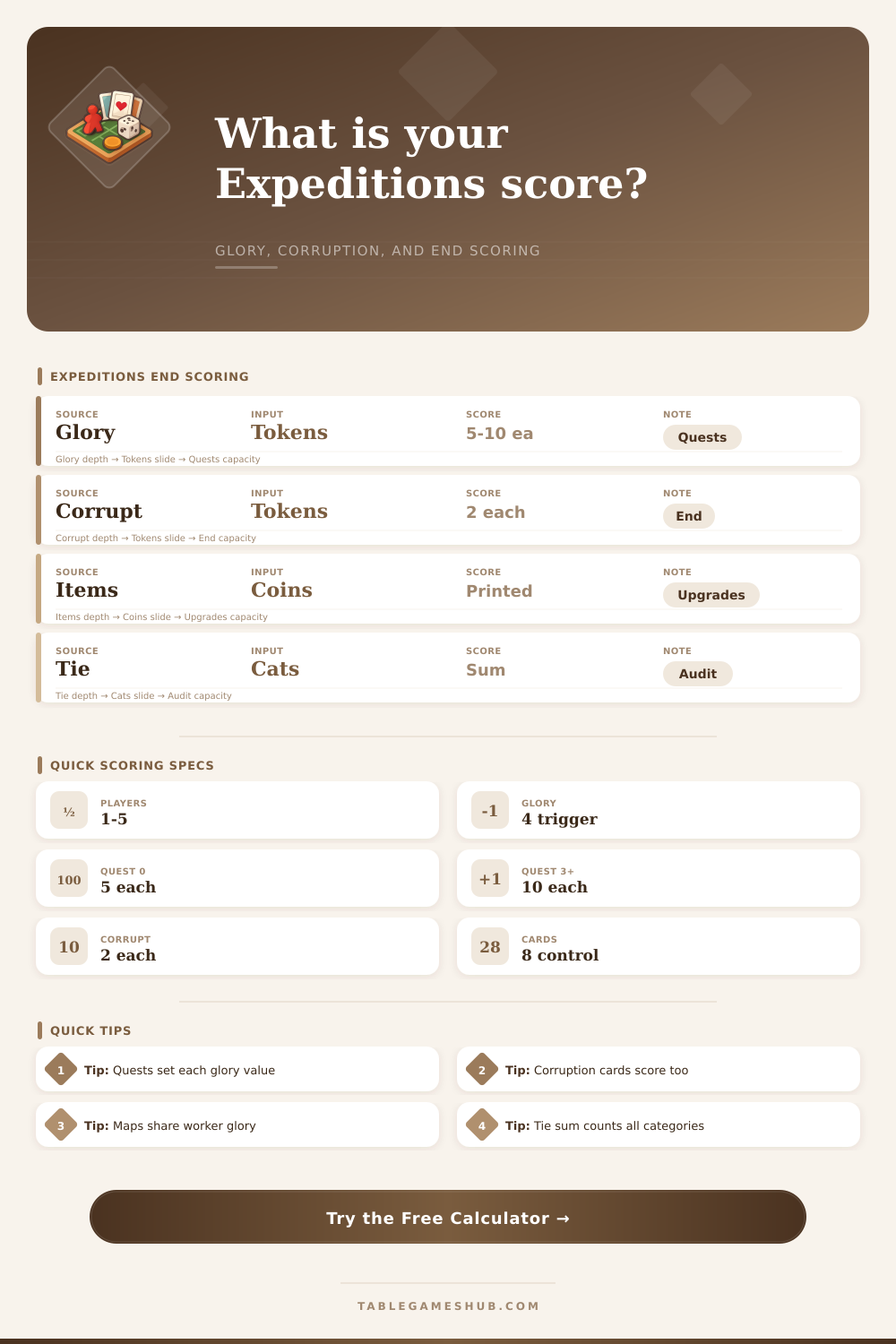
Total final wealth from coins, glory, upgraded item cards, corruption, and the category counts used for tie checks.
⛳Presets
💰Final Scoring Inputs
★Glory Categories Placed
Quests
Needs 4 solved quests.Meteorites
Needs 4 melded meteorites.Upgraded Items
Needs 4 upgraded items.Corruption
Use location 20 or 7 corruption.Cards
Needs 8 cards in control.Workers / Maps
Needs 7 workers or 5 maps.Scoring Breakdown
🧮Scoring Snapshot
📋Reference Tables
| End scoring source | What to enter | Scoring logic | Calculator output |
|---|---|---|---|
| Coins | Total coin value gained | Added directly | Final wealth |
| Glory tokens | Placed glory categories | 5, 6, 8, or 10 each by solved quests | Glory score |
| Upgraded item cards | Printed coin values | Added directly | Item/mech score |
| Corruption | Tokens plus corruption cards | 2 coins each | Corruption score |
| Glory category | Typical threshold | End scoring effect | Tie check count |
|---|---|---|---|
| Solved quests | 4 quests | Raises each glory token value | Number of solved quests |
| Melded meteorites | 4 meteorites | Glory only; meteorites do not add direct coins | Number melded |
| Upgraded item cards | 4 upgrades | Printed coins also score | Number upgraded |
| Cards in control | 8 cards | Glory only | Eligible control cards |
| Workers or map tokens | 7 workers or 5 maps | One shared glory category | Higher worker/map progress |
| Corruption / location 20 | Scenario dependent | Corruption also scores 2 each | Corruption count plus map star |
💡Scoring Tips
And then it’s over. You’re charting unexplored lands, bartering with merchants, and the next thing you know everybody’s banging their fist against the table to determine who has most money. This jumble of competing system all coming together into a single score at end of Expeditions creates sense of chaos during this scoring stage.
You have coins in your palm, glory tokens on the table, item improved back home in your inventory, and corruption dragging you down. Not only do you have to add everything together but figure out which thing affect each other before starting that last round.
How to Score at the End of the Game
In play, most player will concentrate all their effort on collecting coins. They keep an eye on their resource counter as they increase and feel safe with that rising tally. However, the coins are simply a base. The true swing is achieved through glory categories, which is each worth between five and ten points based off how far you’ve progressed down your quests.
You might ignore quest track because it looks like a side activity, but once you solve one or two objective, the value of each glory marker you earned early on makes a huge difference. A modest gain becomes a decisive lead. And finally, tool above will do the math for you, so you don’t have to juggle several different multipliers in your head.
More importantly, though, you has to understand where that input comes from. Traditionally, corruption has been seen as something to avoid at all costs, a kind of penalty to get around. But when you translate those tokens into actualy scoring power (two per marker), it starts to look less like a penalty and more like another scoring engine.
You see, keeping a few (seven or eight) corruption markers on the board may not feel like much, but with clean opponent who aren’t doing much glory, that can suddenly narrow a big gap. It feels counter-intuitive in the heat of battle, but it’s there for a reason.
And then there’s breaking ties: perhaps the most contentious rule in moddern board games (this isn’t a dig; it just happens). In this game, you break ties based on how much progress you made during all your quest, plus all the control you gained, item you collected, and meteorite you got. So instead of everyone trying to specialize as hard as possible in only one part of the game, they’re encouraged to go wide, maybe focus on getting four meteorite melds for glory token but, hey! Those same meld also count towards your tie-breaking total. It’s like having some progress still carry over in terms of narrative weight at end.
Cards are key (and they’re meant to be): Cards is at the heart of engine-building gameplay, and many tactic center on balancing card count for glory versus maintaining flexibility. Having eight cards in hand will earn you a glory category, but it reduce your flexibility when picking actions. It’s a question of short-term gain more than long-term payoff. The page helpfully has a reference table setting all this out, explaining what gets awarded when different threshold are reached.
With seven workers? That count as part of a shared category that includes five map tokens. You don’t get both; this lets you choose where to spend turns and frees up resource to go elsewhere. In the end, it’s less math than it is a check-in to make sure you’re happy with what you’ve done.
Were the upgrades worthwhile? Is that corruption loss going to be worth 2 points per token? Your total will show how you chose to build up and break down across rounds. Sometimes it was all about accumulating power, other times it’s about filling in categories at just the right time. Knowing how thing work makes this end round feel less like a chore and more of a useful review of what you did well, or poorly. Not only do you know who the winner was, but you’ll also see how they outmaneuvered you.