Double Deck Euchre Calculator
Score bid euchre contracts, lone-hand bonuses, set penalties, duplicate-card notes, trump density, and target pressure for common double-deck tables.
made = bidder tricks won >= bid tricks
trump cards = bowers + same-suit trump + jokers
P(at least k) = 1 - sum C(T,i)C(N-T,H-i) / C(N,H)
gap = target - projected score, warning = target x buffer
| Rule profile | Cards used | Deal pattern | Usual target |
|---|---|---|---|
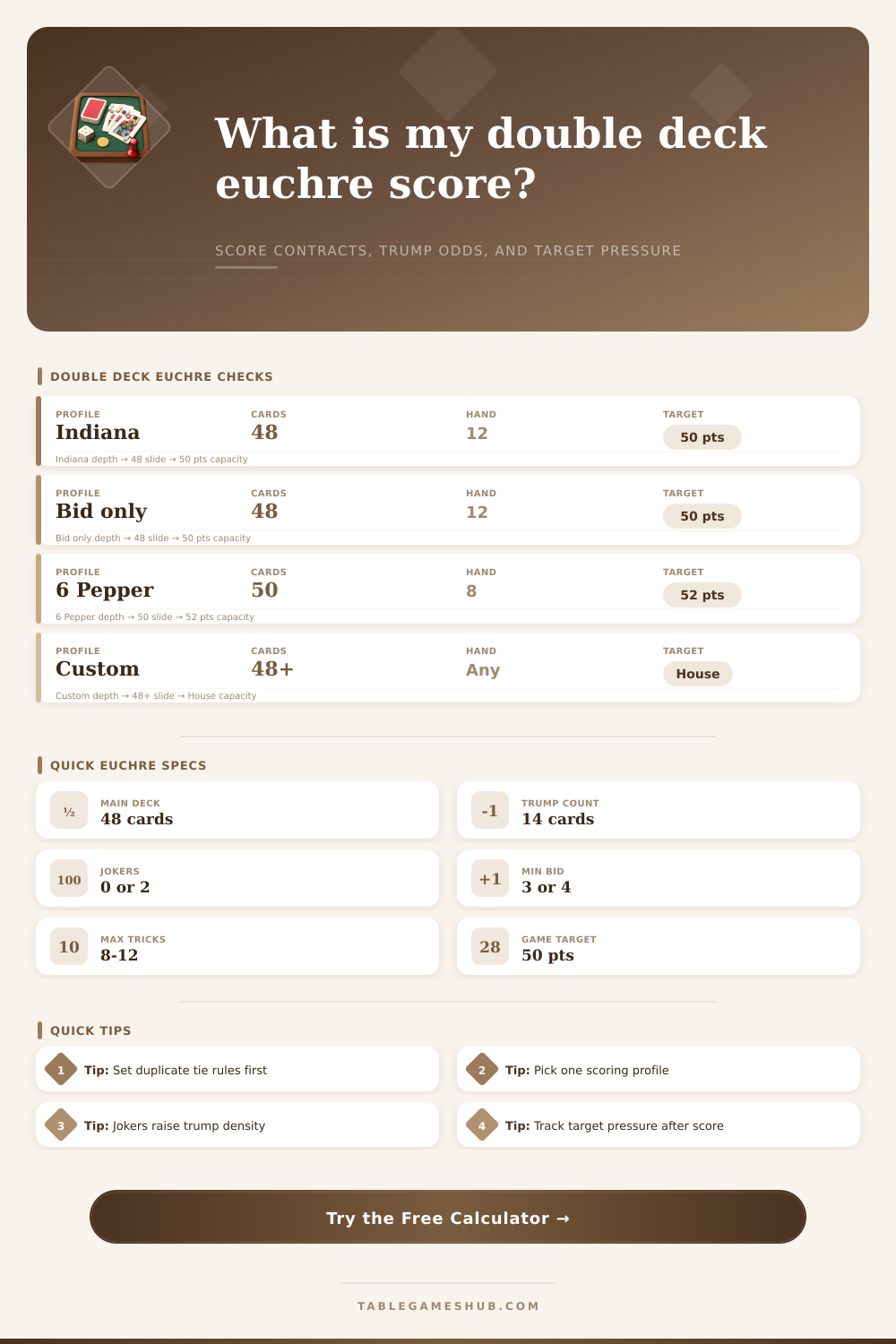
| Indiana double deck bid | 48 cards, two of each 9-A | 4 players, 12 cards each | 50 points |
| Bid-only double deck | 48 cards, duplicate euchre ranks | 4 players, all cards dealt | 50 points |
| Six-player pepper | 50 cards when two jokers are included | 6 players, 8 cards each, 2-card kitty | 52 points |
| Double hasenpfeffer | 48-card pinochle-style pack | 4 or 6 players by house agreement | 25, 32, or 50 points |
| Trump declaration | Highest cards | Trump cards in 48 | Duplicate note |
|---|---|---|---|
| Suited trump | Right bower, left bower, A, K, Q, 10, 9 | 14 before jokers | First equal card played wins many tables |
| No trump high | A, K, Q, J, 10, 9 by suit led | 0 special trump | Duplicate order still needs a house rule |
| No trump low | 9, 10, J, Q, K, A by suit led | 0 special trump | Low calls should be declared before scoring |
| Joker pepper | Jokers, right bowers, left bowers, A down | 16 with two jokers | Joker rank order is a table setting |
| Scoring mode | Made contract | Failed contract | Best use |
|---|---|---|---|
| Score tricks taken | Bidder side scores tricks won | Bidder loses bid; defenders score tricks | Common double-deck bid tables |
| Score bid only | Bidder side scores contract bid | Bidder loses bid; defenders score tricks | Tables that cap overtrick value |
| Bid plus sweep | Bid points plus all-tricks bonus | Penalty selected below | House events with sweep awards |
| Classic euchre points | 1 for majority, 2 sweep, 4 loner sweep | Defenders score 2 for euchre | Doubled-deck casual scoring |
| Trump count target | Chance in hand | Use in calculator | Deck basis |
|---|---|---|---|
| At least 2 trump | -- | Loose check | Current inputs |
| At least 4 trump | -- | Default check | Current inputs |
| At least 6 trump | -- | Strong hand check | Current inputs |
| At least 8 trump | -- | Rare hand check | Current inputs |
I’ve grown up in an environment where the best time was sitting around playing double deck euchre and when somebody announces a loner sweep it seems like half the people has no idea what they’re worth.
It uses two full decks of cards, not just one. There is more trump in play. The hands are longer. Scoring systems is different depending on if you’re in a tournament or simply hanging out with your family. There’s so much variation there but that’s what makes a good bid scorer even better.
How to Use the Double Deck Euchre Calculator
Do not argue at the table, Play the hand and don’t argue about math after each trick. If you want to see how many points you can earn just choose one of the rule profiles and the calculator above will do the math for you. Understanding those profile helps you trust the results.
Your most likely table use either a fixed bid (Indiana) style or maybe they take tricks so the score adjusts as tricks are taken. Or perhaps you play at a table with jokers. If there is six people, the deck changes. Instead of forty-eight cards, there are fifty. All of this matters, and the tool handles the math behind the scenes based off how many hands and trumps is in each deck.
If jokers are in there, that means more high trump cards in the deck. This mean you have a much higher chance of having a good hand to start with. And that’s something that we don’t always think about unless you’ve played with a single deck before. So seeing it laid out for you avoids any over/under bidding due to old habits.
Double deck euchre bidding isn’t so much about counting cards as it is managing risk: do you have enough partnership strength to safely take this contract without running the risk of being set? Under some tables’ rules, a set will cost you points equal to your bid which can be crippling. You can switch between various penalty modes on the calculator. Want to know what happens when you fail to make that bid? Toggle it over and see what it does to your score under your own house rule. When your friends are going to really punish you for a bad bid, it raises the bar because the stakes are higher. There is a little tweak in options but it is a complete shift in strategy for each hand.
Finally, don’t neglect target pressure, that’s what happens once you’re three points from winning. When it’s close every trick counts. One mistake can end the game or leave you chasing by two. With this tool, you’ll see a projected score at the end of the hand. It will alert you when you’re on target; or dangerously off track. How do you know if you’ve got some cushion for playing safe? Or does it make sense to be more aggressive with your partner on the next deal? The projection tells you.
There is one more twist to things, however, as each card come in pairs with both suits and ranks. This means it matters who plays what to break ties. At some tables the first card down gets the trick if you have the same cards. In others, there is a strict system of priorities different than the order of the bowers. This page has a clear table of references to help you understand what to expect so there are no surprises before the game starts. If you know the variant you are playing you won’t be confused when you get two right bowers against each other in a trick.
Careful judgment is key to a higher reward when working alone. When taking a contract as a lone hand, you have no one to cover your weakness. But you get all the points if you win. The calculator takes into account sweep awards and lone hand bonuses. You can see exactly how many points are at stake which helps you decide whether to go it alone. If the odds indicate that you probably have sufficient control over the trump, then going solo is not such a gamble but instead becomes a workable strategy.
Ultimately, euchre (double deck) is a game of both chance and partnership. The tool handles the math to help move the game along so you are free to read your opponent and manage your partner’s expectations. If you’re keeping score seriously or just playing for fun, getting the math correct keeps things moving. Before the first deal, agree on the rules. Disagreement on how to score a sweep should of been fixed before starting.