Power Grid Resource Cost Calculator
Estimate coal, oil, garbage, and uranium payments in Elektros from current market slots, plant demand, refill step, player count, and scarcity pressure.
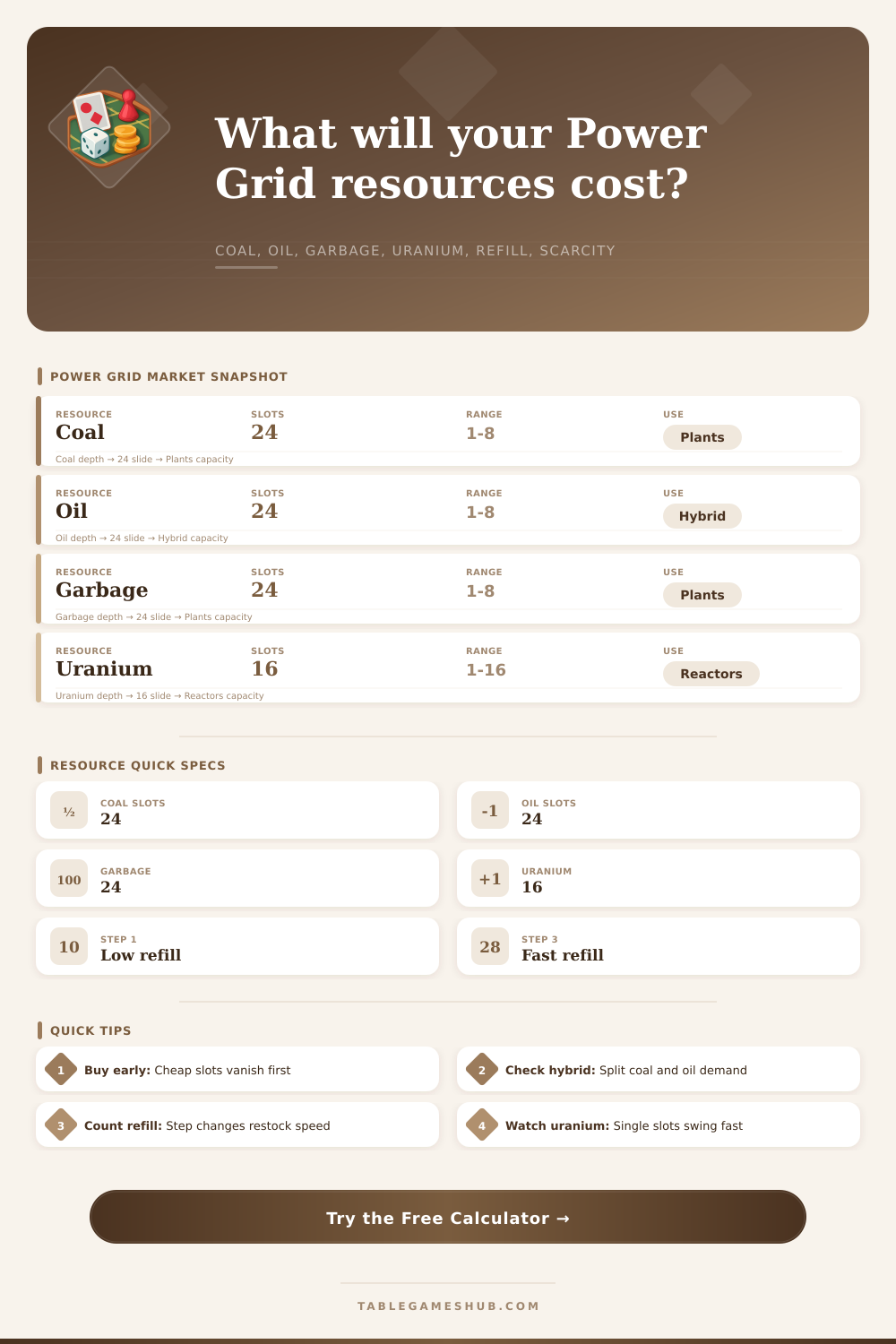
| Resource | Cheapest Band | Middle Band | Highest Band |
|---|---|---|---|
| Coal | 3 tokens at 1 Elektro, then 3 at 2 | Prices 3 to 6, three tokens each | Prices 7 to 8, three tokens each |
| Oil | 3 tokens at 1 Elektro, then 3 at 2 | Prices 3 to 6, three tokens each | Prices 7 to 8, three tokens each |
| Garbage | 3 tokens at 1 Elektro, then 3 at 2 | Prices 3 to 6, three tokens each | Prices 7 to 8, three tokens each |
| Uranium | Single slots from 1 through 4 | Single slots from 5 through 10 | Single slots from 11 through 16 |
| Player Count | Step 1 Refill | Step 2 Refill | Step 3 Refill |
|---|---|---|---|
| 2 players | Coal 3, oil 2, garbage 1, uranium 1 | Coal 4, oil 2, garbage 2, uranium 1 | Coal 5, oil 4, garbage 3, uranium 1 |
| 3 players | Coal 4, oil 2, garbage 1, uranium 1 | Coal 5, oil 3, garbage 2, uranium 1 | Coal 6, oil 4, garbage 3, uranium 1 |
| 4 players | Coal 5, oil 3, garbage 2, uranium 1 | Coal 6, oil 4, garbage 3, uranium 1 | Coal 7, oil 5, garbage 4, uranium 2 |
| 5 to 6 players | Coal 5 to 7, oil 4 to 5, garbage 3, uranium 2 | Coal 7 to 9, oil 5 to 6, garbage 5, uranium 2 | Coal 9 to 10, oil 7 to 8, garbage 6, uranium 3 |
| Plant Mix | Typical Demand | Market Stress | Calculator Watch Point |
|---|---|---|---|
| Coal stack | 4 to 8 coal | High if many players share coal | Coal available and scarcity pressure |
| Hybrid coal-oil | 2 to 5 flexible tokens | Medium, depends on cheaper ladder | Hybrid flex allocation reading |
| Garbage transition | 1 to 4 garbage | Spiky when few plants exist | Garbage shortfall and top slot price |
| Uranium reactor | 1 to 2 uranium | Sharp because slots are single | Uranium highest paid slot |
| Resource Type | Slot Shape | Volatility | Best Use in Calculator |
|---|---|---|---|
| Coal | Three tokens per price level | Moderate, many plant icons | Base-load plant payment estimate |
| Oil | Three tokens per price level | Medium, hybrid plants absorb it | Compare with coal when flex exists |
| Garbage | Three tokens per price level | High when supply is low | Check if a trash plant remains efficient |
| Uranium | One token per price level | Very high near upper slots | Find expected reactor payment |
In the game Power Grid, the amount of money that you spend on resources will determine whether you win the game or whether you lose the game. The fuel market is one of the main markets in Power Grid, and the prices in the fuel market change every time a player makes a purchase of resources from the market or refills the market with resources from there resources tokens. The players must understand the prices in the fuel market because those prices change based off the number of resource tokens that are available in the game.
Each of the resources tokens in the game are not the same, and thus, each of the resources should be treated differentally in the game. For instance, both coal and oil tokens are priced the same, but a hybrid power plant can use oil as one of the resources. However, garbage tokens are priced differently than both coal and oil tokens, and the starting number of garbage tokens that is on the board is less than the number of coal and oil tokens that are on the board.
How to Use the Fuel Market Calculator in Power Grid
Uranium tokens are yet another different resource from the other three types of resources, as the price of uranium tokens are represented by individual tokens that range from 1 to 16, and the prices for those uranium tokens can quickly increase once all of the low-priced tokens are gone from the market. The players must manage each of these different resources, as most of the power plants in the game require different types of resources at different times of the game. The calculator included in the game allows the players to calculate the cost of the resources that they will require for their power plants.
The calculator calculates the cost of those resources based upon the number of tokens that is left on the board, and based upon the icons that are included in the players power plants. The calculator allows each player to test out different markets in the game, such as comparing the features of a dry market to a rich market. A dry market is one in which all of the cheapest tokens of a certain resource are gone from the market, while a rich market is one in which there are still many tokens that are low in price and remain in the market.
The refill timing setting for the calculator allows each player to understand how the market will refill, and to use that information to decide whether they should purchase the resources at that time or whether they should wait until later in the game. Finally, the scarcity pressure setting for the calculator increases the price for all resources at the beginning of the market; this represents the actions of the other players who have already purchased all of the cheap tokens for those resources. Although the calculator can provide valuable information for the players, the calculator isnt able to determine the actions of the other players, or how the market will change after those other players take their turns.
For instance, it is possible for the market to appear inexpensive to a player using the calculator; however, if two other players decide to purchase the resource at the same time as the player using the calculator, the market may appear expensive to that player. The presence of hybrid power plants in a player’s resources makes the market complex for that player and others, as the player may need oil but another player may need coal. Players can use the flex setting in the calculator to study these types of scenarios, but players must also watch the other players in the game to determine what resources they are purchasing.
The refill rate for the market can change based upon the number of players who are using the game, as well as based upon the step that the game is currently in. For instance, the reference table for the game includes the refill rates for markets with two, three, four, five, and six players in the game. Furthermore, early in the game, when there are few players, the refill rate is low.
For instance, during step three of the game, the refill rate is high. The calculator can automatically calculate these refill rates for the players, but players need to remember that during the later stages of the game, the player that can correctly predict the market one turn in advance of the others could of been given rewards. Many players tend to make mistakes in the game when purchasing resources.
For instance, many players tend to treat each of the resources as if they are the same, when each resource has different features. Some players may make the mistake of purchasing the first resource tokens that appear in their resource market, rather than considering whether a hybrid power plant could purchase that resource for a cheaper cost. Other players may make mistakes of ignoring the scarcity market setting in the calculator.
If a player chooses to ignore this setting, they may end up purchasing resources at a price that is higher than that player had originally calculated with the calculator. The calculator shows each player the cost that they will have to pay for the resources that they wish to purchase, as well as the shortfall in the number of tokens that they will have left after purchasing those resources. Thus, to avoid making mistakes with their resources, players should look at the next price band that the resource will cost before they spend any of their money on resources.
Finally, each of the players should view the resources of coal, oil, garbage, and uranium as a single system of resources. By viewing these resources as a single system, the numbers on the screen for Power Grid will show each player patterns of the market and the costs of each resource. The calculator can make these patterns more visible to the players, which allows them to spend less time on the math calculations for the game, and to spend more time keeping tabs on the other players in the game.