Catan Seafarers Calculator
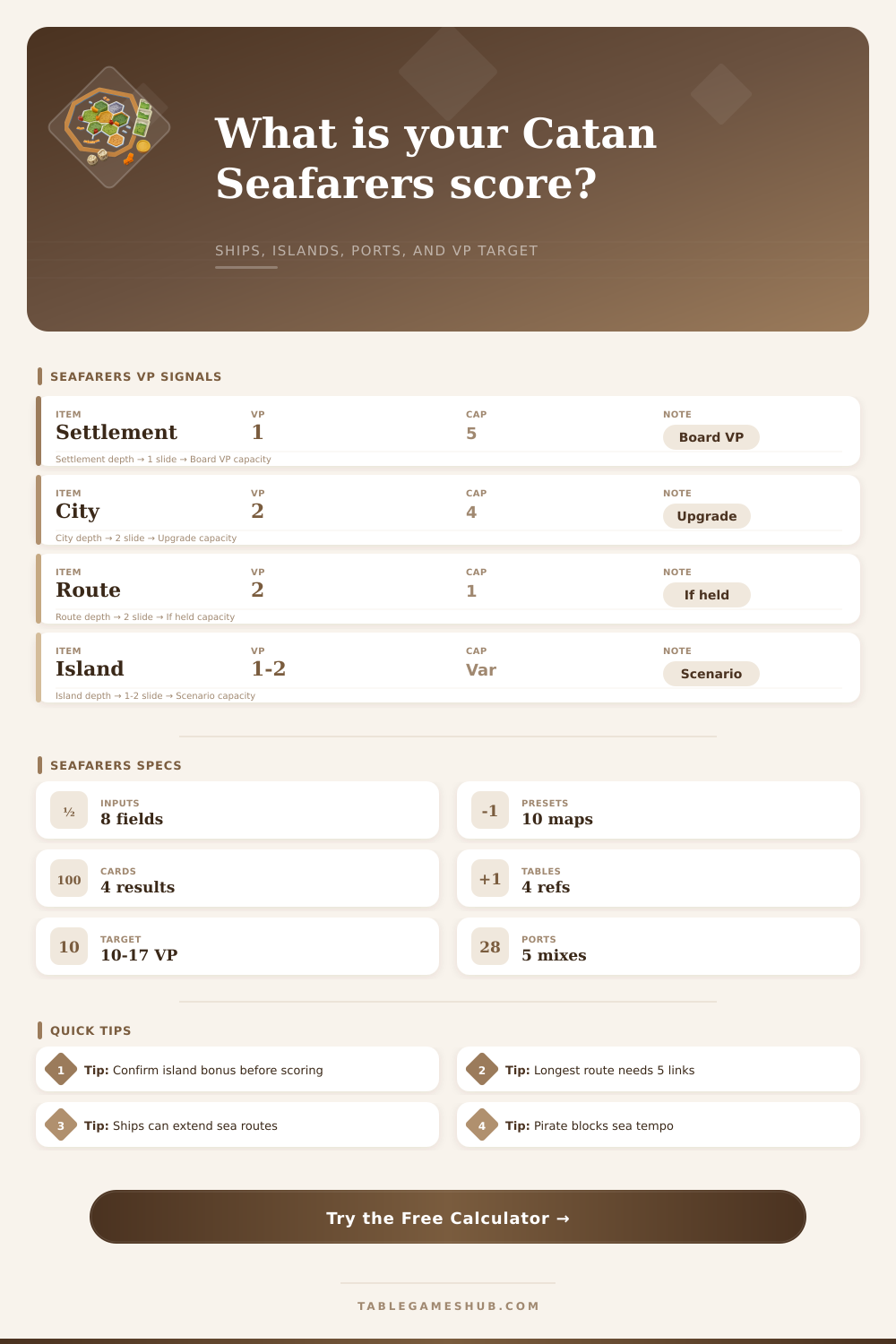
Total a Seafarers position with settlements, cities, victory point cards, island bonuses, ship route length, Longest Trade Route status, scenario target, pirate or robber pressure, and port mix.
Live score breakdown
| Scoring item | Count | Rule | VP |
|---|---|---|---|
| Settlements | 4 | 1 VP each | 4 |
| Cities | 1 | 2 VP each | 2 |
| Island bonus | 2 | scenario | 2 |
| Longest route | held | 2 VP | 2 |
VP source table
| VP source | Point value | Seafarers note | Calculator field |
|---|---|---|---|
| Settlement | 1 VP | May trigger island discovery bonus | Settlements on land or islands |
| City | 2 VP | Upgrade replaces one settlement | Cities upgraded |
| Victory point card | 1 VP | Hidden until revealed by normal timing | Hidden VP cards |
| Longest Trade Route | 2 VP | Usually needs at least 5 continuous links | Route status |
| Island bonus | Scenario value | Printed scenario rule controls value | Island bonus VP |
Route and ship checks
| Route state | Route length | Award | Common check |
|---|---|---|---|
| No qualifying route | 0-4 links | 0 VP | Add ships or roads to reach five |
| You hold the card | 5+ links | 2 VP | Verify no opponent is longer |
| Eligible but behind | 5+ links | 0 VP | Need to exceed the holder |
| Tied with holder | 5+ links | 0 VP | Tie usually does not transfer card |
| Pirate blocks lane | Any length | No VP change | Tempo loss until moved |
Scenario target and port pressure
| Scenario lane | Typical target | Port value | Pressure note |
|---|---|---|---|
| Basic exploration | 12-13 VP | 3:1 helps finish | Pirate slows ship expansion |
| Multiple islands | 13-14 VP | 2:1 port can swing pace | Island bonuses matter heavily |
| Fog or discovery map | 12-14 VP | Mixed ports are flexible | Unknown coast changes route math |
| Wonder or special objective | 15-17 VP | Port engine supports builds | Track objective VP separately |
| No useful port | Any target | Low conversion | Need wider production or trades |
Seafarers plays like Catan on water (until the second time you play it), and then you know that the ocean is nothing more than an area for your plans to meet their death at the hands of pirates. The base game is wood, brick, and point-counting. This expansion is all about taking chances as you try to link dots across a wildly shifting map. It’s about having something to keep tabs on: not only what do I have? What might I reasonably accomplish before another player blocks my lane? That’s why how you set up your scoring matter most in this variant. But there’s a lot more going into this than meets the eye.
So much so that the calculator handles the math and weigh different variables once you plug in where you currently stand. (I mean, why do mental math when your opponent is glaring at you?) It factors in your cities, yes, and your settlements, absolutely, but it accounts for those pesky behind-the-scenes variables that make Seafarers unique: Is there a pirate ship on the map? What level of threat does it pose? Are there any island bonuses? Does one player have an advantage due to port access or blocked routes? Until you’re sitting there without a move to make, most players forget about the tempo pressure.
Why You Need This Seafarers Calculator
By taking into account route blockage and port access, this tool makes you face facts earlier… Specifically if you’re winning on paper or merely treading water waiting to lose in practice. Take the Longest Trade Route award, for example. In vanilla Catan that’s pretty much an afterthought. It becomes relevant late-game, maybe. Ships make all the difference here. Sure, five links might not look like much. But if those links are boats sailing over dangerous seas past enemy islands, that’s a big deal for turn order and resource investments.
Does the calculator account for whether you have the card or simply qualify for it? Yes, because having the card means there’s no VP if another player extends your chain. Most folks overlook that. They calculate the points as if they’d win them only to discover they don’t have the card(s) required. On the page, the reference table explains who has the award (qualify versus possession) and breaks it down into two point.
That adds another level of complexity as you discover islands. In some games, bonus points are available simply by occupying an unoccupied island. On others they only become valuable when you achieve certain objectives. If you use the wrong bonus, target number becomes meaningless. Read the scenario sheet thoroughly before launch. The pre-sets is useful in that they load the most common setup, but then it’s up to you to confirm the island mechanics align with what you’re playing. An island shrouded in fog may conceal resources, changing how you value a nearby settlement compared to a clear coastal spot.
Finally there’s the pirate. While the robber stalls production in vanilla Catan, the pirate halts movement completely in Seafarers. If the pirate sits on a square that contains your sole line of access to a critical link or valuable resource, you’re out of luck. To account for this pressure, the tool estimates how much tempo you lose. It doesn’t affect your final score, but it informs whether or not your estimated end-time is reasonable. A +1 pace adjustment may seem minor, but over the span of ten turns it could be difference between finishing a city vs being blocked from doing so.
The port mix is important too. A useful 2:1 port can be a lifesaver on a tight resource board. Otherwise, you’re at the mercy of trading for what others want to sell. That’s a soft advantage that isn’t shown in hard VP but should of count as part of your overall standing. The calculator accounts for that. It includes both hard and soft benefits such as resource security and mobility in its calculations.
Seafarers comes down to this: embrace the chaos. There are pirates, islands, and a changing board. None of it is something you can control, but you can manage it all by keeping track of what’s going on. By separating official points from situational pressure, you stop guessing and begin to plan. You come to view the route itself as something alive, something to protect, rather than simply a scorecard to tally up at the end. The ocean will not forgive you, but if you have the proper tools, you’ll never lose your way again.