🎲 Rummikub Points Calculator
Total rack penalties, winner points, opening meld gaps, and cumulative standings for a 2 to 4 player Rummikub round.
📌Named scoring presets
⚙Round settings
🧮Rack and score sheet inputs
Player 1
Player 2
Player 3
Player 4
| Player | Rack total | Round score | Before | After |
|---|
📐Formula cards
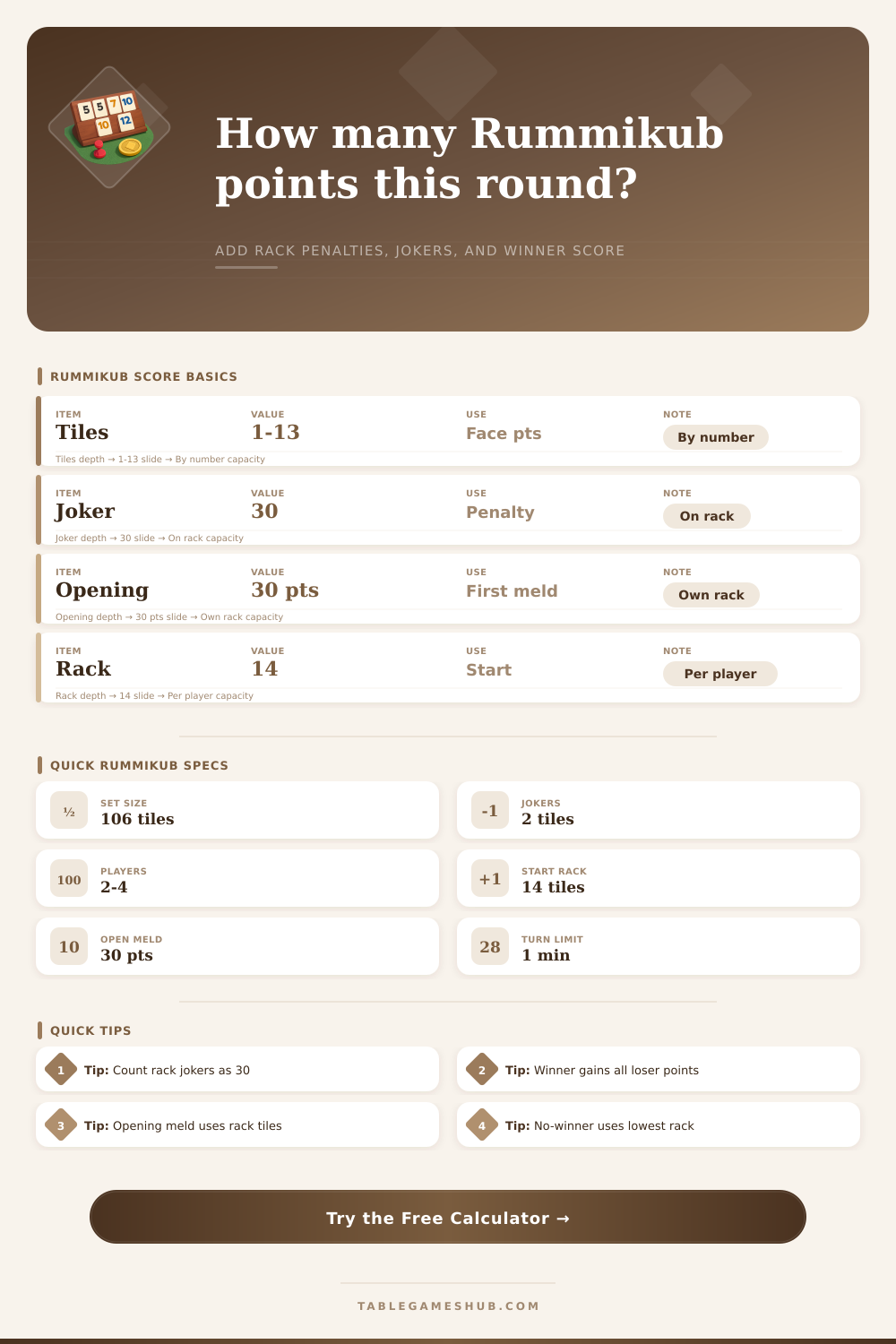
Numbered tiles use face value; each joker left on a rack adds 30 penalty points.
When a player goes out, the winner gains the combined rack penalties of the other players.
Each non-winner records the negative value of their adjusted rack total for the round.
If nobody goes out, lowest rack wins; other players lose the difference from that low rack.
🧩Rummikub component/spec grid
Standard set with numbered tiles and jokers.
Two copies of 1 through 13 in four colors.
Wild in sets; 30 points if left on rack.
Each player begins with fourteen tiles.
Initial meld points must come from that rack.
Same color, consecutive numbered tiles.
Same number, no repeated color.
Calculator supports the standard player count.
📊Reference tables
| Round state | Winner rule | Other player score | Winner score |
|---|---|---|---|
| Player empties rack | Declared player wins | Minus own rack penalty | Sum of all other penalties |
| Pool empty, no play | Lowest rack total wins | Lowest rack minus own rack | Sum of other differences |
| Opening meld check | At least target points | Not a round score | Shows points short or excess |
| Cumulative sheet | Add round score to prior | Can move below zero | Round scores net to zero |
| Item | Round value | Opening meld value | Calculator input |
|---|---|---|---|
| Numbered tile 1 | 1 point | 1 point | Add to numbered total |
| Numbered tile 2-12 | Face value | Face value | Add values together |
| Numbered tile 13 | 13 points | 13 points | Add to numbered total |
| Joker on rack | 30 point penalty | Not on rack | Use joker dropdown |
| Joker in opening meld | Represents a tile | Represented tile value | Enter represented points |
| Example | Rack penalties | Winner round | Score effect |
|---|---|---|---|
| Clean 4-player finish | 17, 12, 9 | +38 | Losers score -17, -12, -9 |
| Joker catch | 43, 18, 11 | +72 | One joker adds 30 to a rack |
| Low-rack no-winner | 8, 14, 22, 10 | +30 | Winner gains differences 6, 14, 2 |
| Two-player race | 0, 7 | +7 | Opponent takes -7 |
| Output | Positive means | Negative means | Use it for |
|---|---|---|---|
| Round score | Won points this round | Lost rack value | Single-round tally |
| Cumulative after | Ahead on the score sheet | Behind across rounds | Multi-round match standings |
| Opening status | Ready to open | Short of target | Checking first meld points |
| Largest penalty | Most points exposed | Not applicable | Finding the costly rack |
💡Scoring tips
Separate numbered tiles from jokers
Total the face values of numbered tiles first, then add 30 for each joker still sitting on a rack.
Check the zero-sum balance
In a normal finish, the winner's positive round score should equal the combined negative scores of the other players.
There is a silence when one player clears their rack in Rummikub, and you know it’s different than any other kind of game. The winner isn’t just relieved. Everyone else knows how expensive their remaining tile are going to be, or how horribly theyve played.
Scoring in Rummikub is more than math. It’s psychological warfare dressed up like addition. You need a good way to count up the total scores and rack penalty. This keeps you from losing your cool, while still helping you remember the swings.
How to Score and Keep Track in Rummikub
But at the heart of this game is the idea of exposure. Each tile you’re holding represent potential points for your opponent if they beat you instead. Each time you lay down a run, or a set, you aren’t simply creating a hand: you’re removing exposure from yourself. Because if somebody beats you to the punch, you’ll take a big ol’ hit to your bankroll.
This is where the calculator steps in. It do all the math for you. You won’t have to scribble frantically on napkins or deal with flying eraser dust as tension builds during a competitive round. If you know what each number adds to the penalty pot, then you’ve got half the battle won.
That thirteen isn’t just a good card, it’s a liability. And while it might help complete a run in a few turns, oftentimes it hurts more than helps to keep it in hopes of connecting with it later. Sometimes you gotta sacrifice a set to clear space, but it’s worth it.
And then there are the jokers. In play, these two special tiles serves as wild cards; in scoring, however, they turn into monsters. At the end of the round, if one of them lands on your rack, it’s worth thirty points. That’s a huge swing in a game whose rounds frequently result in scores in the single or low double digits.
When the player mentally tallies his or her hand, the joker’s penalty value is often forgotten. Seeing a valuable wild card in play, he or she ignores the potential cost of having it too long. By letting you mark down how many jokers are left on each rack, the tool accounts for that possibility, turning what might otherwise be an abstract risk into a concrete number that you’ll be able to factor into your decisions.
Another obstacle that new players stumble over is opening the board. By rule, you must get to 30 points with your initial meld before placing it down on the table. This means that you’ll be holding more tiles than you may prefer. Your exposure rises.
Players who are afraid they won’t have enough points on their rack to open (or at least they think there’s no way to finish) end up sitting out a turn. Other people rush and don’t quite hit the mark; they spend all of their time reshuffling tiles without being able to play any. This part of the calculator is designed specifically for verifying the opening meld gap. In other words, it will let you know whether you’re under by however many points, or if you’ve passed the mark.
Not only is it handy for confirmation purposes, it helps you see what kind of pace you’re setting yourself for early in the game. Maybe knowing that you’re two points off from opening up changes everything about your next move.
But what about when we run out of tiles and nobody goes out? That’s when things get realy interesting. The rules switch and the person with the least amount of points on their rack is declared winner. All other players loses whatever they would have scored minus that loser’s rack total.
This makes end game strategy a whole new ball game. Rather than thinking “how do I go out”, you’re thinking “how do i not hurt myself compared to everyone else”. It forces a defensive mindset where you may choose to shed certain high value tiles even though it means you can’t finish off a set because minimizing your exposure is more important then completing a run. The tool handles this by comparing the rack total rather than adding up the penalty which accurately reflects whether you’ve gained or lost ground in a tie-breaker.
Keeping track of cumulative scores across multiple rounds is where most house games fall apart. Sure, they might remember which player won the last round, but have no clue that their opponent still has them down 15 points from two rounds back. The calculator tracks your position after every round, meaning it will add current round’s score to what was already accumulated.
Not only does this keep things honest, but you’re able to see just how much one bad hand with jokers can destroy an otherwise solid lead. It adds a story to the match that basic win/loss records simply lack.
In the end, Rummikub isn’t just about recognizing patterns; it’s also about taking risks. You’re constantly balancing short-term gains (laying down a tile) against long-term costs (preventing someone else from doing so). Your intuition guides your next move, while the math informs your position. Your calculator handles the hard work of arithmetic, freeing your mind for more strategic thinking: not subtraction, but strategy.
It’s those silent pauses between turns, when you consider taking a leap of faith that might cost you everything, versus playing it safe. That constitute the true game.