Point City Score Calculator
Total printed building points, Civic Token formulas, permanent resource icons, solo AI comparison, and the official tie edge.
🏙 Point City Score Presets
📋 Final Tableau Inputs
The game still scores total points; the average view helps compare engine density between cities.
Use only for a verified missed printed point or corrected Civic Token count.
🏗 Permanent Resource Icons
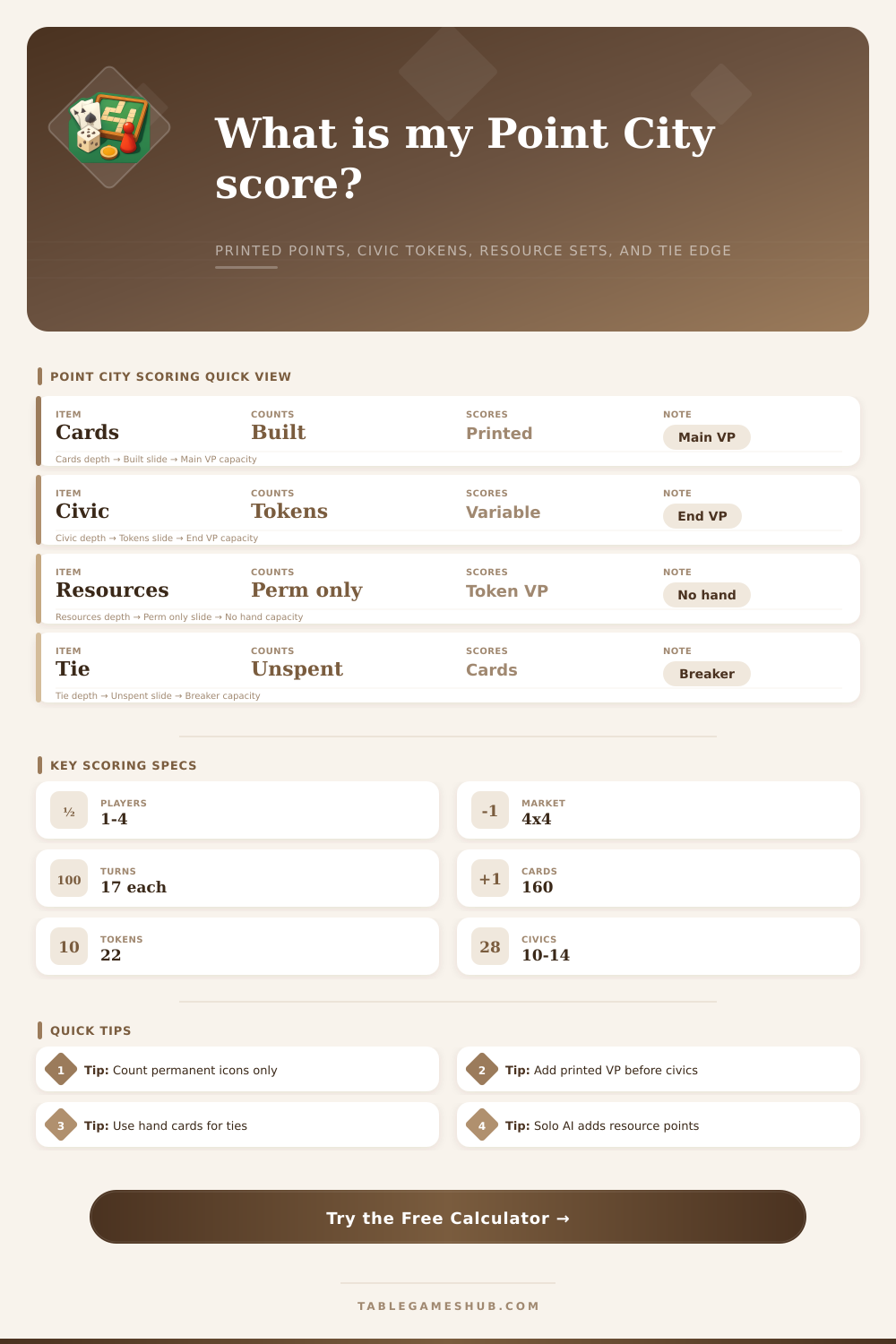
Civic Tokens that reference resource types score permanent resources on constructed Building Cards, not unspent Resource Cards.
🏅 Civic Token Formula Inputs
Single-resource token
Two-resource set token
Threshold token
Built-card token
Unspent-card token
Manual Civic total
Point City Final Score
Score Breakdown
🧩 Game Component Spec Grid
📊 Setup And Scoring Reference
| Player count | Tier 1 cards used | Tier 2 cards used | Tier 3 cards used | Civic Tokens used |
|---|---|---|---|---|
| 1 player solo | 40 | 24 | 18 | 10 in a line |
| 2 players | 40 | 24 | 18 | 10 available |
| 3 players | 52 | 36 | 28 | 12 available |
| 4 players | 64 | 48 | 38 | 14 available |
🏁 Civic Token Formula Reference
| Civic Token type | Calculator formula | Best input to verify | Scoring caution |
|---|---|---|---|
| Single resource icon | Matching permanent icons × token rate | Economy, Ecology, Energy, Community, Industry, or Ingenuity count | Do not include unspent Resource Cards |
| Two-resource set | Lower of icon A and icon B × points per set | The smaller resource pile limits the sets | Choose the exact pair printed on the token |
| Threshold resource spread | Resource types at or above threshold × points per type | Every permanent resource type count | Ingenuity is only counted when the token allows it |
| Built-card quantity | Floor of built cards divided by award interval × rate | Constructed Building Card count | Only built cards in your City count |
| Unspent Resource card | Scored hand cards up to cap × points each | Resource cards remaining after final turn | Separate from official tie-break hand count |
🤖 Solo AI Comparison Table
| Solo difficulty | AI printed points | AI resource scoring | AI Civic Token scoring | Extra AI item |
|---|---|---|---|---|
| Easy | Printed points on AI buildings | 1 point per permanent resource | 3 points per Civic Token | No Ingenuity hand bonus |
| Medium | Printed points on AI buildings | 1, 2, or 3 points for 1, 2, or 3+ of each type | 5 points per Civic Token | No Ingenuity hand bonus |
| Hard | Printed points on AI buildings | 1, 3, or 6 points for 1, 2, or 3+ of each type | 7 points per Civic Token | 1 point per Ingenuity Resource Card |
📝 Endgame Audit Reference
| Audit line | What to count | Calculator field | Common correction |
|---|---|---|---|
| Printed VP | Numbers printed on constructed Building Cards | Printed points on built cards | Exclude Civic buildings with no printed points |
| Permanent resource VP | Resource icons on built buildings only | Six permanent resource inputs | Ignore spent and unspent Resource Cards |
| Civic Token VP | Every claimed Civic Token formula | Civic Token Formula Inputs | Add unusual tokens in manual Civic total |
| Tie edge | Unspent Resource Cards after scoring | Unspent Resource Cards in hand | Compare only if final scores are tied |
💡 Point City Scoring Tips
In Point City, all your strategy come down to math in the last few minutes of the game. For seventeen turns youve been building, bartering, grabbing civic tokens, and betting on some crazy strategy to pay out in the endgame. It’s time. The cards flip over, the clock stops, and now you has to see whether your gamble worked, or if your neighbor spread out his bets and won big.
If you get this part right, you’ll be patient. Scores builds up in stages during the game and are totaled at the end. The first level of score is printed on each card (that’s just the beginning). But here’s where things gets interesting, did you match up your resource icons with formulas on your civic tokens? That’s the layer that many players miss, and requires more than scanning your tableau for visible VP symbols, it require you to go through all your icon on your constructed buildings and compare them to what is required by each token in play.
How to Score Points in Point City
For instance: if one of your civic tokens rewarded VP based off combinations of community and energy icons, you can’t tally those numbers up individually. But you only gets points for pairs, not individually. Whatever combination of resources you have the least of in your permanent holdings determines how many points you’ll score. That’s an additional factor punishing unevenness and rewarding careful use across the half-dozen different categories.
It forces you to consider whether or not now is the right time to buy that awesome building, despite how much it will hurt your long term ability to maximize those end-game multipliers when you need them most. After entering numbers of your respective counts, the calculator do all the hard math for you. It will show you what kind of value those in-game token transactions was worth compared to raw printed points.
It’s helpful when looking back at mid-game strategic decisions and seeing which ones really did make a difference and which ones didn’t. But it alters your outlook on playing solo mode in general as well. If you play against the AI, it’s not just about getting to a bigger number, but knowing how the computer builds up its score according to the difficulty setting.
Easy mode may look like it’s giving away the store since it doesn’t give many points per token. But it does expects you to outscore the relentless pileup of victory points from the AI over time. On harder levels, the AI get huge bonuses for having multiple copies of the same icon. That introduces a new kind of pressure: do I need to match that efficiency with specialization? Or do I want to try to counteract it with variety and hope my threshold-based tokens activates before they do? The strategic difference is what makes solitaire such good practice for learning about engine design via token selection.
The tie-breaker rule adds another bit of psychology to hand management when facing off against humans. Having unspent resource cards can break ties, so you’ll be more reluctant to spend the final couple of cards in your hand if you think it’s coming down to the wire. But spending them may also allow crucial purchases to swing your printed score above the cutoff and out of any potential tie. It becomes a careful dance of investment for power vs. They hoard to stay secure.
As most vets will tell you, however, the tie-breaker can be dangerous. It puts part of your destiny in someone else’s hands (the one who built differently). You’re better off going with a solid total based on good building placements and smart use of tokens.
This game has enough cards in each tier to scale well for 2 or 4 players. It balances the number of tokens against component tiers so there is always just the right pressure on the market. What this does is provide a level of consistency in the scoring rules independent of the number of players, with only some slight change to the number of particular tokens that might be present. With a strong engine, you know it’s going to work effective for whatever number of players as long as you’re conscious of how many tokens are actualy up for grabs.
For new players, however, the mental juggling act of remembering these variables while playing quickly becomes unmanageable, making it very useful to have a concrete point of reference about how each token type contributes to final total. That makes scoring less of a slog and more of a teachable moment, because now, you know precisely where you gained/lost points.
In the end, Point City is all about treating each and every one of those icons on your board not just as triggers for an ability, but as a potential point source. Once you begin thinking of resources as dual-purpose assets feeding not only your engine but also your end-game score, the game opens up in a way that feels deeply satisfying. What appeared to be a complex calculation becomes instead a clear narrative about efficient city planning, and it’s a shift in perspective that makes everything click.