⚔ Pathfinder XP Calculator
Track experience points, level thresholds & character progression
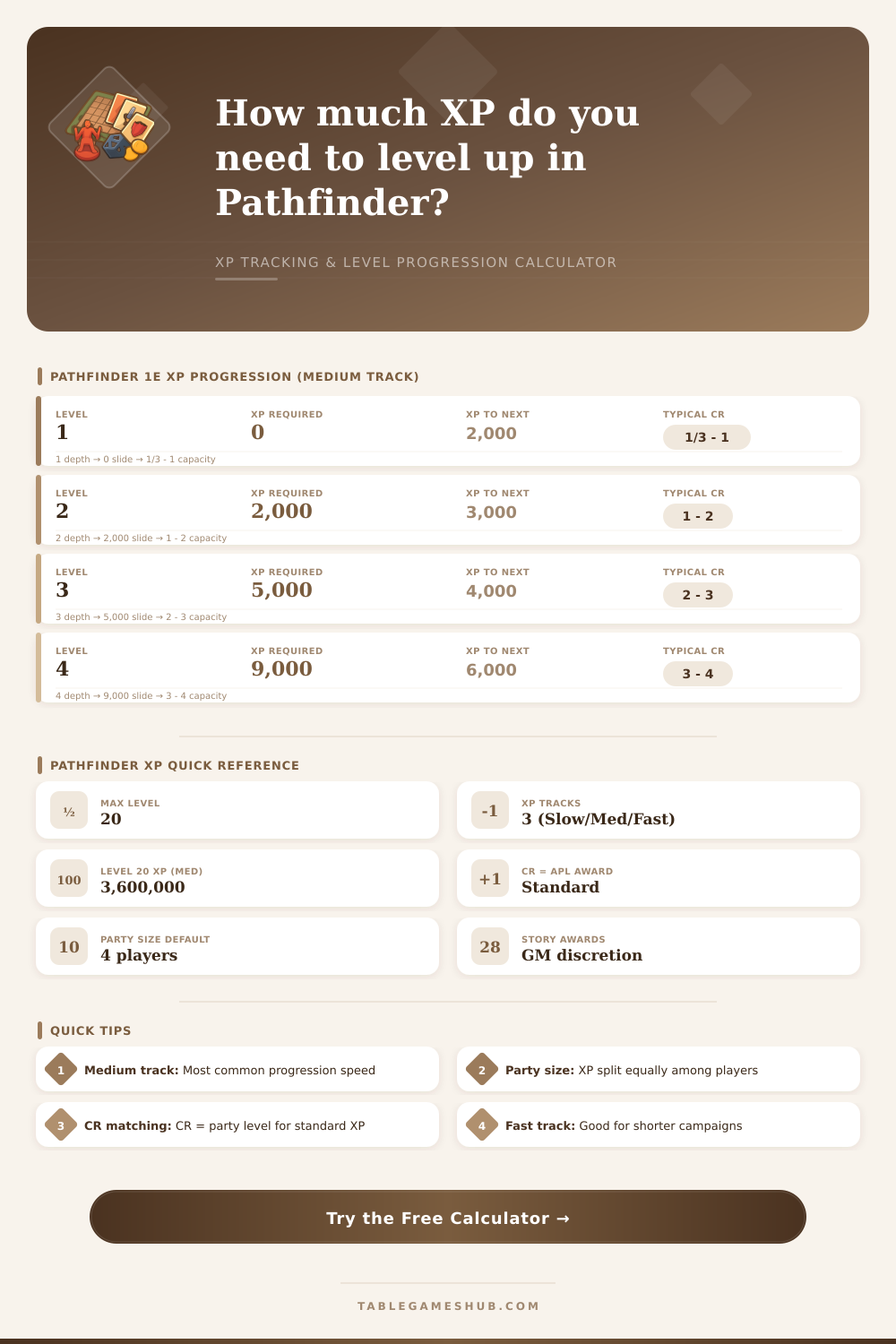
| Level | XP Required | XP to Next Level | Typical CR |
|---|---|---|---|
| 1 | 0 | 2,000 | 1/3 – 1 |
| 2 | 2,000 | 3,000 | 1 – 2 |
| 3 | 5,000 | 4,000 | 2 – 3 |
| 4 | 9,000 | 6,000 | 3 – 4 |
| 5 | 15,000 | 8,000 | 4 – 5 |
| 6 | 23,000 | 12,000 | 5 – 6 |
| 7 | 35,000 | 16,000 | 6 – 7 |
| 8 | 51,000 | 24,000 | 7 – 8 |
| 9 | 75,000 | 30,000 | 8 – 9 |
| 10 | 105,000 | 45,000 | 9 – 10 |
| CR | Total XP | Per Player (4) | Encounter Type |
|---|---|---|---|
| 1/3 | 135 | 34 | Easy |
| 1/2 | 200 | 50 | Easy |
| 1 | 400 | 100 | Standard |
| 2 | 600 | 150 | Standard |
| 3 | 800 | 200 | Moderate |
| 5 | 1,600 | 400 | Challenging |
| 7 | 3,200 | 800 | Hard |
| 10 | 9,600 | 2,400 | Very Hard |
In Pathfinder, characters gather XP during adventures. You win those prizes by hitting targets, social changes, exploring new places, fights against monsters and other actions. When those spots mass, the playing characters rise in level and become more mighty.
The Game Master (GM) has big power to decide when the characters receive XP
How Experience Points Work in Pathfinder
One interesting detail about Pathfinder 2e is that you always require exactly 1,000 XP to rise, and that number never adjusts. Some folks call that “relative XP“, because the rewards depend on the level. In other games, for instance, a goblin would always valeu 50 XP.
But in Pathfinder 2e, a creature of the level of the group values 40 XP, and those values adjust according to the level of the character. All players and the GM understand that. None needs to look at a table or recall how much XP each stuff values, which makes the tracking of XP sober but simple.
Minor task gives 10 XP, moderate task 30 XP, and important task 80 XP. Moderate and important tasks also can give a hero point. Moreover, Pathfinder doubles the XP for every additional two CR (Challenge Rating) of the trouble of the encounter.
In Pathfinder 1e, the process to pass the 20th level was different. To reach a level higher than 20, the character had to double the amount of experience needed for the prior level. So, if we assume medium progress, a 20th level character would require 2,100,000 XP to become 21st, because to reach the 20th from the 19th you required 1,050,000 XP.
For games with high characters, it is better to use milestones instead of XP for the progress.
Good tip for GMs is to distribute the XP at the end of the game session. Like this, if a character wins enough XP to rise, the game is not suspended because of the process of level change. Trace every little prize of XP can be tedious.
Some GMs prefer to give XP based on the progress of the story, which usually feels better for the players.
In the first edition of Pathfinder Society, characters rise every 3 XP. In the second edition, it follows progress of 12 XP. The XP does not return to zero after you rise, and characters that reached the amount must rise before they join another game.
Some GMs simply give one XP for every encounter, and when players reach ten spots, they rise. The rules also allow to give XP for roleplay and other events; that is much more easy in Pathfinder than in 3.5, because they removed all those abilities that costXP.