⚔️ Pathfinder HP Calculator
Calculate hit points for Pathfinder 1e and 2e characters at any level
HP Breakdown by Level
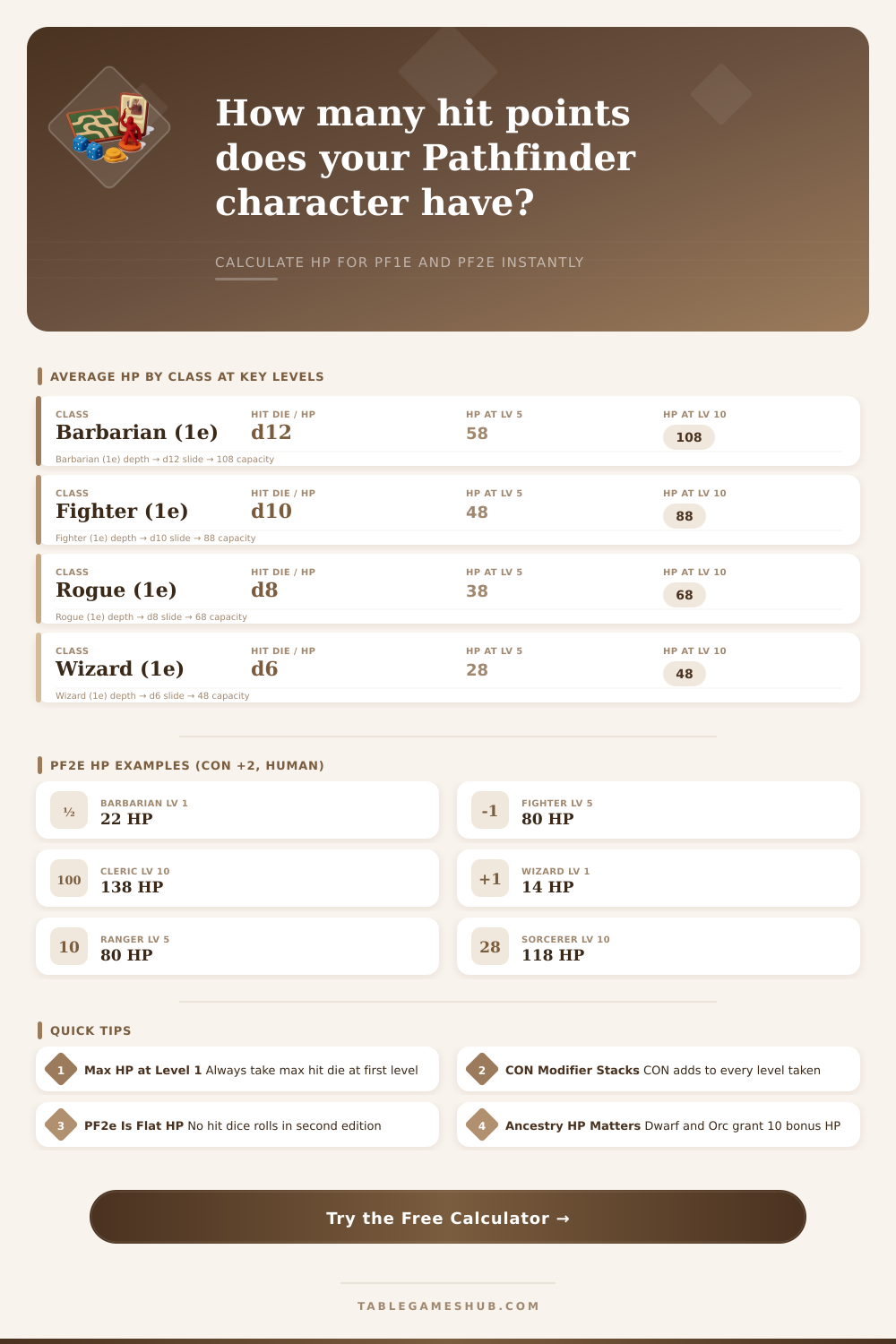
Class Hit Dice & CON Modifier Reference
Class HP at a Glance
❤ Constitution is King
In both editions, your Constitution modifier is added to your HP at every single level. A CON of 16 (+3) gives 60 bonus HP by level 20 in PF1e, making it one of the most impactful stats for any character.
🎯 PF2e vs PF1e Hit Points
PF2e characters generally have higher HP than PF1e due to flat class HP per level plus ancestry HP. A level 5 PF2e Barbarian will have significantly more HP than a PF1e Barbarian, making combat feel more tactical and less swingy.
Hit Points (or HP) is a basic idea in Pathfinder They show how healthy and strong a creature is at a certain moment. Wounds remove those points, and natural or magic cures replace them. Simply said, HP measures how much damage a character or creature can take before it falls or dies.
Your maximum value of HP represents your general health, energy and heroic drive when you are rested. Almost every creature and object has Hit Points. To find the value of a monster, you roll the dice pointed at its Hit Die.
What Are Hit Points (HP) in Pathfinder?
High Constitution gives you more HP and better Fortitude save.
When you create a character, your first amount of HP comes from the total of the racial value and the class base, which is made of your Constitution modifier and a fixed number. Basically, for a new player, HP is your class base plus your Constitution modifire. In the first level, characters usually receive the maximum amount of their HP.
Later, many groups allow using the average value instead of rolling. For instance, a wizard with a d6 would receive 3.5 HP per level.
The averages are these: d4 gives 3 HP, d6 gives 4 HP, d8 gives 5 HP, d10 gives 6 HP and d12 gives 7 HP. Always remember to add the right modifiers at every new level. Most monsters that do not have a class use d8 for their HP, which averages 4.5 each level if they do not have a special bonus.
Pathfinder has clear inflation of hit points compared with older versions. Higher dice give an extra point each level. A good Toughness feat adds yet another point each level.
Moreover, favored class bonus gives another point. Initial HP also can add about six extra points. The result is that some characters can have three more HP each level, plus initial bonuses, compared with the 3.5 edition.
In Pathfinder Second Edition, the system works a bit differently. Characters no longer roll dice for HP. Instead, they receive a fixed amount when they rise in level, and there are no short rests to get points by means of dice.
Characters regain a set amount of HP during a long rest.
The current HP of a monster is usually a secret known only to the GM. Even so, because Pathfinder monsters commonly have a likely number of HP based on their CR, a successful check of the Knowledge skill can help a wise player guess howmany HP stay at the enemy.