🎯 Bust Dart Calculator
Measure checkout risk, finish chance, and safe leaves before you step to the oche.
Bust pressure
Risk rises when the route is long, the leave is awkward, or the rule demands a specific finish.
Risk = route pressure x miss pressure x rule pressure
Checkout chance
Finish odds come from the setup dart, the closing dart, and how well the leave fits the route.
Finish = setup chain x close accuracy x route fit
Safe leave
The best leave is the highest finishable score that still keeps the next visit in a calm lane.
Leave = best valid end score for the rule set
| Measure | Value | Formula | Note |
|---|
| Score band | Route shape | Darts left | Comment |
|---|---|---|---|
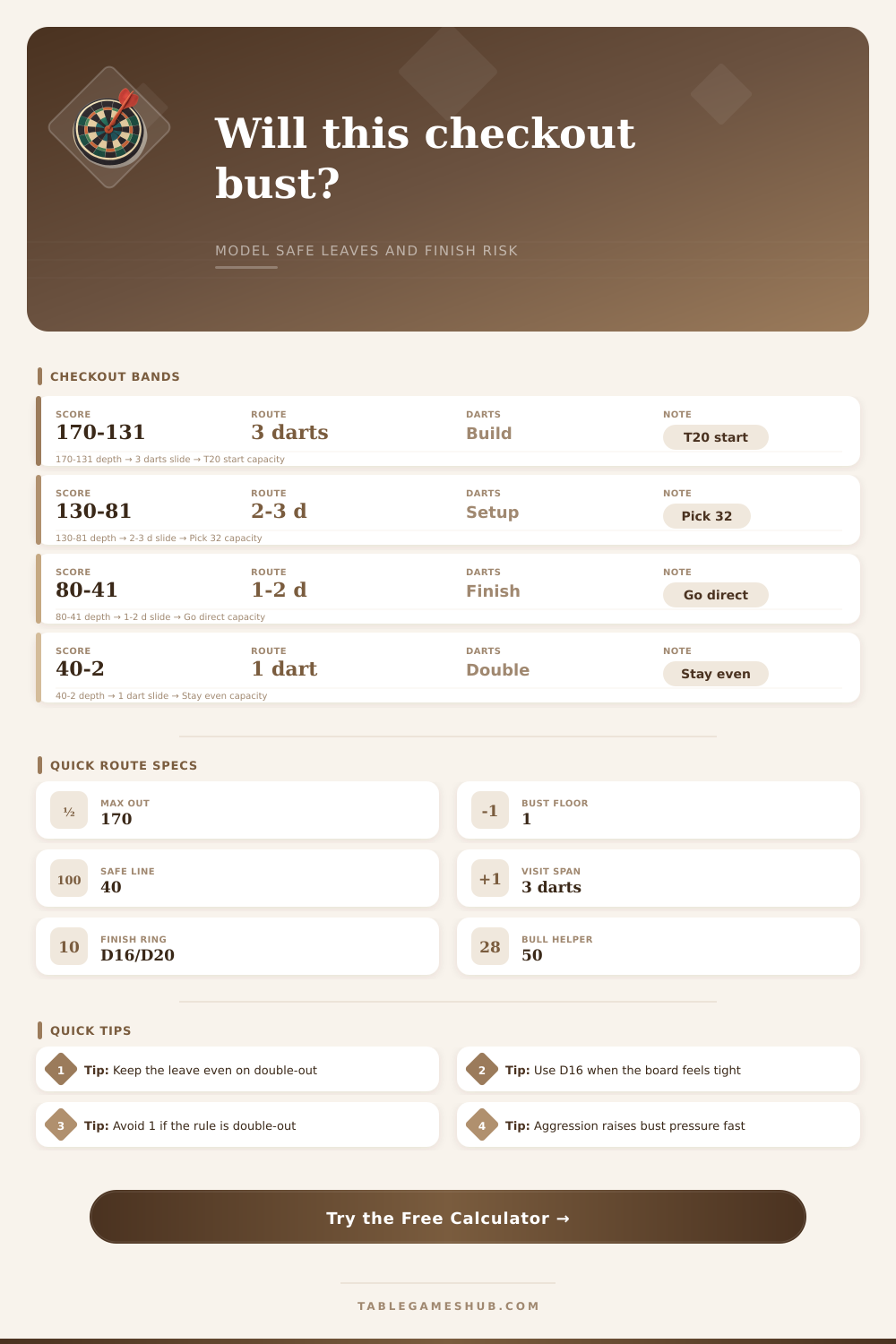
| 170-131 | Treble build | 3 | Big routes need calm setup. |
| 130-81 | Finish setup | 2-3 | Usually one build dart and one close. |
| 80-41 | Finish lane | 1-2 | Direct doubles become realistic. |
| 40-2 | Double zone | 1 | Stay even and avoid the 1 trap. |
| Finish ring | Score value | Best use | Risk note |
|---|---|---|---|
| D20 | 40 | Classic top finish | Great when the board is open. |
| D16 | 32 | Pressure saver | Popular because the lane feels sturdy. |
| D12 | 24 | Low-middle close | Often the cleanest rescue from awkward scores. |
| Bull | 50 | 50 finish | Useful when the route lands in the middle. |
| Rule set | Finish rule | Bust trigger | Use case |
|---|---|---|---|
| Double-out | Finish on a double | 1 or illegal close | Most league and pub legs |
| Master-out | Double or treble | Illegal close only | Faster closing lanes |
| Straight-out | Any exact score | Overshoot only | Friendly or practice legs |
| No rule set | Local house rule | Use your home rule | Custom board nights |
| Route | First dart | Finish ring | Risk profile |
|---|---|---|---|
| Safe | T19 or T16 | D16 or D20 | Lower bust pressure |
| Balanced | T20 or T18 | D20 or D12 | Middle-of-the-road line |
| Aggressive | T20 repeat | Bull or D20 | Big score, bigger swing |
| Rescue | S20 or S16 | D8 or D4 | Used when the score gets awkward |
Protect the even leave
On double-out, a clean even number is usually safer than chasing a fancy score that creates a bust trap.
Pick D16 under heat
If the leg feels tense, D16 and D20 usually keep the route more stable than a flashy bull finish.
Use this bust dart calculator to test checkout risk, compare safe leaves, and see how rule set, target choice, and pressure change the next visit before you throw.
A strategy involving mathematical routes to score zero by hitting a double is the strategy behind darts checkouts. A checkout in darts is the sequence of throws that a player take to finish a game. Furthermore, in order to finish a game, a player must land there dart in a double segment.
As many games includes double-out rules, players must ensure their last dart lands in a double segment. Should a player score more points than the total remaining for the player, they will bust on their turn. Based off the total score remaining on the board, players can determine which mathematical route will best help them land on zero.
How to plan a darts checkout
Scores between 170 and 131 are high scores that require three dart and the use of trebles. Scores in the range of 130 to 81 require a setup dart, which is a throw that will leave a specific double for the next turn. Scores below 80 are considered low scores and can typically be finished direct.
For scores between 0 and 40, players are in pure double territory, as they will have to hit a single number to finish the game on a double. A player’s skill level will impact the strategy that they use to navigate a checkout route. A novice player may be required to account for rescue shots due to their lower accuracy with the dartboard.
In contrast, a league player is likely to hit all of their setup. Checkout routes should account for a player’s hit rate. Furthermore, players can use either an aggressive or safe checkout route.
An aggressive route will attempt to finish the game in the least amount of dart possible. However, the chance of busting will be higher using this route. Using a safe route will provide for the player to leave a manageable score for the next turn; the chance of busting is reduced.
The rules that is set for any given game will impact the checkout route a player chooses. For instance, double-out rules will require a player to hit a double with their last dart. In this case, odd score may be difficult to finish on a double alone.
Master-out rules allow a player to finish on a treble, and master-out rules make the finishing process faster. Straight-out rules allow any segment of the dartboard to count as a finish, and straight-out rules are generally used for casual practice games. Additionally, there is other factor that can impact a player’s accuracy while completing a checkout.
Pressure factors and bailout cushions can help model a player’s accuracy under high tension. Mathematical outputs provide information about the chosen route to checkout on a score in darts. The bust chance tells a player how likely the player is to bust on a checkout.
If the bust chance is high, the route to checkout is volatile. Checkout odds calculates the chance that a player will successfully finish the game based on the player’s accuracy and the difficulty of the leave chosen. The program also calculates a recommended leave for the player to follow to maintain a high chance of successfully finishing the game.
Finally, the expected remainder for a visit provides an estimate of how many points will remain on the dartboard after the player finishes their visit. However, the expected remainder do not account for the chance that the player might bust. The choice of the first dart for players can be critical in some cases.
Using the treble 20 can provide the best score reduction for the player. However, the treble 20 is a difficult segment for players to hit, especially under high tension. Choosing the treble 16 allows the player to have more control over the game.
The treble 16 is a better choice for players who would like to maintain their playing rhythm. The choice of the final double can also have a significant impact on the player’s checkout. The double 16 is the most common final double chosen by players.
However, the double 20 is an aggressive choice for the final double. There are mistake that a player can make during a checkout game. An overly aggressive route for checkout is one mistake that can occur.
If the player follows such a route, they can easily bust on their checkout. However, by following a balanced route to checkout, a player can reduce the chance of a bust while still attempting to finish the game. Through using these mathematical models to calculate the best route for checkout and understanding the different score band on a dartboard, players can make better decisions during a darts match game.