🎳 Bowling Tournament Prize Fund Calculator
Shape payout depth, reserve holdback, and champion weighting before the lane lights come on.
| Line item | Input | Derived | Note |
|---|
| Place | Payout | Share | Shape note |
|---|
| Structure | Champion feel | Tail feel | Best use |
|---|---|---|---|
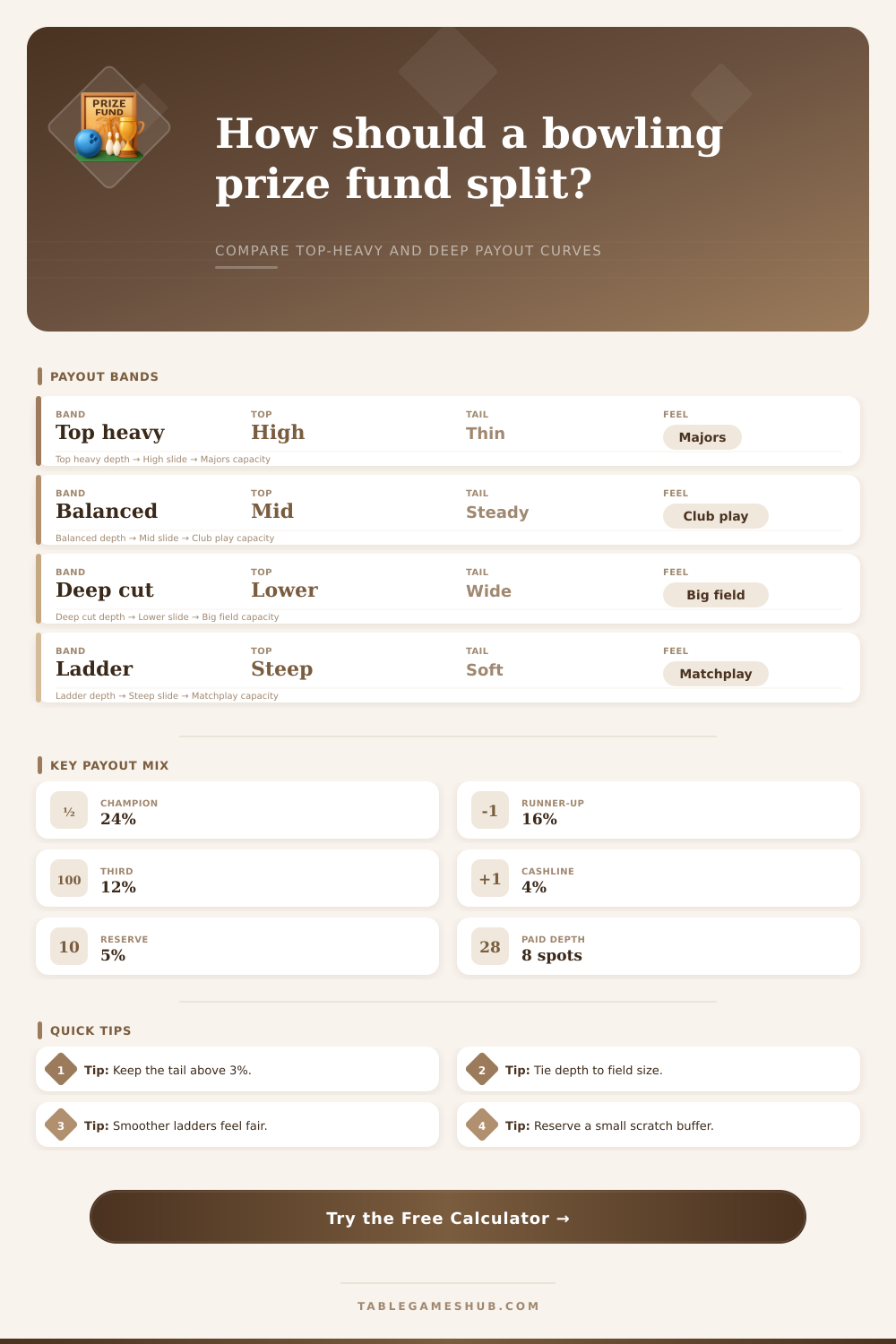
| Top heavy | Very strong | Thin ladder | Majors, stepladders, final pairings |
| Balanced | Clear lead | Moderate depth | Club tournaments and league finals |
| Deep | Less extreme | Wide tail | Large fields with many cash spots |
| Ladder | Sharp peak | Soft finish | Matchplay cuts and seeded brackets |
| Format | Top anchor | Tail anchor | Note |
|---|---|---|---|
| Scratch | High | Moderate | Rewards pure score and tight leaderboard gaps |
| Handicap | Medium | High | Lets the lower seed line stay meaningful |
| Mixed field | Medium | Medium | Good when skill spread is wide but still stable |
| Team event | High | Lower | Use a stronger lead prize and compact tail |
| Field size | Paid rate | Cashline | Shape note |
|---|---|---|---|
| Small | 20-25% | Higher | Keep the ladder short so the field stays focused |
| Medium | 25-33% | Middle | Balanced depth works well for most lane patterns |
| Large | 33-40% | Lower | Use a softer drop so more bowlers stay in range |
| Huge | 40%+ | Lowest | Spread the tail wider and keep rounding controlled |
| Band | Champion | Runner-up | Cashline |
|---|---|---|---|
| Fast peak | 26-30% | 14-18% | 2-4% |
| Stable peak | 22-25% | 15-17% | 4-6% |
| Deep ladder | 18-22% | 14-16% | 5-8% |
| Wide tail | 16-20% | 12-15% | 6-10% |
Protect the cashline
If the last paid spot feels too small, raise the cashline anchor before you widen the field.
Match the format
Handicap and mixed events usually feel better with a softer drop rate and a deeper tail.
Use the breakdown to check the reserve, the ladder shape, and the field pressure together so the payout plan stays clear for bowlers and staff alike.
When you are organizing a bowling tournament, you must create a payout structure for the prize fund that will be awarded to the tournament winners. A payout structure is a plan that determines how much money each of the tournament winners will recieve from the total prize fund that was established for the tournament. For instance, if there is forty bowlers entering your tournament and each bowler pays thirty dollars for entry into the tournament, the total prize fund will be twelve hundred dollars.
This total prize fund must be distributed among the bowlers such that the winner receives a large portion of the prize fund and the other bowlers receive smaller portions. A payout structure can be designed to be top-heavy or deep. A top-heavy payout structure awards most of the prize fund to the first-place winner and the second-place runner-up.
How to Set Prizes for a Bowling Tournament
Such a payout structure is used for major tournaments in order to ensure that there is a large difference between the prize awarded to the winner and the other competitors. However, if the prize structure is too top-heavy, the cashline (the last position to receive a prize) will be too small. If the cashline is too small, the bowlers in the lower prize positions may become dissatisfied with the tournament prizes.
A deep payout structure spreads the total prize fund among a greater number of participants. Deep payout structures is useful for large fields of bowlers since they ensure that more bowlers are interested in entering the tournament. The number of entrants for the tournament will influence the payout structure.
For small tournaments with twenty-four entrants, a steep payout structure will encourage bowlers to exhibit precision in there games. For large tournaments with sixty entrants, you will use a deep prize fund structure to provide breathing room for the number of entrants. The number of paid entrants should be between one-quarter and one-third of the total number of entrants.
If there are too many paid entrants, the prize for the champion will be small. However, if there are too few paid entrants, many of the bowlers may not be motivated to participate in your bowling tournament. The tournament format will also influence the prize structure.
For instance, scratch tournaments award prizes to the highest scores achieved by the bowlers, and such tournaments use a top-heavy prize structure. For handicap tournaments that require participants to use a handicap to even out the skill levels among the entrants, a deeper payout structure is required. Such a payout structure will ensure that the bowlers in the lower positions receive enough prizes to remain competitive and interested in the tournament.
Team tournaments use a top-heavy payout structure since teams want to receive large prizes for winning. However, in tournaments with fields of mixed abilities, the organizer awards a balanced prize structure. A reserve holdback should be used when calculating the prize fund for the bowling tournament.
A reserve holdback is a small portion of the prize fund, usually four or five percent of the total prize fund, that is set aside before prizes are distributed to the top scoring bowlers. This prize holdback can be used to account for unforeseen costs that may occur during the tournament. If there is no reserve holdback, the prize structure may not add up to the total prize fund, and the prize structure may be difficult to manage.
The payout structure can be designed to follow a specific payout curve. A top-heavy payout curve awards the champion a large portion of the prize fund with the other prize winners receiving smaller portions of the prize fund. A balanced payout curve awards the champion the majority of the prize fund but provides a deeper portion of the prize fund to the other prize winners.
A deep payout curve distributes the prize fund in such a way that the champion will receive less of the prize fund than the other prize winners. A ladder payout curve provides a large portion of the prize fund to the champion with a gradual decrease in the portion of the prize fund given to the other prize winners. The champion will receive twenty to thirty percent of the total prize fund, and the cashline will earn two to ten percent of the prize fund.
Common mistakes must be avoided when creating the payout structure for your bowling tournament. Paying the champion too much is a mistake that can be avoided because it may result in the lower prize winners feeling undercompensated for there efforts in the bowling tournament. An attempt to provide equal prizes to all competitors will remove the competitive edge of the bowling tournament.
The payout structure must take into account the number of ties among the bowling tournament competitors because the prize fund can be depleted if there are ties among the competitors without a reserve holdback for prize funds. The ratio between the prize awarded to the champion and the prize awarded to the cashline should be even. A ratio of five to ten times is even for most bowling tournaments.
Any ratio higher than fifteen times may only be seen in professional bowling tournaments. First, determine the prize fund, the number of tournament entrants, and the prize amounts to be awarded to the top contestants. Fine tune the decay rate and the payout structure for the tournament such that the winner is awarded a large portion of the prize fund while the prize awarded to the cashline is sufficient for compensation.
When you make the contestants aware of the prize structure that will be awarded to the top competitors, they will feel as though the tournament is fair to all contestants. The tournament will be fair if the prize structure is mathematically sound and the bowlers feel that the prizes are distributed fair to the top competitors.