📜 Pathfinder 1e Point Buy Calculator
Official Purchase Method for Pathfinder First Edition ability scores
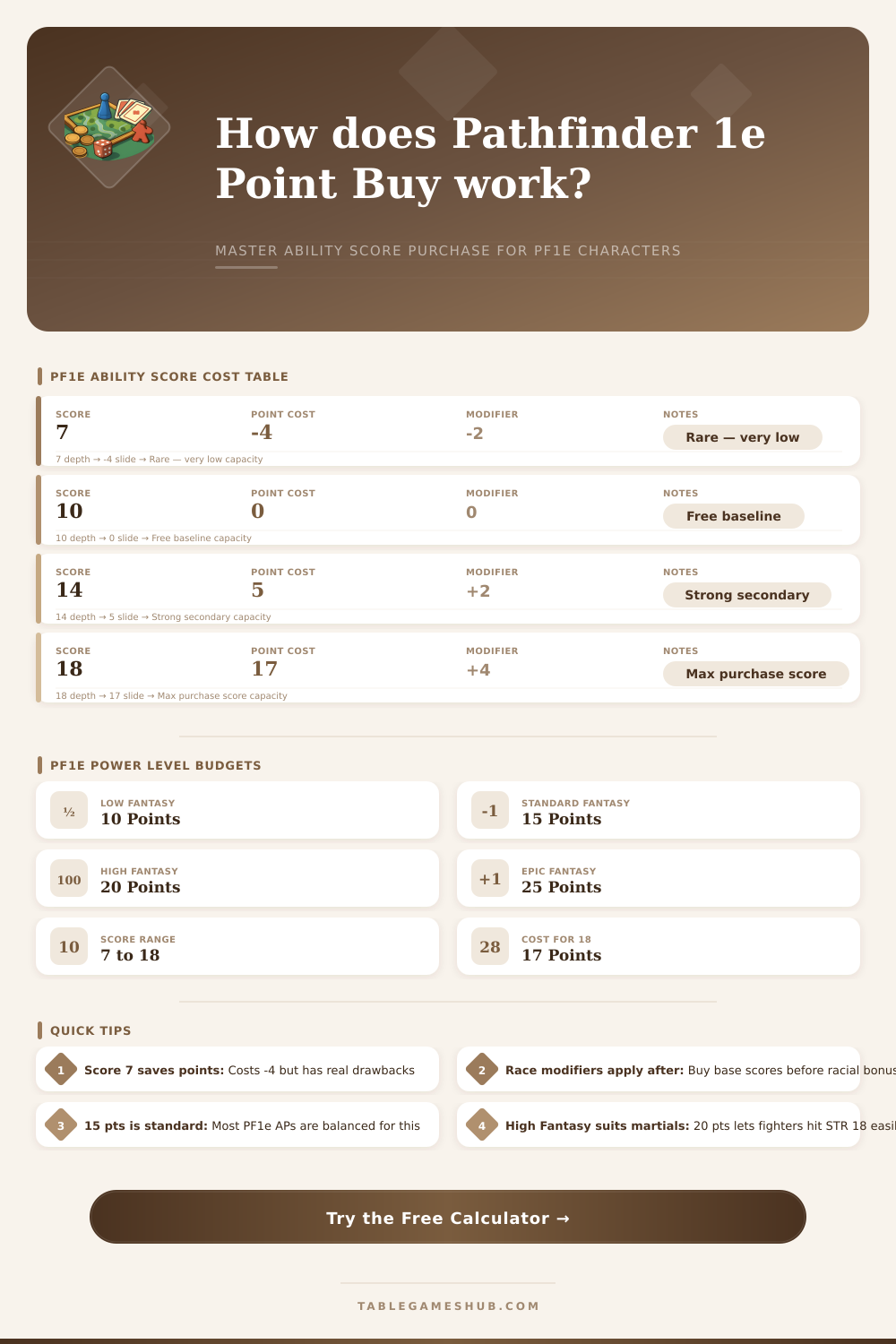
| Score | Point Cost | Modifier | Efficiency Note |
|---|
| Race | STR | DEX | CON | INT | WIS | CHA |
|---|---|---|---|---|---|---|
| Human | +2 to any one ability score of choice | |||||
| Elf | — | +2 | −2 | +2 | — | — |
| Dwarf | — | — | +2 | — | +2 | −2 |
| Halfling | −2 | +2 | — | — | — | +2 |
| Gnome | −2 | — | +2 | — | — | +2 |
| Half-Orc | +2 to any one ability score of choice | |||||
| Half-Elf | +2 to any one ability score of choice | |||||
Pathfinder 1e's purchase method allows buying scores as low as 7 (earning 4 points back) and as high as 18 (costing 17 points). The non-linear cost curve makes every point above 14 increasingly expensive, reflecting the diminishing-returns design philosophy of the d20 System. The default 15-point Standard Fantasy budget was chosen to match the average result of 4d6-drop-lowest while ensuring all players start equal.
In Pathfinder 1e, your primary casting stat (INT for wizard, WIS for cleric, CHA for sorcerer) determines both your highest-level spells and bonus spells per day—making it critical to maximize it. Unlike 5e, PF1e uses a Constitution modifier to determine bonus hit points per die, so CON 14 (+2) is a strong investment for martial classes. Dump stats of 7 or 8 are more punishing in PF1e due to the heavy use of all six ability scores in skill and save calculations.
The system of poent-purchase in Pathfinder 1e is to create character scores. Every player receives a number of points to improve basic attributes. Initially, every attribute has a value of 10.
A character can increase a score by spending points, or lower attributes under the initial value to win more points for other stats
How point-buy works in Pathfinder 1e
The cost for increasing stats grows when the value becomes higher. For instance, going from 11 to 12 costs only 1 point, but moving from 16 to 17 could cost 2 or 3 points. This growing cost means that making a unique stat really high is very expensve.
There are calculators created specifically for Pathfinder and Pathfinder Society. Those tools simplify the math, so that players do not have to trace the costs manually.
The adventure campaigns are balanced around 15 poent-purchase, because you assume that characters will work together as a team and will create combinations. You use 20 poent-purchase when you want to have mighty characters without need of such combinations, similarly to the “drop-in” games of Pathfinder Society or home games where the GM manages a less coordinated group. Because the game started as a port of 3.X, which was designed for 15 points, the developers probably later adapted that to 20 points, especially in newer adventure ways, although it is not clear when exactly that happened.
Some groups even use more points. Using 25 points helps classes that depend on several high attributes. Higher poent-purchase allows you to create heroes that seem more real or low-magic.
Rather, lower poent-purchase does not really alter the balance, it only lowers the success rate of an action by 5 or 10 percent, which is not a big difference. Pathfinder is explicitly designed as a race, where characters get levels and become more capable in their skills while they learn new things.
Poent-purchase urges players to dump some stats, for instance putting 7 in Charisma and 18 in Strength. A wizard with 7 strength will not do physical attacks, and if some one would attack him, his checks probably would fail. Going under 7 theoretically gives an extra point, but then the score could be only 3 for many purposes.
When you see how many various builds exist in Pathfinder, poent-purchase allows each to play whatever they want, and it is much better than rolling. Rolling for stats was popular in the 1980s with the original game, when there were only 4 classes. Some tables use methods like 4d6 dumping the lowest, or even give players a free 18-stat to start.
Commonly, the amounts of poent-purchase at various tables include 32 or 36points.