🏀 Bowling League Prize Fund Calculator
Shape payouts, side pools, and ladder depth for league awards.
| Item | Input | Result | Note |
|---|
| League size | Entries | Slot depth | Shape note |
|---|---|---|---|
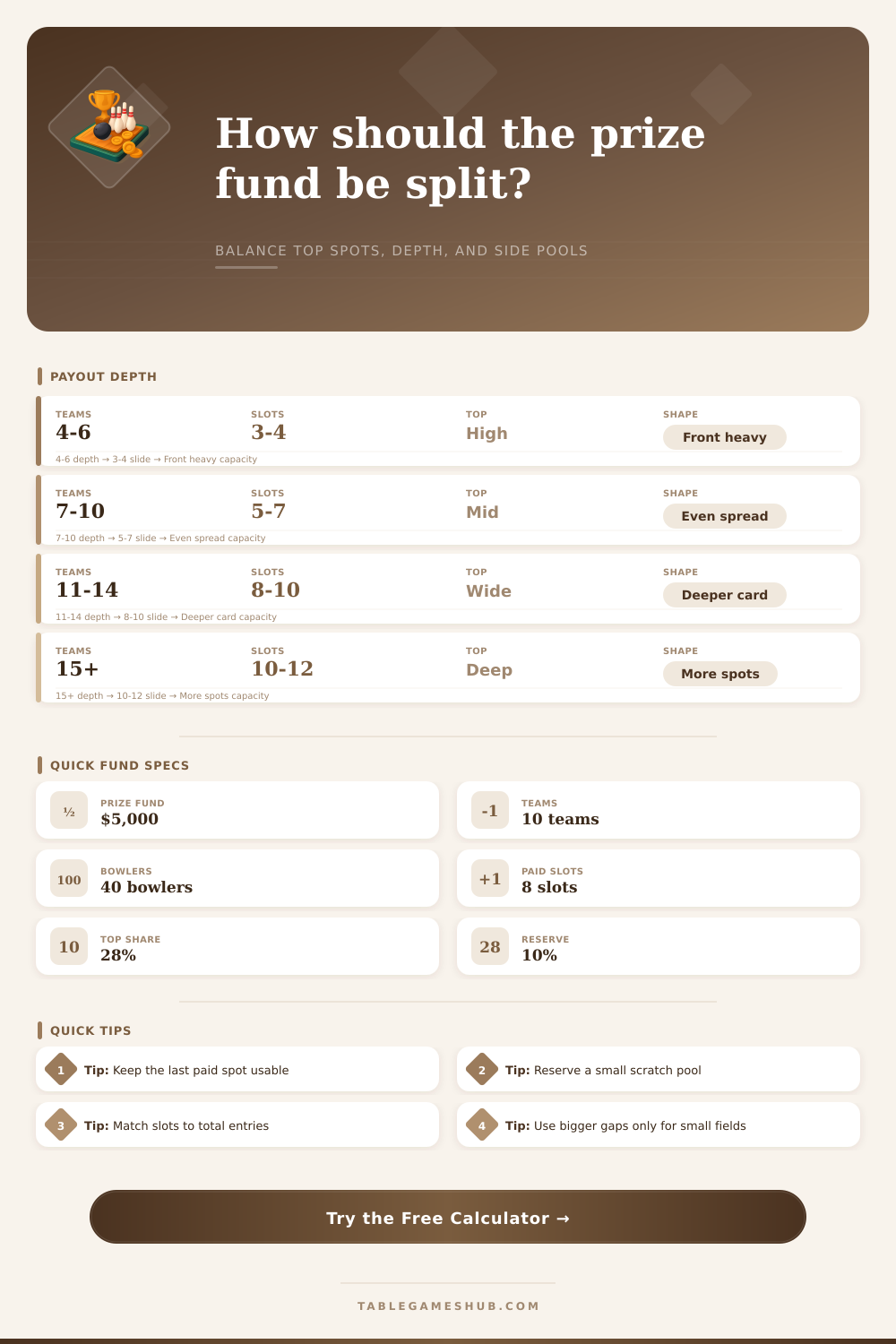
| Small field | 4-6 teams | 3-4 slots | Top heavy |
| Compact league | 7-10 teams | 5-7 slots | Balanced |
| Mid-size mix | 11-14 teams | 8-10 slots | Deeper ladder |
| Large field | 15+ teams | 10-12 slots | Wider spread |
| Curve | Top share | Middle share | Floor feel |
|---|---|---|---|
| Flat ladder | Light top | Close gaps | Strong floor |
| Balanced | Even top | Smooth middle | Clear floor |
| Front-loaded | Heavy top | Steeper middle | Low floor |
| Championship | Winner focus | Wide spread | Sharp floor |
| Avg game | Cap | Handicap | Use case |
|---|---|---|---|
| 170-179 | 90 pins | 31-50 pins | Wide mix |
| 180-189 | 85 pins | 21-40 pins | Tight mix |
| 190-199 | 75 pins | 11-30 pins | Clean pace |
| 200+ | 65 pins | 0-20 pins | Scratch lean |
| Pool type | Share | Signal | Note |
|---|---|---|---|
| Ladder | 60-80% | Main path | Primary award line |
| Scratch | 5-15% | Bonus | Performance side pot |
| Reserve | 5-10% | Buffer | Keep room for finals |
| Special | 0-10% | Add-on | Optional extras |
Protect the floor
If the last paid spot is too tiny, the ladder feels shallow even when the top prize looks strong.
Keep a side buffer
Scratch and reserve pools help you handle finals, specials, or late league changes without breaking the ladder.
Use this bowling league prize fund calculator to balance top awards, side pools, and handicap context so your payout plan stays clear, fair, and easy to explain.
To distribute the prize funds collected from entry fees to the bowlers in a manner that encourage them to continue to compete in the league for an upcoming seasons. If too much of the prize money is given to the winner of the bowling season, it can make the prize structure feel exclusive to those with high average. If too even of a distribution of prize money is used, however, the prize structure may not encourage bowlers to compete against each other during their seasons.
One of the main factor to consider in determining how to distribute the prize money is the size of the bowling league. For leagues with relatively few teams, such as those with four or six teams in the league, a front heave distribution of prize money should be used. For leagues with many teams, such as leagues with ten or more participating teams, a wider distribution model should be used for prize money.
How to Divide Prize Money in a Bowling League
Side pools can be used to distribute the prize money within the bowling league. A scratch side pool can be established for teams that want to recognize those with the highest raw scores, regardless of average. A reserve side pool can be created for situations where prize money must be allocated outside from the prize distribution for the teams.
The total amount of prize money within these side pools should not be too large, or the teams that place within the bowling league wont have enough prize money to motivate them to continue to compete within the league. The use of high handicap caps for the teams allow for those with low bowling averages to compete against other teams with higher averages. The use of low handicap caps means that each team will behave as if it were a scratch league, where high averages is required to succeed in the league.
These settings can help to indicate whether prize money should reward skilled bowlers or attendance in the league. The target for how top heave the prize money should be distributed can be used to determine how the prize money should be distributed to those who place in the bowling league. Using a top heave target of 30%, for instance, means that the champion will win a majority of the prize money, while those that place in the middle will win smaller amount of prize money.
A higher top heave target will increase the amount of prize money that goes to the winner, but will decrease the amount of prize money for those in the middle. Another factor to consider is the floor amount for prize money, or the amount of prize money given to the final position of teams that place in the bowling league. If the floor amount for prize money is too low, it is possible that the teams will become dissatisfied with the prize money awarded to them.
Common pitfalls in the distribution of prize money include not accounting for the total number of bowlers within the league. The total number of entries within the bowling league is calculated by multiplying the number of teams within the league by the number of bowlers within each of those teams. Additionally, another pitfall is failing to calculate the amount of prize money that should be awarded to each bowler within the league.
The total prize money divided by the number of bowler entries within the league will determine the amount of prize money to be awarded to each bowler. This amount should of been sufficient to motivate the bowlers to continue to compete in the league. The format in which the league will compete can have an impact on how the prize money within the league is distributed.
If the league uses a scratch format, the prize money will be awarded independently of the average of each bowler. In a handicap format, prize money can be awarded according to the skill of each bowler. A mixed format combines both scratch and handicap competition formats.
However, no matter the competition format within the league, the floor amount for prize money should be protected. A higher prize money floor amount will encourage teams to compete in the league and register for the upcoming season.