🧙 Pathfinder 2e Encounter Calculator
Build balanced encounters with XP budgets & threat levels
| Creature Level vs Party | XP Each | Role | Suggested Count |
|---|---|---|---|
| PL – 4 | 10 | Lackey | 6 – 8 |
| PL – 3 | 15 | Low Lackey | 4 – 6 |
| PL – 2 | 20 | Low | 3 – 4 |
| PL – 1 | 30 | Moderate | 2 – 3 |
| Party Level | 40 | Standard | 2 |
| PL + 1 | 60 | Tough | 1 – 2 |
| PL + 2 | 80 | Elite | 1 |
| PL + 3 | 120 | Boss | 1 |
| PL + 4 | 160 | Extreme Boss | 1 |
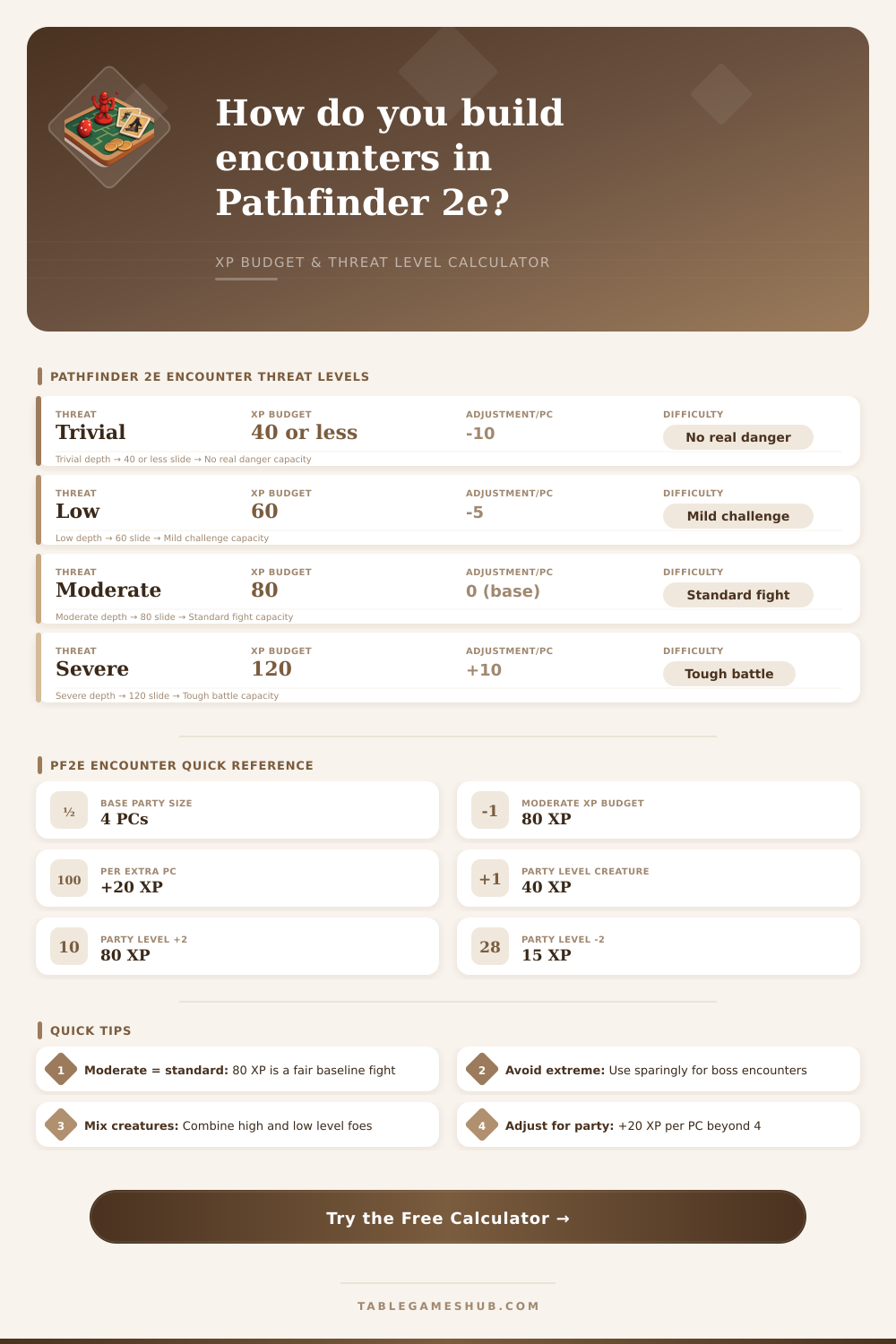
| Threat | XP Budget | Character Adjustment | Description |
|---|---|---|---|
| Trivial | 40 or less | –10 per PC | Poses no real danger |
| Low | 60 | –5 per PC | Minor challenge, little risk |
| Moderate | 80 | 0 (base) | Fair fight, some risk |
| Severe | 120 | +10 per PC | Dangerous, resources drained |
| Extreme | 160 | +20 per PC | Potentially lethal |
Pathfinder is a tabletop RPG based on the rules of Dungeons & Dragons 3.5. It is like classic games as Baldur’s Gate and Neverwinter Nights During adventures, there will be times when a simple skill check is not enough to solve a challenge… For instance, when scary monsters block the way and the only option is fight.
Encounters are the heart of every adventure. An encounter is an event that presents a specific problem to the PCs that they must solve. Mostly these are fights against monsters or hostile NPCs, but there are other types, like trapped halls or political talks with a suspicious person.
How to Make Encounters in Pathfinder
Heroes team up to beat monsters, avoid traps and corner villains. If something interesting happens while they walk through the city, and the group spends “screen time” on it, it counts as an encounter. Pathfinder uses the terms “combat encounter” and “roleplaying encounter“, but it does not define them very clearly.
When you build a combat encounter, the first step is to decide how it fits in the general adventure. Later, you estimate the level of threat using one of five categories. Trivial encounters are so easy that the characters almost cannot lose.
The Challenge Ratings in Pathfinder assume a group of four players, and the APL system is based on that same idea. For an encounter to be balanced between the players and the monsters, the proper CR is APL+4.
Extra players can really unbalence the encounters, even at level one. Some fast but not perfect ways to fix that are to increase the number of monsters or raise their Hit Dice and Hit Points. A slightly gentler method would be to increase the CR of the encounter by one or two points or add helpers to the monsters.
There are tools that allow you to build encounters quickly and easily. They have filters and all info about the creatures, and some even allow you to print the encounter sheet. Modern generators help with the huge datebase of Pathfinder, with 4000 monsters, 7000 items and 3000 spells.
The rules for building encounters in Pathfinder 2e are simple and reliable.
Random encounters also can spice up the play. At the start of every day of exploration, you roll a die and compare it with the terrain type in the table of random encounters. If the roll is a success, the players meet something, and on a critical success, they meet two things.
In Pathfinder 2e, you use a d20 to see whether an encounter happens, followed by a d10 to determine the type, harmless, dangerous or creature, and a final d20 roll based on the table of the area. One fun idea is to start with a trivial encounter, like bandits on the road, so that the players get comfortable, and later have an owlbear rush in and hurt everyone.