⚔ Pathfinder Point Buy Calculator
Pathfinder 1e ability score purchase method — all power levels, races & class presets
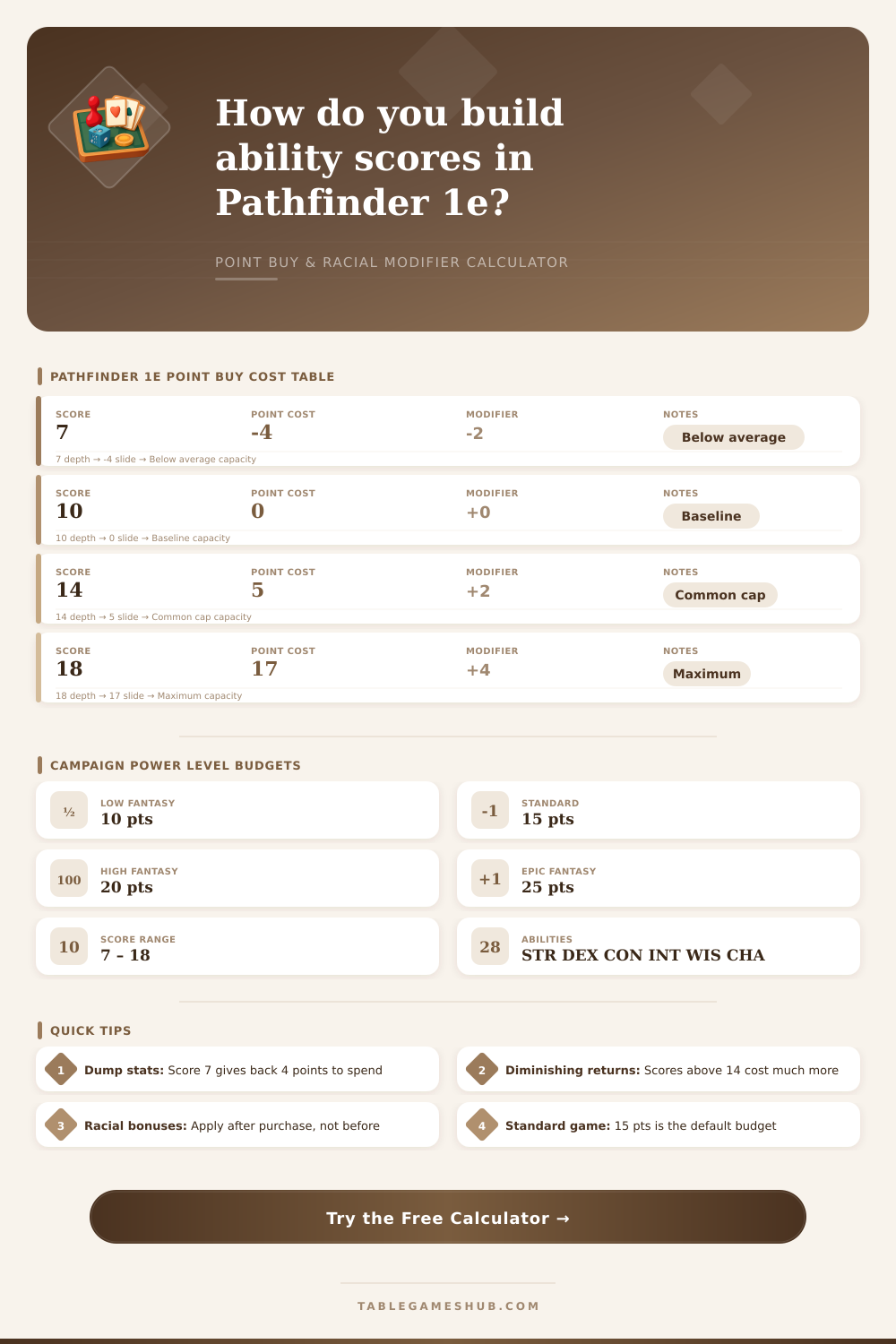
| Score | Point Cost | Modifier | Notes |
|---|---|---|---|
| 7 | -4 | -2 | Below average (dump stat) |
| 8 | -2 | -1 | Below average |
| 9 | -1 | -1 | Slightly below average |
| 10 | 0 | +0 | Baseline (free) |
| 11 | 1 | +0 | Slightly above baseline |
| 12 | 2 | +1 | Above average |
| 13 | 3 | +1 | Above average |
| 14 | 5 | +2 | Good primary stat |
| 15 | 7 | +2 | Good primary stat |
| 16 | 10 | +3 | Costly — primary focus |
| 17 | 13 | +3 | Very costly |
| 18 | 17 | +4 | Maximum purchasable |
The system of point buy in Pathfinder is basically how you build the scores of your character. You start with everything at 10 and then spend points to improve stats or reduce others to free more points. It is different than ability boosts, here you trade points between the stats.
The total that you invest determines the final values and there is a hard limit at 18 for any skill when you first create your character
How Point Buy Builds Your Pathfinder Character
What makes this system attractive is the flexibility that it gives without everything in chaos. Instead of rolling dice and hoping for the best result, you receive a set number of points to distribute as you want. Even so, because you want to be strong in some stats, you will have to sacrifice something else.
That keeps the group balanced and stops you from having godlike power while another ends up with teribla results.
The community of Pathfinder found some standards over time. A 15-point buy is called “Standard Fantasy,” while 20 points are “High Fantasy.” Most of the old Adventure Paths were created for 15 points, part because they were from the times of 3.5, that lasted longer than they should. Currently, 20 points are the most common choice, and usually you use soft limits to avoid too weird builds.
When you have 20 points, your character is quite solid. But jump to 25 opens real room for your concept. If you go to 30, things become even freer, you start to see characters that are competent even without magic.

The higher your budget, the better you can create classes that require several strong stats. Adventure Paths assume 15 points because they expect the team to work together. But when you play something as Pathfinder Society, where characters do not know each other, 20 points allow each to feel strong.
There was a big debate in the forums of Paizo. With 678 messages, about whether 15 points were a fair amount. People talked about various causes, especially about death.
At 15 points, characters die more commonly and that feels more severe than when you use 20.
Here is something you must consider: leave at least one skill odd to get more from your budget. Even so, low stats under 7 do not genuinely help you a lot. A wizard with 7 strength does not throw punches, so it could be even 3 for all practical targets.
Online calculators made point buy quite simple. You do not need to count all numbers by hand when tools can do that for you. Even so, deciding between 15 and 10 or 16 and 9 for your character can be difficult.
New players especially do not have a reference for such decisions. Ranking the six stats feels simpler than juggling indefinite combinations. Interestingly, the choice between dice or points cause fewer conflicts in Pathfinder than it does in 5e.