Okey 101 Score Calculator
Score a 101 Okey round with opening floor checks, double-open mode, rack points, joker relief, opponent penalties, round multipliers, and closing bonuses.
Net round score
+191
Positive means this round helped you.
Your penalty
11
Rack after joker relief, before multiplier.
Open status
Open
Threshold coverage for table open.
Per opponent swing
+48
Average gain against the other seats.
| Open type | Usual requirement | Calculator handling | Table note |
|---|---|---|---|
| Standard meld open | 101+ meld points | Uses threshold input | Runs and sets count by tile face |
| Raised table floor | 110 to 151 points | Enter the local floor | Useful for house variants |
| Double-open pairs | Pair layout declared | Adds double status bonus | Score it separately from meld open |
| Unopened player | No valid reveal | Applies rack cap pressure | Change cap by editing rack points |
| Penalty item | Default value | Where entered | Effect |
|---|---|---|---|
| Rack remainder | 0 to 202 | Hand remaining points | Subtracts from net score |
| Joker relief | 25 each | Joker count | Reduces your rack penalty |
| Opponent pool | Combined total | Opponent penalties | Adds to your round swing |
| Finish bonus | 0, 50, or 101 | Finishing bonus | Adds if you close the round |
| Multiplier | When used | Score impact | Practical check |
|---|---|---|---|
| x1 normal | Regular round | Base totals unchanged | Best for casual logs |
| x2 penalty | Table penalty round | Doubles all round swings | Confirm before dealing |
| x3 pressure | Local comeback rule | Triples gains and losses | Volatile with unopened racks |
| x4 double-stack | House-only variant | Quadruple exposure | Use only if everyone agrees |
| Scenario | Your rack | Opponent pool | Likely read |
|---|---|---|---|
| Clean closer | 0 to 15 | 100+ | Strong winning swing |
| Late opener | 30 to 70 | 80 to 160 | Positive if opponents are heavier |
| Double attempt miss | 80+ | Low pool | High exposure round |
| Unopened rack | 101+ | Any pool | Cap or multiplier may decide it |
Risk management is well executed, but then somebody slams their tiles down on the table and declares the pot. Suddenly the game has changed. A single player’s decision to open the table have shifted things around.
This moment will often lead casual Okey players into arguments about score sheets and debating whether they should of opened their hand or not. It usually boils down to two thing, what’s the threshold for going public and how do you calculate the penalty if it all turns to chaos at the end of the round? You need a clear scoring mechanism at your table to resolve these issues without killing pace of play.
Simple Guide to Okey Scoring Rules
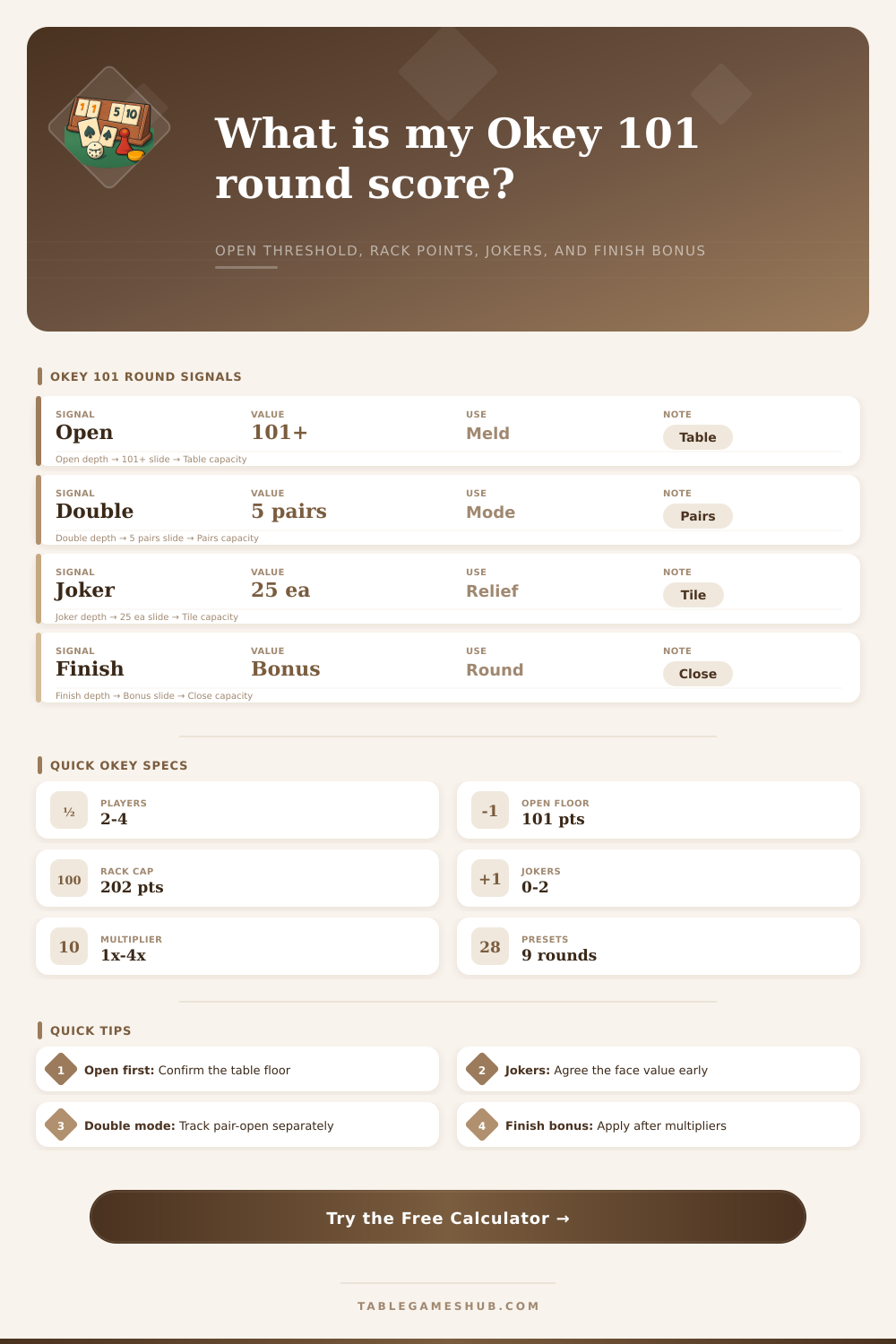
To get a handle on the math, let’s first review how opening floor works. For most typical tables, you must have at least 101 points in melds before you are allowed to show your hand to everyone. That’s mainly because they don’t want people going public with a poor hand that neither threatens them nor offers an opportunity for victory. By opening prematurely, you risk large penalties should another player reach the finish line ahead of you.
The calculator above takes care of all the math for you after you input your table’s unique set of rules. You no longer have to calculate in your head whether or not your melds satisfies the minimum requirement. You will have no more guesswork. You can just focus on the tiles… And leave the arithmetic of winning to the calculator.
The other complication that has tripped players up when it comes to scoring is jokers. While these are some serious wildcard cards that can absorbs gaps in a difficult sequence, they come at a steep price should you not win the round. Depending on what variation you’re playing, any jokers remaining in your hands after the round ends will cost you twenty-five points each. This is not bad on its own, but it becomes even worse when combined with escalating rounds or additional house rules that increases the penalty.
You’ll want to take a risk and hold back a joker for a do-or-die play, but the longer you wait to play the greater the risk. How much you think that one tile will cost you if you lose may help you determine if it’s still worth the reward.
Things get interesting when considering opponent penalties and multipliers. At the end of each round, it’s not just about who has the lowest score left on their rack but also what others might hold. You can easily find yourself ahead by a lot, even if you don’t have the lowest score yourself. That’s because everyone else holds a bunch of high numbered tiles. The Zero-Sum game of Okey ensures that your opponents’ terrible rounds becomes yours… As long as you haven’t opened too early and you’re keeping it under the cap.
The reference table on this page shows how much multipliers changes the final score difference between players.
Some house variations add extra challenges, such as double-open mode and raised floors, which can make it hard to go public. The idea here is to make things tougher and more tense… Plus there’s a payoff for being patient! But this means you must pay closer attention to scores. You might assume you have enough to win, only to find out too late that you need a higher score or that your house has different meld. House rules can start arguments if they are not understood properley. Keep the rules clear and agree on them before the deal. Maintain a record of who owes what, when, and how penalties will be enforced.
Okey 101 scoring is less about complex calculations and more about good communication. With basic multiplier points or detailed joker point deductions, the rules are clear: Let’s keep the score, and keep the action going. Knowing the cost of your hand in relation to the floor, and how much risk a wild card adds, helps you make smarter calls at the table. It gets you from guesswork to strategy, and makes your next round not just a free-for-all of throwing tiles, but a tense duel between skill and nerves. When somebody breaks the seal, everybody knows who paid and how much they owed.