♟ Chess960 Position Number Calculator
Convert SP numbers to legal back ranks, validate manual layouts, build seeded starts, compare mirrored positions, and inspect Chess960 castling lanes.
| Step | Output | Formula or validation | Note |
|---|
| Placement stage | Choices | Index math | Calculator output |
|---|---|---|---|
| Light-square bishop | b, d, f, h | number mod 4 | First bishop file and color pass. |
| Dark-square bishop | a, c, e, g | floor(number / 4) mod 4 | Second bishop file and color pass. |
| Queen | One of six empty files | floor(number / 16) mod 6 | Queen file after bishops are placed. |
| Knights | Two of five empty files | floor(number / 96) mod 10 | Knight pair from ordered combinations. |
| Rooks and king | Three remaining files | R, K, R left to right | Rook and king starts plus castling lanes. |
| Validation rule | Required count | Why it matters | Failure message |
|---|---|---|---|
| Piece inventory | R2 N2 B2 Q1 K1 | Every first-rank setup uses normal chess material. | Manual rank has missing or extra pieces. |
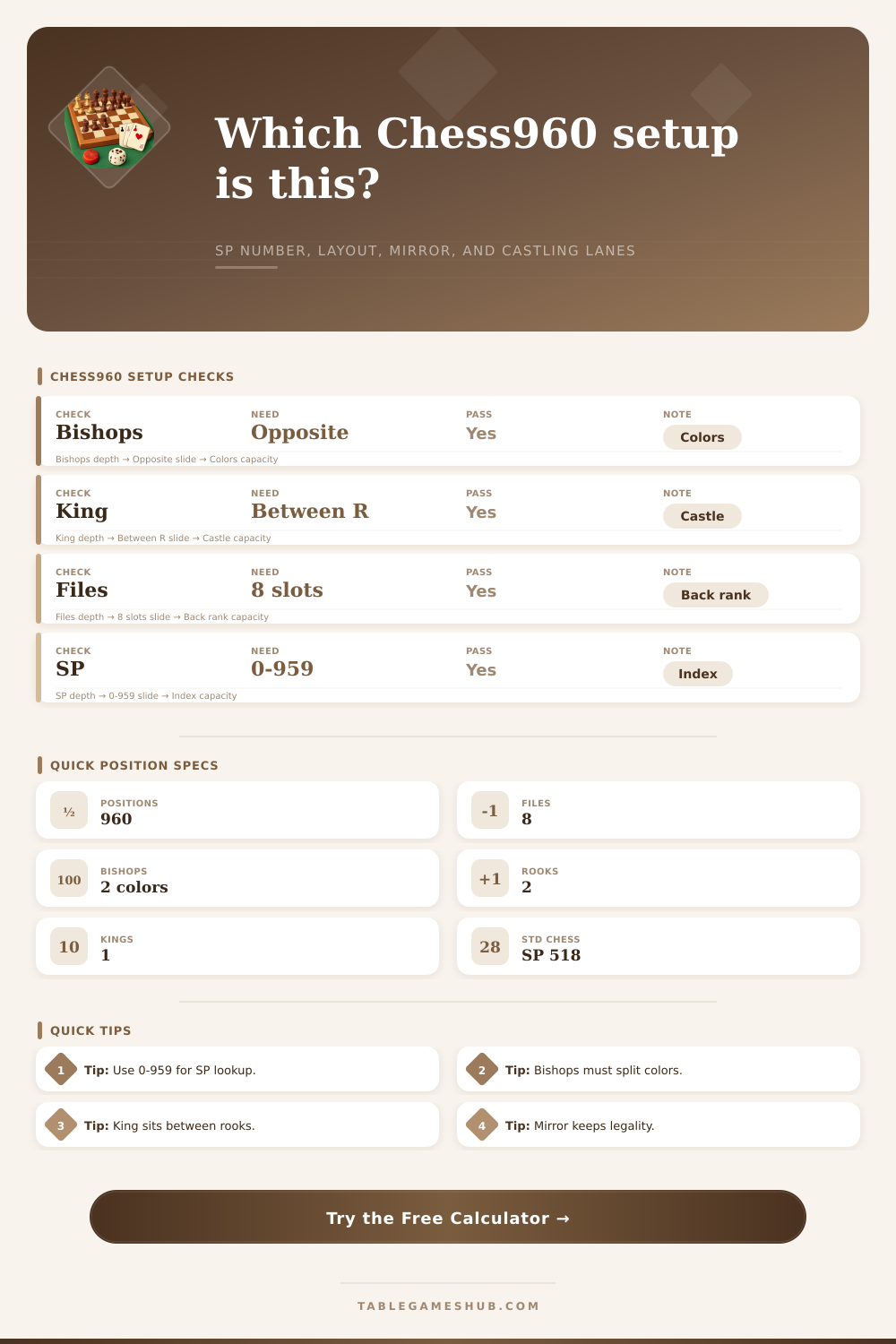
| Bishop colors | One light, one dark | Chess960 keeps opposite-color bishops in every setup. | Bishops are on the same color. |
| King position | Between both rooks | Castling must remain possible on both sides. | King is not between rooks. |
| Rank length | Eight files | Files a through h must all be occupied. | Rank must contain exactly eight letters. |
| Allowed letters | R, N, B, Q, K | No pawns or empty files appear in the back rank code. | Only R, N, B, Q, K are allowed. |
| Castling side | King final file | Rook final file | Lane interpretation |
|---|---|---|---|
| Kingside castling | g-file | f-file | King and kingside rook finish as in classical O-O. |
| Queenside castling | c-file | d-file | King and queenside rook finish as in classical O-O-O. |
| Rook already final | c or g applies | d or f may match start | The final squares are fixed even if a piece starts there. |
| King already final | c or g may match start | Rook still completes final lane | Chess960 notation can look unusual but uses fixed destinations. |
| Lane blockers | Calculator lists files | Pieces must clear between start and final squares | Use the lane report to prepare an arbiter card. |
| Comparison | Classical chess | Chess960 | Lookup note |
|---|---|---|---|
| Back-rank variety | One arrangement | 960 arrangements | Standard chess is included as one legal Chess960 position. |
| Position number | Usually not needed | SP number identifies layout | Calculator accepts zero-based and one-based display. |
| Castling finals | King to g or c | King to g or c | Destinations are identical; starts may differ. |
| Bishop rule | Opposite colors by layout | Opposite colors by generation | Manual validator catches same-color bishop errors. |
| Mirror lookup | Same type of board | Often different SP number | Mirror output helps compare left-right reversed starts. |
SP number alignment
Use zero-based SP 0-959 for strict lookup tables. If an event sheet lists 1-960, switch the display selector so the same layout maps correctly.
Castling card check
Write king start, rook starts, and final c/d/f/g files on the pairing sheet. It prevents confusion when a rook or king begins near its final square.
Chess960 is a version of chess where the starting position of the pieces change for every game. Instead of always starting on the same square, the pieces start in 960 different legal arrangement. Because of the different starting position for the pieces, a system are used to label each position with a number.
This system of numbers is necessary for labelling each position instead of writing out the position of all of the piece. The system of numbers is used to represent the exact placement of all of the pieces on a chess board at the start of the game. Each of the 960 positions are legal according to two rules: the bishops must start on opposite colors of the board, and the king must start between the two rooks.
Chess960 Starting Positions and Numbers
All of the other pieces just fill in the remaining square. The number representing the position of the pieces is create by noting the choice of each of the pieces in the description of the position. This number can be used to record the position during a tournament, or to seed a draw of a chess game from a previous time that the game was play.
There are three different modes that can be used on the calculator to determine the numbers for each of the Chess960 positions. One mode will expand a position number into the arrangement of the back rank of the chess board. Another mode will take an arrangement of the back rank and determine its number if it is a legal arrangement.
The third mode will use a short phrase to create a number within the 960-slot range of possible starting positions, enabling a club to seed a draw. Each of these mode use the same rules for the pieces. The designer uses the rules for the bishops and the king to create an environment that is balanced for both player.
If the bishops were to always start on the same color of the chess board, then one side would always have an advantage in the number of squares that it could reach with the bishop. If the king were not required to start between the two rooks, then it would be impossible to castle on one side of the board. By enforcing these rules, the designer of Chess960 ensured that each player had an equal chance of winning the game.
Because the starting files of the pieces is different for each game, the castling rules has changed for Chess960. The king will still end on the g-file for kingside castling, and will end on the c-file for queenside castling. However, the rook may not start on the same square for each player as it does for standard chess.
The player must know which files to which the king and rook will travel to determine if any pieces must be moved prior to performing castling. The calculator can display the start files for each of the rooks and the end files for each of the castling lane. Positions can be mirrored on a chess board to create a new arrangement of the chess pieces.
The number for a mirrored position will not typically be the original position number with a plus or minus number. A player that is studying one side of the board may encounter a mirrored position. In such a game, the strategy learned on that side of the board will not apply to that mirrored position.
The chess calculator can be used to determine both the number of the original position and the mirrored position. Players often make mistake when attempting to shorten the process of writing out the position of the pieces. One common mistake is to place both bishops on the same color of the chess board.
In such a case, a bishop will be unable to access half of the square on the chess board. Another common mistake is to place the king on one of the end files of the chess board. In such a case, castling on one side of the board may be impossible.
However, these mistake can be avoided by including the validation of the position as part of the process of recording the position of the pieces. Another use of the position number is to keep records of the games that are play over long periods of time. The records of the numbers of the positions can reveal patterns within the games that are played during a given season by a league.
For instance, a coach can use the position numbers to determine if a player struggle with positions in which the queen starts on the b-file, and to create a training program to focus upon these files for that player. The numbering system for Chess960 positions changes the way that a player study the opening of the game. Instead of memorizing the moves for each opening, a player learns the principles of the game.
The advantage of the game go to the player that can adapt to the new positions rather than the player that memorizes the moves for each possible starting position. The designers of Chess960 created the system of numbering each position in order to provide advantage to the adaptation of the game. Thus, while the number itself is simply a label for a position, the label is important in that it indicates the position that each player must play to win the game.