Ticket to Ride Route Length Calculator
Score a claimed route, test card readiness, add destination ticket support, and compare map variants before committing train pieces.
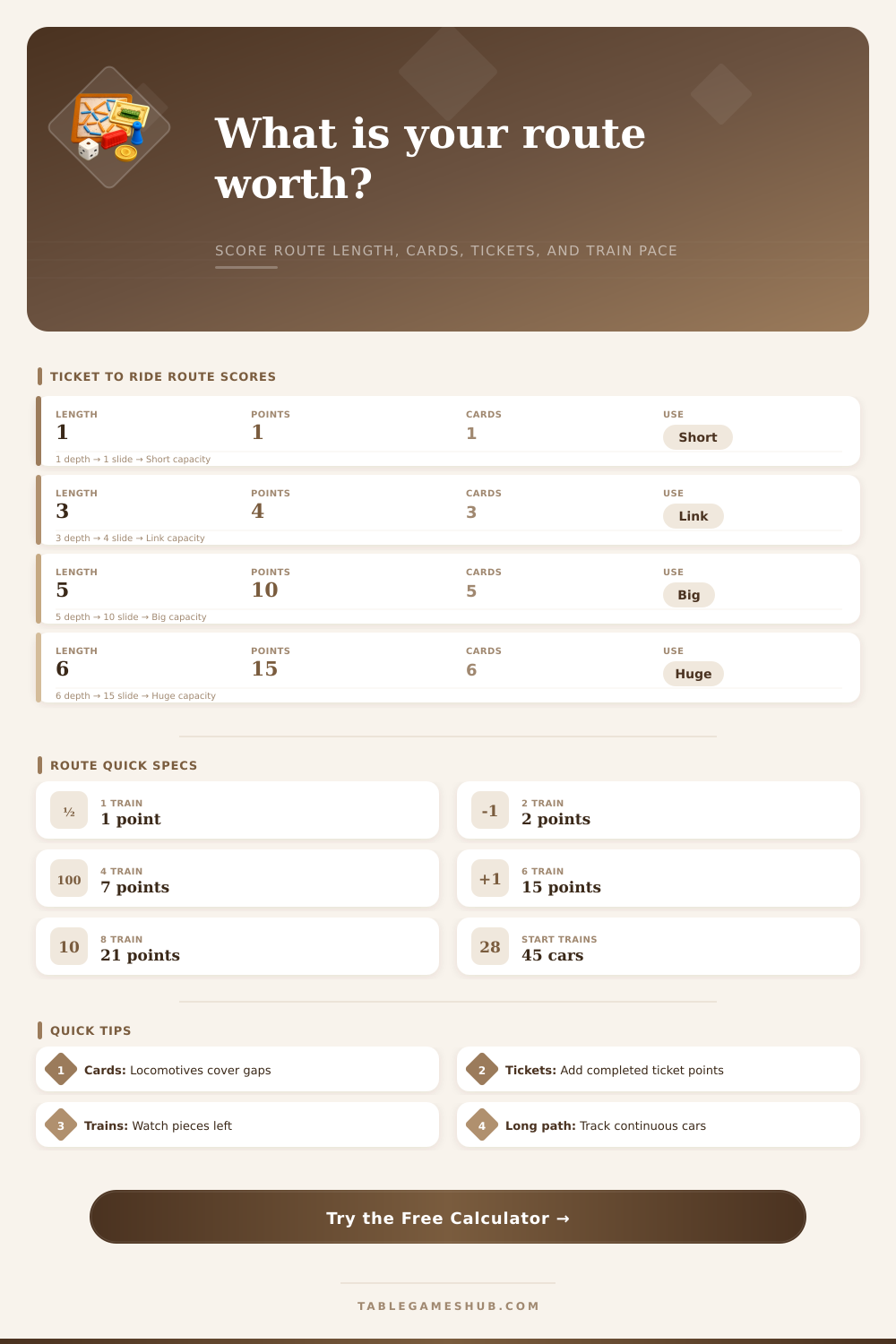
| Route Length | Printed Score | Point Per Train | Typical Use |
|---|---|---|---|
| 1 train car | 1 point | 1.00 | Short link, station approach, or final city connection |
| 2 train cars | 2 points | 1.00 | Flexible connector for finishing tight ticket paths |
| 3 train cars | 4 points | 1.33 | Efficient mid-board extension without heavy card delay |
| 4 train cars | 7 points | 1.75 | Strong scoring route that still fits most train reserves |
| 5 train cars | 10 points | 2.00 | High-impact route that often defines a ticket lane |
| 6 train cars | 15 points | 2.50 | Classic big route, excellent when cards are already ready |
| 8 train cars | 21 points | 2.63 | Map-specific long route such as Europe expansion-style boards |
| Requirement | Cards Needed | Locomotive Role | Calculator Treatment |
|---|---|---|---|
| Colored route | Same color as route length | Optional wild card | Matching cards plus locomotives must reach route length |
| Grey route | One chosen color set | Optional wild card | Uses matching count as the chosen color set |
| Ferry route | Route length cards total | Some icons mandatory | Required locomotive icons must be covered first |
| Tunnel route | Base route length plus draw risk | Optional wild card | Adds a readiness caution for Europe tunnel routes |
| Sea route | Ship cards on Rails and Sails | May use ship wilds | Applies lower train reserve pressure on mixed maps |
| Map Variant | Starting Pieces | Route Planning Factor | Calculator Adjustment |
|---|---|---|---|
| USA / Classic | 45 trains | Longest route and dense central links | Standard scoring and train pressure |
| Europe | 45 trains | Tunnels, ferries, and stations | Adds tunnel caution when route type is tunnel |
| Switzerland | 40 trains | Mountain routes and country tickets | Higher train pressure with fewer pieces |
| Nordic Countries | 40 trains | Ferries and tight player count | Mandatory locomotive pressure matters more |
| Team Asia | 45 trains | Shared team routes and hidden cards | Marks long route value as team path support |
| Rails and Sails | Mixed pieces | Train and ship route planning | Uses mixed-route caution and sea lane label |
| City Maps | 15 to 20 pieces | Shorter route network | Amplifies end-game trigger warning |
| Check | Formula | Positive Signal | Warning Signal |
|---|---|---|---|
| Net ticket swing | Completed ticket points minus unfinished penalties | Target route supports multiple tickets | Route does not repair an unfinished ticket |
| Route readiness | Matching cards plus locomotives minus route length | Zero or positive card margin | Cards short after locomotive coverage |
| Train reserve | Trains remaining minus target route length | Enough pieces for one more connector | Reserve falls near final turn trigger |
| Longest path gain | Current path plus target route length | Route extends a continuous chain | Route scores points but breaks path continuity |
The calculator is an tool that will help you to make decisions in the game Ticket to Ride. The calculator will help you evaluate the relationships between route length, the number of route cards that is required to complete the route, and the value of the destination tickets. Route length is one of the main factors to consider in the game, as route length is directly relate to the number of points that are awarded to a player for that route.
Additionally, route length is also related to the number of trains that a player use up out of the total pool of available trains to all players. As there are fewer trains available to all players, the risk for each player increase, which is reflected in the calculator. Locomotive cards are special cards in Ticket to Ride.
Use the Calculator to Choose Routes in Ticket to Ride
The value of locomotive cards change based upon the type of route that a player is to take. For instance, if a player intends to use a ferry route, locomotive cards are required in order to match the icons on that ferry route; however, only surplus locomotive cards can be used to fill in for colors on the ferry route. Additionally, tunnels require locomotive cards to be use in order to mitigate the risk of drawing extra train cards.
The calculator will prevent a player from making an error in which a locomotive is counted twice; the calculator will account for the requirement of locomotive cards before calculating the total number of route cards that is required. Different maps can have an effect upon the game of Ticket to Ride due to the different starting numbers of trains on each map. For instance, the Europe map and the classic map start with forty-five trains each, but the Switzerland map start with forty trains.
The Switzerland map features routes that are shorter in length and include mountain segment. Additionally, the Nordic map includes more ferries that must be claimed, which increases the number of locomotive cards that are required for those routes. The map setting can be changed in the calculator to reflect the number of trains that start on the map that is to be played; the calculator will reflect the number of trains that will remain in play after each player makes their route claim.
In addition to route length, another factor that can impact the value of a route is the number of destination tickets that is completed by that route. Destination tickets can have an impact upon the total value of the route that is taken. For instance, a route that includes five cars can earn a player ten points, but that same route may also earn the player two destination tickets for twenty-two points.
Therefore, the value of the route may include the value of these destination tickets, which the net ticket swing field in the calculator calculates. Therefore, if the net swing of destination tickets is positive, the player will earn more points from the route than the route indicated; however, if the net swing of destination tickets is negative, the route wont add to the player’s points. Players are rewarded for taking long routes in Ticket to Ride rather than short routes.
For instance, while two three-car routes may earn a player eight points, a single six-car route earn fifteen points. Thus, the player seeks to earn as many points as possible, which makes taking long continuous routes a goal of the game. The longest continuous path field in the calculator will help to determine how many cars can be added to the longest continuous route that a player has made as of yet.
Another of the factors that is considered in the game is the color of the cards that a player has; each color has certain characteristics. For instance, grey routes allow a player to use any color of train card that the player has in large quantity, but it is difficult to have large quantities of each color of train card. Additionally, routes that are of a specific color require the player to use only that color of train card; if the player owns many cards of that color, however, these routes are safer to take.
The matching-cards field in the calculator will help to determine if a player has overcounted there train cards of the specific color that are required for the route to be taken. The number of trains that are remaining in play is one of the main factors that help to determine the length of the game. If a player has only six trains left, taking a route that requires eight trains will use up the remaining number of trains of other players.
The reserve-after-claim line in the calculator will reflect the number of trains that will remain after a player takes the route that they claim. If the number of trains that remain is low, however, any remaining destination tickets that are not completed will cost the player points. The calculator is useful for players in that it considers all of the different factors that can enter into the game of Ticket to Ride.
While route length is important, it is also important to consider the number of train cards, the number of trains, and the value of the destination tickets. Thus, the calculator allows a player to consider all of these variable together in order to make an informed decision regarding which routes to take and which routes to ignore. It should of been used by more people.