🧩 Sudoku Solver Calculator
Enter your puzzle, choose difficulty & technique — get the complete solution instantly
Click any cell and type a number (1-9). Leave blank for empty cells. Use preset buttons above to load sample puzzles.
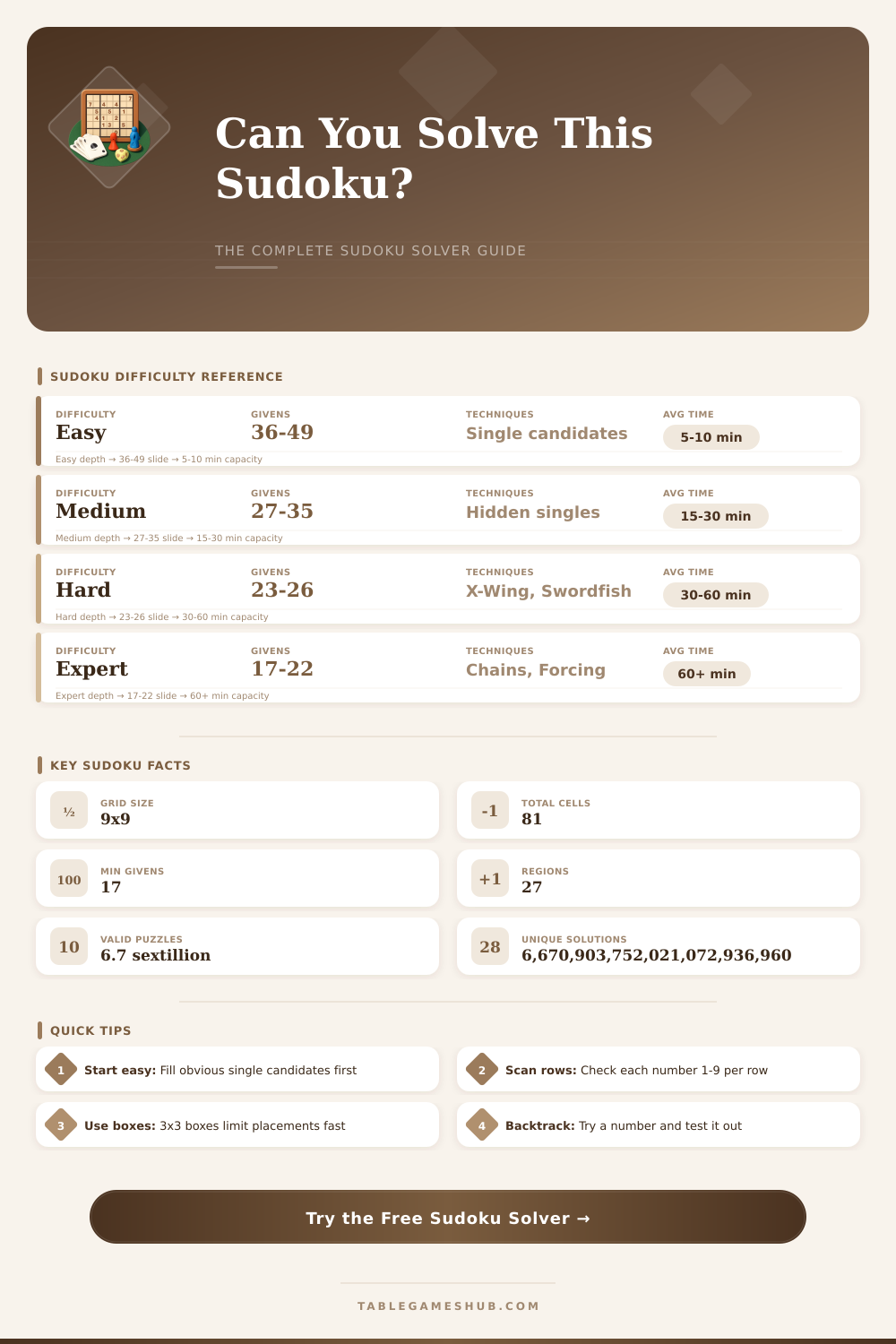
| Difficulty | Given Cells | Empty Cells | Primary Technique | Avg Solve Time | Backtrack Steps |
|---|---|---|---|---|---|
| Easy | 36 – 49 | 32 – 45 | Naked Singles | 5 – 10 min | 0 – 5 |
| Medium | 27 – 35 | 46 – 54 | Hidden Singles | 15 – 30 min | 5 – 50 |
| Hard | 23 – 26 | 55 – 58 | X-Wing, Naked Pairs | 30 – 60 min | 50 – 200 |
| Expert | 17 – 22 | 59 – 64 | Swordfish, Chains | 60+ min | 200+ |
| Minimal | 17 (exact) | 64 | Forcing Chains | 90+ min | 500+ |
| Technique | Difficulty | Description | Cells Resolved |
|---|---|---|---|
| Naked Single | Easy | Only one digit fits in a cell | 1 per step |
| Hidden Single | Easy–Medium | Digit fits only one cell in region | 1 per step |
| Naked Pair | Medium | Two cells share same two candidates | Eliminates others |
| Hidden Pair | Medium | Two digits appear only in two cells | Clears candidates |
| X-Wing | Hard | Rectangle pattern eliminates candidates | Row/col elimination |
| Swordfish | Hard–Expert | 3-row/col pattern for elimination | Multi-row elim |
| XY-Chain | Expert | Chain of bivalue cells | Endpoint elim |
| Backtracking | Any | Try digit, check, revert if wrong | Guarantees solution |
| Variant | Grid Size | Extra Constraint | Typical Givens | Difficulty Range |
|---|---|---|---|---|
| Standard | 9x9 | None | 17–49 | Easy–Expert |
| Diagonal | 9x9 | Main diagonals = 1–9 | 15–35 | Medium–Expert |
| Killer | 9x9 | Cage sums specified | 0 (cage clues) | Hard–Expert |
| Samurai | 21x21 (5 grids) | Overlapping grids | 80–120 | Hard–Expert |
| Mini Sudoku | 6x6 | None | 10–22 | Easy–Medium |
| Sudoku-X | 9x9 | Both diagonals unique | 14–30 | Medium–Expert |
Scan every empty cell for cells where only one digit (1-9) is possible given the row, column, and 3x3 box constraints. These are always safe to fill immediately with zero risk of error.
For each digit 1-9, find which rows, columns, and boxes already contain it. Then determine where in remaining regions the digit can only go to one cell — this is a Hidden Single and can be filled in safely.
Write small pencil marks (candidates) in each empty cell showing which digits are still possible. Then apply elimination techniques like Naked Pairs and X-Wing to remove candidates systematically before placing digits.
If logic stalls, pick a cell with only 2 candidates. Try the first digit and continue solving. If you hit a contradiction, backtrack and try the second digit. This guarantees a solution but requires tracking your branch point.
Sudoku solver is a program that fits to settle any Sudoku puzzle. Such solvers exist online and surpass amount of 50 free versions to choose. Some work right away while others walk through the process slowly, explaining the reasons for every change in the cells one after the other.
Many solvers have the useful feature of step-by-step explanation. One simply enters a Sudoku that seems a bit too hard, and the solver shows how it is solved, one stage at a time. Every stage includes a description of the used method and how one counts the number for every empty space.
How Sudoku Solvers Work
Some solvers allow to choose, whether one wants the solution shown fully or follow the descriptive guide.
Such programs not simply give an answer. They truly help to improve the skill of settling puzzles and allow to practice various strategies. Some solvers offer thousands of free puzzles with levels, so that there is always a new challenge.
One of them makes daily Sudoku for newspaper, that grows in trouble during the scael of one until five stars.
From the technical view, many different methods move such solvers. Backtracking is one of the most common. It acts assigning numbers to empty cells one by one and checking, whether each input is safe before last.
When something fails, it goes back and tests another way. Adding checks for single ones in the start of the solving can quickly boost the whole thing. Another famous method is the Dancing Links of Donald Knuth, that one considers the most efficient mode to address covering tasks like Sudoku.
Linear programming is another approach, and some solvers do that with less than 100 lines of code. Linear formulas also answer for finding a solution, that follows all Sudoku rules.
Some solvers support not only the standard 9×9 grid. There are fast versions, that address many kinds and grids until 16×16. Online based solvers care about variants like Killer Sudoku, mini Killer, Thermo-Sudoku and Sandwich Sudoku. There are even solvers based on images, that use OCR technology, so one can settle a puzzle right away from a photograph or entered numbers manually.
Sudoku itself is a logical number puzzle game. Its trouble relates to amount of cells filled at first and what methods one uses to build it. One requires at least 16 numbers so that a puzzle has a unique solution.
Creating a Sudoku solver is a good programmer exercise, especially for understanding, how backtracking works beforemoving to a maker of puzzles.