Mus Score Calculator
Total one Mus hand in the official lance order: Grande, Chica, Pares, then Juego or Punto, including pass points, accepted stakes, declined envidos, combination payments, Ordago calls, and 30 or 40 point sets.
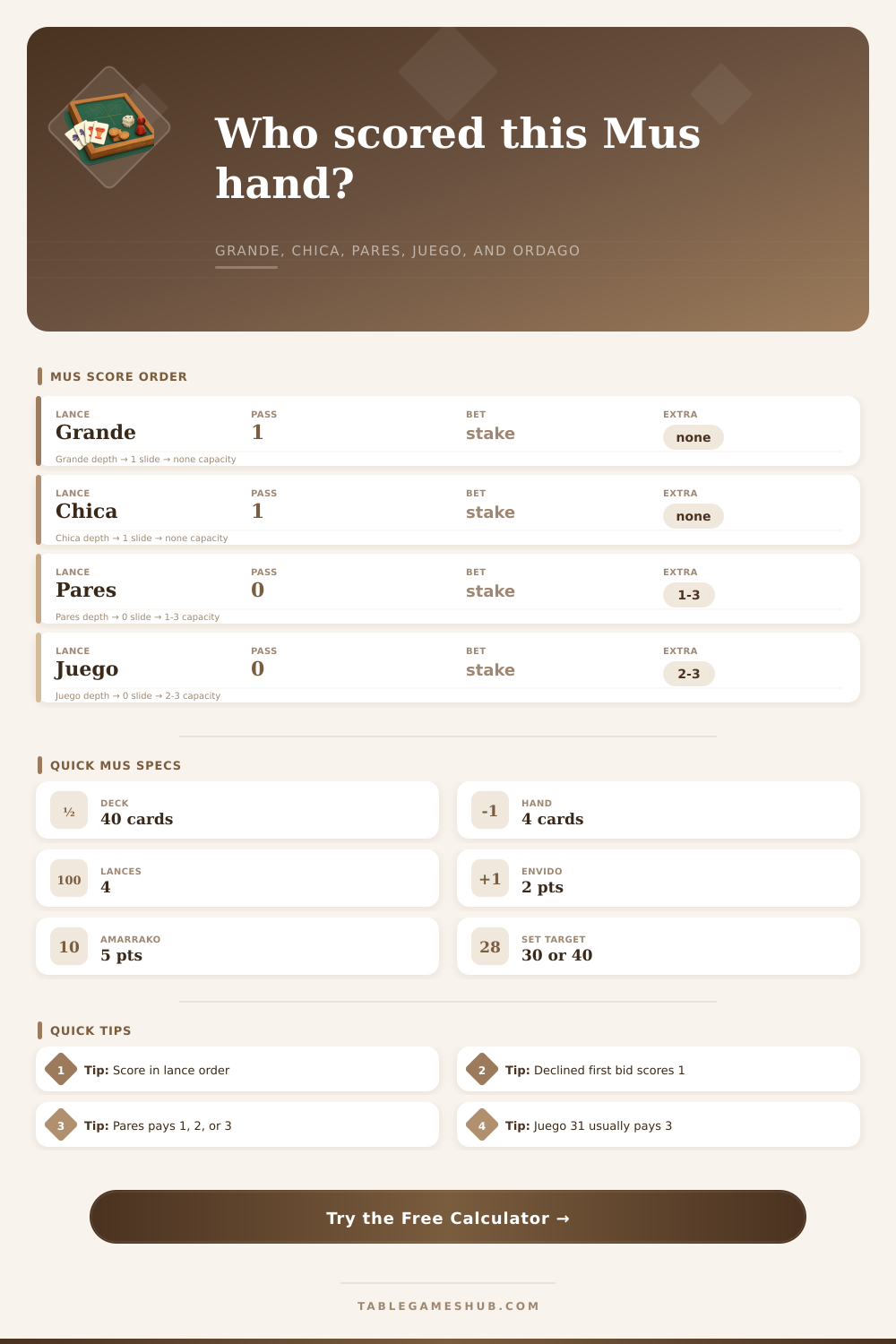
Lance order and base scoring
| Lance | What wins | If passed | Extra count |
|---|---|---|---|
| Grande | Highest ordered hand | Winner gets 1 | None |
| Chica | Lowest ordered hand | Winner gets 1 | None |
| Pares | Best pair class | Count payments | 1, 2, or 3 |
| Juego | Best 31+ total | Count payments | 2 or 3 |
| Punto | Highest under 31 | Winner gets 1 | None |
Pares and Juego payments
| Item | Condition | Points | Calculator field |
|---|---|---|---|
| Pares | One pair | 1 | Pares payment |
| Medias | Three equal | 2 | Pares payment |
| Duples | Two pairs or four equal | 3 | Pares payment |
| Juego 31 | Exact 31 | 3 | Juego payment |
| Other Juego | 32, 33, 34, 35, 36, 37, 40 | 2 | Juego payment |
Bet outcome formulas
| Outcome | Grande / Chica | Pares / Juego | Use when |
|---|---|---|---|
| In pass | 1 to best hand | Payments only | No bet accepted |
| Accepted | Stake to winner | Stake plus payments | Bet was called |
| Declined | Decline value | Decline plus collector payments | Opponent refused |
| Ordago | Set at stake | Set at stake | Accepted all-in call |
Preset score cases
| Preset | Target | Main swing | Audit point |
|---|---|---|---|
| NABO 40 Closeout | 40 | Juego 31 | Stop at target |
| 30-Point Club Set | 30 | Pares plus Juego | Short-set target |
| Chica Declined | 40 | Decline value | Immediate collect |
| Punto Instead | 40 | Punto pass | No Juego hands |
| Ordago Grande | 40 | Set decision | Ignore later lances |
By the time the score has hit thirty-eight stones, there’s an electric tension on the Basque card table that you should recognize. Voices grow quiet; the air goes thin. You look at the people around room and you think they might be threatening you because you know one wrong move could give win to the opposing team. In Mus it isn’t so much about arithmetic as it is memory management in the heat of battle. It’s not simply a matter of adding up numbers, but rather keeping track of a chain of events and each event alter the value of the next.
There’s also an inflexible ranking system of four lances: Grande comes first, followed by Chica, then Pares, and finally Juego or Punto. That’s not random; that’s based off how easy it is to hit a hand. Grande takes high cards, which are easier to get (and easier to see). Chica takes low cards, which are harder to get because they helps your partner make a bigger Grande. Then there’s Pares, taking pair of the same rank, and Juego, taking specific point totals. Because they’re done from top to bottom even if someone gets Grande they can still lose out on all other lances. Remembering which came first is important here, the lance you score last may leave you one short on the final tally.
How to Keep Score in Mus
Once you enter the specifics about your hands, the calculator takes care of the rest. That means no more guessing at stakes in your head and trying to outbluff your competitors. Perhaps the most important field to fill out is what happens on each lance. Did someone pass? Was their bet met? Was it declined? If it’s a decline, then this has a significant impact on economy of the hand because now the other team owes you money. Usually, there’s an additional penalty beyond the initial amount wagered. That’s where casual players stumble, they assume amount is static. When someone declines, things change quickly. Make sure you know how much to write down. Is it base amount or the added penalty?
But here’s where it gets complicated: both Pares and Juego are combo-pay games. In Pares, you earn one point for any pair, two for three-of-a-kind, or three if you have two pairs or four-of-a-kind. For Juego, you get three points for having exactly thirty-one and two points for any other playable sum. That tiny difference makes all the differance when the game is close. One player could of had a good Juego of thirty-one and think he’s got it in the bag, until his partner reveals a poor Grande and loses the first point. It’s the total picture that wins the game, not necessarily the hottest hand. This is what people forget about these games. How important the overall score is as opposed to a specific card in your hand.
Then there are those calls that go beyond just numbers, the psychological layer known as ordagos. An Ordago is an all-in call that can win or lose the set immediately if accepted. Your opponent will fold, awarding you a hefty penalty. Or your opponent will call and he go bust; end of game. It’s that decision point where good becomes great. And it isn’t just about the cards but also reading the table. How confident is your opponent? What are the odds of your hand?
Of course, knowing what the goal score is also helps with the context. In casual club games, they may end at say, thirty, whereas tournaments is likely to run to forty points. In a forty-point set, every stone carries equal weight at ten points, but at thirty-eight, each stone is worth twice as much then it was at ten. The room for error gets much smaller. A miscount on a pass point can cost you dearly. Forgetting that only Chica and Grande have their own pass stones while Pares do not could be disastrous.
That’s what makes Mus beautiful. It’s social intuition balanced with skill. It’s drama provided by people while the cards gives us the structure. If we keep correct scores the drama retains its integrity as no one can question exactly how they got to those final points. Whether it’s for fun or real money, keeping things clear will avoid arguments. Perhaps the single greatest skill is knowing how to avoid arguing at the card table. Hands come and go, cards shuffle, but the score is the one thing we know we can count on to be truthful.