Ascension Storm of Souls Calculator
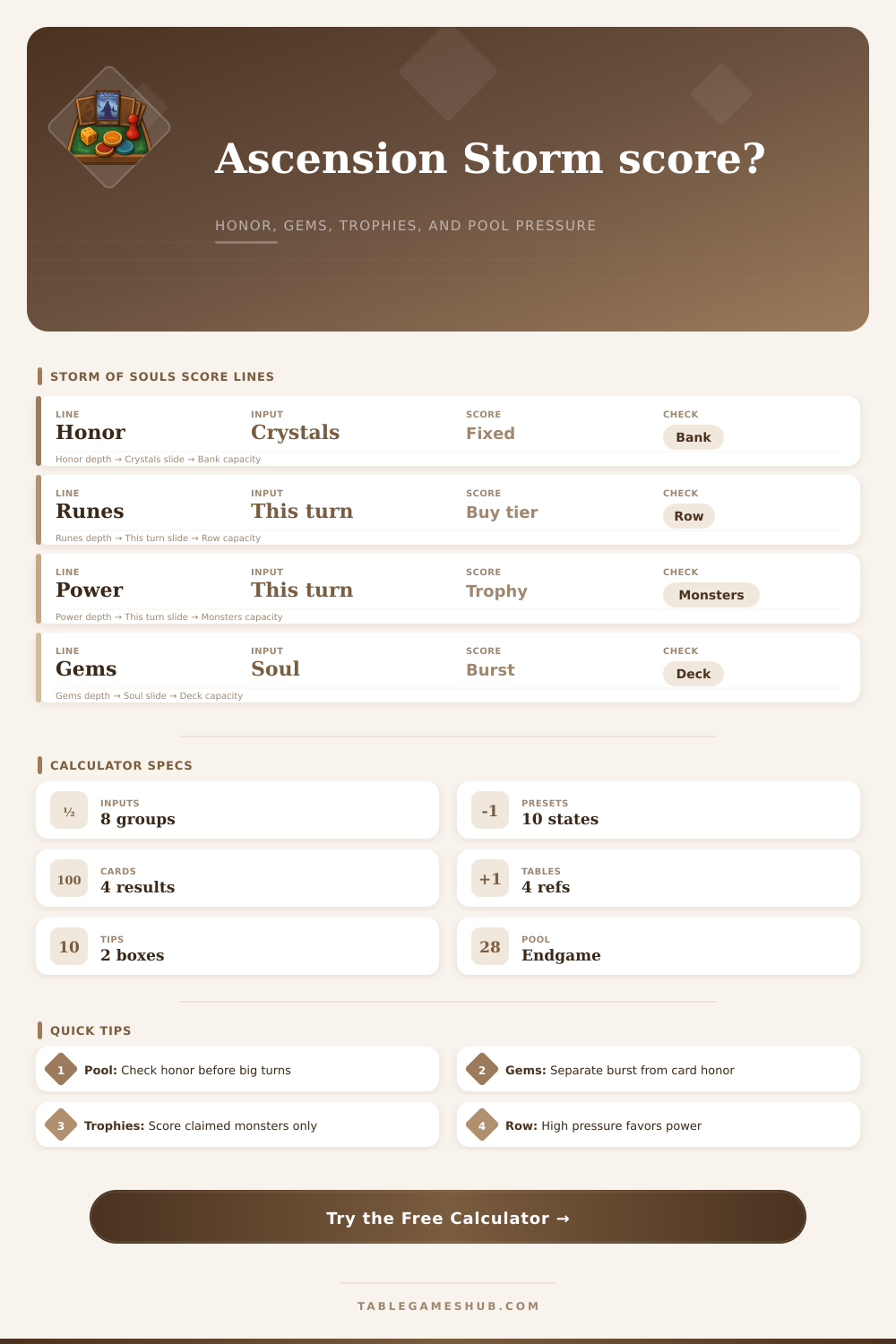
Score an Ascension: Storm of Souls position with banked honor, deck honor, runes, power, construct momentum, soul gem bursts, trophy monsters, center row pressure, and the endgame honor pool.
| Score line | What to enter | Calculator treatment | Audit cue |
|---|---|---|---|
| Honor crystals | Gained honor tokens beside the player | Direct final score | Use the visible bank, not all honor gained by the table. |
| Card honor | Printed honor on acquired deck and constructs | Direct final score | Separate printed endgame honor from crystals. |
| Runes | Current or next decisive turn buying power | Projected acquisition value | High runes matter only if the row offers useful buys. |
| Power | Current or next decisive turn monster power | Projected monster and trophy value | Monster-heavy rows raise conversion reliability. |
| Honor pool | Central pool remaining before the next turn cycle | Endgame pressure and risk | Low pool can deny slow construct payoffs. |
| Profile | Main signal | Projection helper | Best score check |
|---|---|---|---|
| No construct engine | Resources come from hand and row | No construct tempo bonus | Card honor and crystals carry the score. |
| Light construct support | One or two recurring effects | Small final-turn consistency bump | Confirm constructs are still in play. |
| Mechana chain online | Several constructs feed each other | Strong tempo and rune conversion | Count printed construct honor once. |
| Dreamborn support | Trophy and construct synergies | Moderate trophy and burst bump | Do not score unclaimed trophy monsters. |
| Mixed constructs online | Cross-faction utility engine | Balanced tempo helper | Check which effects still apply this turn. |
| Pressure state | Row read | Resource bias | Calculator effect |
|---|---|---|---|
| Quiet row | Useful cards are likely to remain | Runes convert cleanly | Neutral pressure and low denial. |
| Rune-rich row | Several valuable buys are exposed | Runes are favored | Rune projection rises. |
| Monster-heavy row | Honor is available through kills | Power is favored | Power and trophy projection rise. |
| Swing cards exposed | One card can change the score race | Both resources urgent | Pressure and contest risk rise. |
| Cursed or clogged row | Weak buys or awkward monsters remain | Conversion falls | Projection is discounted. |
| Table | Common pool | Low pool signal | Score audit focus |
|---|---|---|---|
| 2-player duel | 60 honor | 12 or less remaining | One burst turn can close the game quickly. |
| 3-player table | 90 honor | 18 or less remaining | Track player order before assuming another turn. |
| 4-player table | 120 honor | 24 or less remaining | Pool drains fast when multiple players defeat monsters. |
| Pool exhausted | 0 honor | Game end triggered | Finish the round, then count printed card honor. |
Now imagine you’re sitting back down for a round of Ascension: Storm of Souls and that knot forms in your gut. Everything appears under control, the board looks manageable enough but calculating your final score feel incredibly difficult. Your head is full of calculations, too many variables to keep track of. Construct, runes, and honor crystals is ready. You simply can’t remember them all and make an educated guess.
Enter the calculator. It do the math for you based off your scenario. It keeps you from overestimating this turn and completely missing out on bigger picture of the game. It’s not just totaling up the present moment, it’s about understanding how these resources will impact each other in the endgame.
Why You Should Use a Score Calculator
Storm of Souls is a race against the honor pool; most players don’t track it because they’re so focused on next move. But it’s all about the center pool and what you do there. If you let that get too low, you might not get a chance at engine you’ve been building up. This is where tracking both your estimated intake and how much pool you have left becomes important.
If there’s only 20 honor left in a four player game and someone else has power at the ready, you might not get another turn. The tool will show you how far away you are from being at that tipping point, helping you consider whether or not to wait.
Another trip-up for lots of people is distinguishing between printed card honor and gained honor. The former exists on the cards that leave the row; the latter is right next to your player sheet so it’s instant and real. Figuring out how much comes from each source help clarify where you stand. You’re playing a high-stakes game if your total hinges on brittle structures that can gets wiped away. It may not show in the numbers until its too late.
Does the middle row contain runes or power? Depending on it’s contents, it offers a different form of protection. Power is typically a straight shot, with most monsters offering same amount of honor per point. Runes can be flexible currency, as long as you have something else to spend them on. If not, they’re worth lesser.
The key is reading the row’s impact in the reference tables. A rune-laden row becomes a money-maker for spending tokens; a monster row emphasize the value of power. Before committing yourself to one or the other, read board situation.
Another wrinkle is that calculator includes constructs and soul gems, which are forms of waiting for rewards. While your constructs will be awesome if left running, they needs to be protected and maintained. Soul gems offer burst, which can win a tight match in one turn. By accounting for them, it’s assuming some number of them are actively helping you get more honors, so how many do you have?
That helps avoid overestimating your soul gem score, which is a mistake players make when tallying up just “honor” including the gems. Those should of be separate categories. It is not honor, and it is not yet honor, but rather honor pending. If they help you buy or win an item or a person that gives you honor, then it becomes honor.
In Storm of Souls, accumulating is one thing; timing is another. Having enough resources to move forward while not exposing yourself to premature game-ending risks are key. This is where the interface shines: it breaks down your score in such a way that you can visualize this balance. Are you relying too much on one engine? Do you diversify?
And use it to double-check your assumptions on each turn instead of at the end. Doing so will alter your gameplay and make guesswork an informed decision.