Terra Mystica Score Calculator
Total final VP from cult tracks, network size, buildings, town tiles, round scoring, resources, and faction bonuses.
| Scoring Source | Formula Used | Points | Notes |
|---|
| Final Scoring Area | Rank or Count | VP Award | Calculator Treatment |
|---|---|---|---|
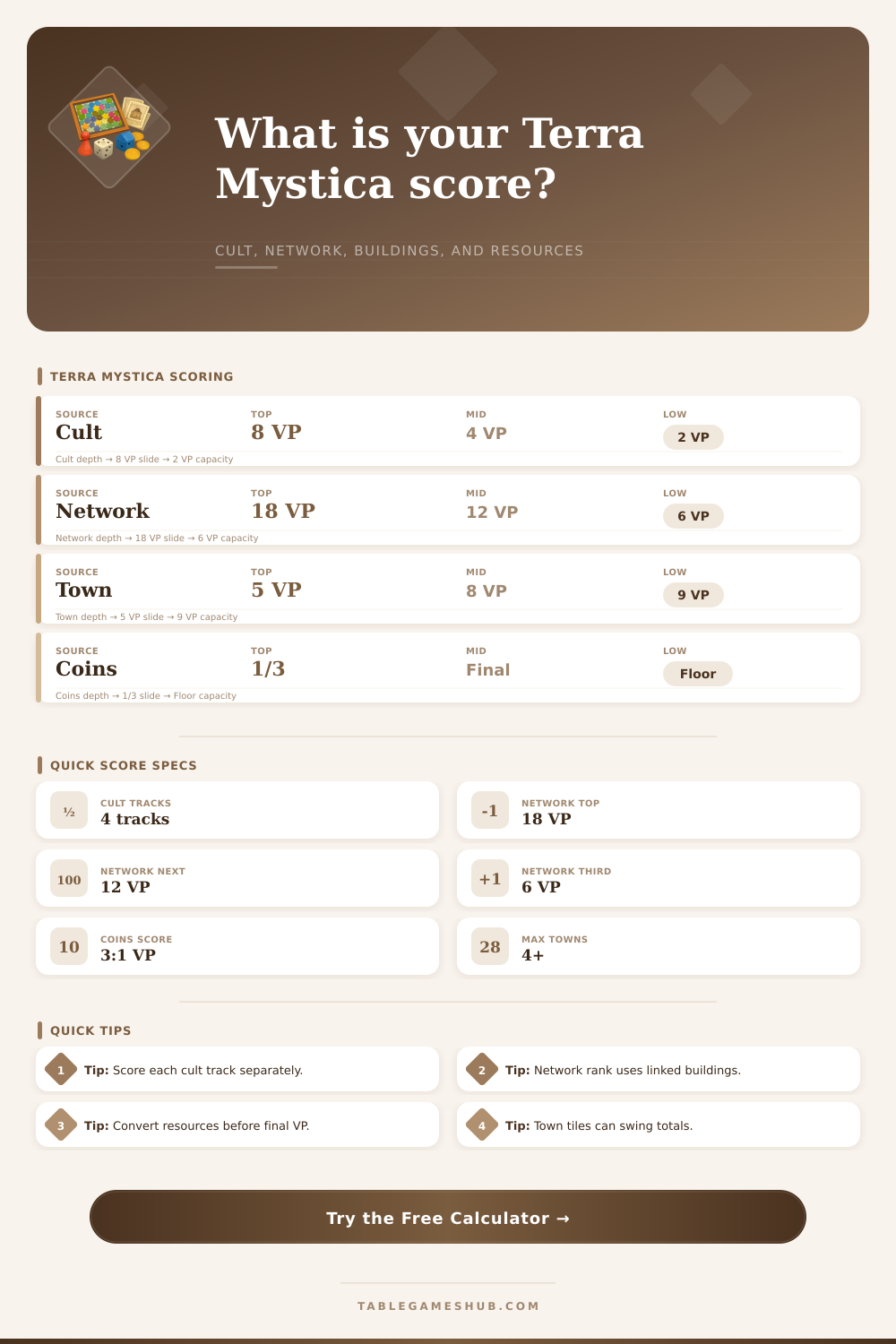
| Cult track first place | Highest position | 8 VP | Compared against the best rival value entered for that track. |
| Cult track second place | Behind top player | 4 VP | Used when your marker is below rival leader but strong enough for placement. |
| Cult track third place | Competitive lower rank | 2 VP | Estimated when your marker still sits in the active scoring band. |
| Largest connected network | First, second, third | 18, 12, 6 VP | Your network is ranked against the entered rival network sizes. |
| Building Type | Supply Count | Common Endgame Signal | Scoring Use |
|---|---|---|---|
| Dwellings | 8 | Map presence and network reach | Used in structure total and faction bonus estimates. |
| Trading Posts | 4 | Economy converted into towns | Used in structure total and balanced build checks. |
| Temples | 3 | Cult tile access and track pressure | Used with sanctuary count for cult-engine bonuses. |
| Stronghold or Sanctuary | 2 | Special power and high-value build | Used as a late-game development multiplier. |
| Faction Selector | Bonus Estimate | Best Matched Input | Why It Matters |
|---|---|---|---|
| Witches | Town-focused VP | Completed towns | Witches often convert broad dwelling expansion into town scoring. |
| Engineers | Network support | Network structures and rivals | Bridge-heavy positions can overperform in the connected-network race. |
| Alchemists | Coin finish | Coins and resource conversion | Large coin endings are more meaningful for this faction profile. |
| Cultists | Cult pressure | Four cult positions | Priest-heavy development often produces extra final cult placement value. |
| Endgame Tile Focus | High Signal | Medium Signal | Calculator Estimate |
|---|---|---|---|
| Largest settlement emphasis | Network 12+ | Network 8-11 | Adds a connected-structure bonus by network size. |
| Map distance emphasis | Network plus towns | Network without towns | Adds reach value from network and completed towns. |
| Town emphasis | Three or more towns | One or two towns | Adds an estimate per town to compare tile-heavy games. |
| Cult dominance emphasis | Average cult 7+ | Average cult 5-6 | Adds points when cult tracks are a declared scoring focus. |
Terra Mystica is a game in which several different categories determine the number of victory point that a player earn. These categories can include the number of victory points that a player earns from their management of their cult track, the size of their networks, and the number of leftover resource that they have at the end of the game. However, players can lose the game if they dont correctly calculate how many victory points each of these category will provide to them.
A scoring tool can be helpful for this calculation, as the tool will allow players to view their total victory points that they will earn in the game without having to perform the arithmetic calculation themselves. Furthermore, players can also use the tool to compare their score to that of there rivals in the game. Players earn victory points from each of the four cult tracks that is included in the game.
How to Use the Terra Mystica Scoring Tool
Each of these tracks provides victory points to a player based off their final position on that particular track. If, for instance, a player is in first place on one of the cult tracks, but in second place on another of the cult tracks, they will earn victory points for being in a highly position on the first track, but will not earn victory points for being in a low position on the second track. A player can input their position within each of the four cult tracks into the tool, as well as their position within each of the four tracks relative to their best rival player.
The scoring tool will then calculate the victory points that they will earn from these cult tracks for the player. The next category of victory points for players is earned based upon the size of the largest network of structure that a player created within their lands. A network is different than the total number of structures that a player own; a player may own structures that are not connected to each other.
A player must enter the size of their largest network of connected structures within the tool, as well as the sizes of their rivals two largest networks of structures. The tool will then display for the player whether they earned the highest number of victory points in this category, the second-highest number of victory points, or if they earned the third-highest number of victory points. Resource conversion is the final way that players earn victory points during the game.
Prior to the end of the game, players must divide the number of worker, coins, priest, and power tokens that they control by three to determine their victory points from this category. Resource conversion can significantly impact a player’s total victory points during the game. Additionally, within the tool, this score is represented as a single line item in the tool; players can use the tool to determine whether it is more beneficial to hoard the resources within the game than to use those resources to create building or towns within their lands.
The various factions in Terra Mystica also provide players with different bonus to their victory point total. For instance, players who select one of the factions that earn bonus victory points for the number of towns that they create will earn additional victory points to their total. Other factions earn bonus victory points based upon their number of temple relative to the total number of towns that they control, and other players earn victory points based upon the total number of coins that they have relative to other rivals in the game.
Each of these bonuses can be selected within the tool for the player, and the selection of each of these factions will add the estimated victory points to the total victory point that a player will earn in the game. Finally, there are endgame scoring tiles that may alter the victory point conditions for the remainder of the game. For example, one scoring tile may provide victory points to the player who create the largest settlement within the game.
In this case, players will want to encourage the construction of one large settlement of buildings. Another example may be a scoring tile that provides victory points to the player who dominates the cults within their land; in this case, the player will earn victory points for moving one of their priest to another portion of the land. These scoring tiles may be selected within the scoring tool, which will calculate the victory points that each player will earn based upon the active scoring tile.
Despite the benefits of the tool, many player make mistakes when using the tool; one common mistake is forgetting to separate a player’s points based upon their number of cult points, network points, and leftover resources. By forgetting to separate these different points, players may make incorrect decisions regarding whether they should focus upon one of these categories or all of them. Additionally, another common mistake with players is forgetting to adjust the size of the rival networks after the final round of building for the game.
Such a mistake in calculation can impact a player’s calculated total rank within the game. However, these different inputs into the tool allow players to remember these distinctions, ensuring that they have a clear understanding of there rank within the game. Beyond these different calculation error that may occur while using the tool, one of the main benefits of the tool is that it allows for players to test out different move that they can make within the game prior to the game ending.
For instance, players can change the position of their cults within the tool, or adjust their network size within the tool. As a result, the player can determine if making such a move is worth the cost to the player in terms of the worker or priests that they must commit to such a move. Thus, the tool helps to reveal which aspect of a player’s strategy are fixed relative to the game’s end, and which aspects of their strategy can still be changed prior to the end of the game.
Overall, then, the tool helps to remove the need for players to utilize arithmetic calculations within the game; instead, they can focus upon making strategic decision within the game.