🏠 Monopoly Rent Calculator
Check street deed rent, houses, hotels, railroad ownership, utility dice rolls, mortgage status, card multipliers, and expected game-money rent.
| Step | Formula | Result |
|---|
| Group | Spaces | Base Rent Range | Hotel Rent Range | Group Size |
|---|---|---|---|---|
| Brown | Mediterranean, Baltic | M$2 to M$4 | M$250 to M$450 | 2 streets |
| Light Blue | Oriental, Vermont, Connecticut | M$6 to M$8 | M$550 to M$600 | 3 streets |
| Pink | St. Charles, States, Virginia | M$10 to M$12 | M$750 to M$900 | 3 streets |
| Orange | St. James, Tennessee, New York | M$14 to M$16 | M$950 to M$1000 | 3 streets |
| Red | Kentucky, Indiana, Illinois | M$18 to M$20 | M$1050 to M$1100 | 3 streets |
| Yellow | Atlantic, Ventnor, Marvin Gardens | M$22 to M$24 | M$1150 to M$1200 | 3 streets |
| Green | Pacific, North Carolina, Pennsylvania | M$26 to M$28 | M$1275 to M$1400 | 3 streets |
| Dark Blue | Park Place, Boardwalk | M$35 to M$50 | M$1500 to M$2000 | 2 streets |
| Selected Deed | Base | 1 House | 2 Houses | 3 Houses | 4 Houses | Hotel |
|---|
| Type | Owner Holding | Rent Formula | Example | Special Note |
|---|---|---|---|---|
| Railroad | 1 railroad | M$25 | M$25 normal | Multiplier can double. |
| Railroad | 2 railroads | M$50 | M$100 with 2x card | Count all owner railroads. |
| Railroad | 3 railroads | M$100 | M$100 normal | No dice roll used. |
| Railroad | 4 railroads | M$200 | M$400 with 2x card | Highest railroad tier. |
| Utility | 1 utility | 4 x dice total | Roll 7 = M$28 | Use the roll that landed. |
| Utility | 2 utilities | 10 x dice total | Roll 8 = M$80 | Both utilities owned. |
| Dice Total | Ways on 2d6 | Probability | One Utility Rent | Two Utility Rent |
|---|---|---|---|---|
| 2 | 1 | 2.78% | M$8 | M$20 |
| 3 | 2 | 5.56% | M$12 | M$30 |
| 4 | 3 | 8.33% | M$16 | M$40 |
| 5 | 4 | 11.11% | M$20 | M$50 |
| 6 | 5 | 13.89% | M$24 | M$60 |
| 7 | 6 | 16.67% | M$28 | M$70 |
| 8 | 5 | 13.89% | M$32 | M$80 |
| 9 | 4 | 11.11% | M$36 | M$90 |
| 10 | 3 | 8.33% | M$40 | M$100 |
| 11 | 2 | 5.56% | M$44 | M$110 |
| 12 | 1 | 2.78% | M$48 | M$120 |
| Situation | Uses Improvements? | Uses Dice? | Uses Group Count? | Rent Result |
|---|---|---|---|---|
| Unimproved street, no full group | No | No | No | Printed base rent |
| Unimproved street, full group | No | No | Yes | Base rent doubled |
| Street with houses or hotel | Yes | No | Building group already assumed | Selected deed tier |
| Railroad landing | No | No | Yes | 25, 50, 100, or 200 |
| Utility landing | No | Yes | Yes | 4x or 10x dice total |
| Mortgaged deed | No | No | No | Zero rent |
Deed tier check
For streets, select the exact improvement level first. The calculator applies double base rent only when the selected street has no houses or hotel.
Utility roll check
Utilities use the dice total that moved the token to the space. A roll of 7 is the most common 2d6 total, but the actual landing roll controls rent.
A rent calculator is a tool that calculates the amount of rent that a player must pay during a game of Monopoly. By using a rent calculator, players can prevent argument regarding the rules of Monopoly. A rent calculator require players to input information regarding the color of the Monopoly deed cards, the dice roll, and the number of property that are owned by the player.
Based off these inputs, the rent calculator provides a total amount of rent that the player must pay during that turn. Thus, the use of a rent calculator allow players to accelerate the speed at which they can play Monopoly, and ensure that no player must reference the rulebook during their turn. While many players are aware that if they own all of the properties of a color group they will receive double the rent for those properties if they have no improvement made to the properties, few players may remember that if improvements are placed on those properties the double rent rule does not apply.
How to Use a Monopoly Rent Calculator
The double rent rule only applies to the base rent listed for each property if a player own all of the properties of a color group and if those properties contain no improvements. Should a player place a house on a property, the rent for that house will be the amount listed for the next level of improvements listed on that property’s deed card. Thus, a rent calculator is beneficial in that it can calculate this rent amount automaticly.
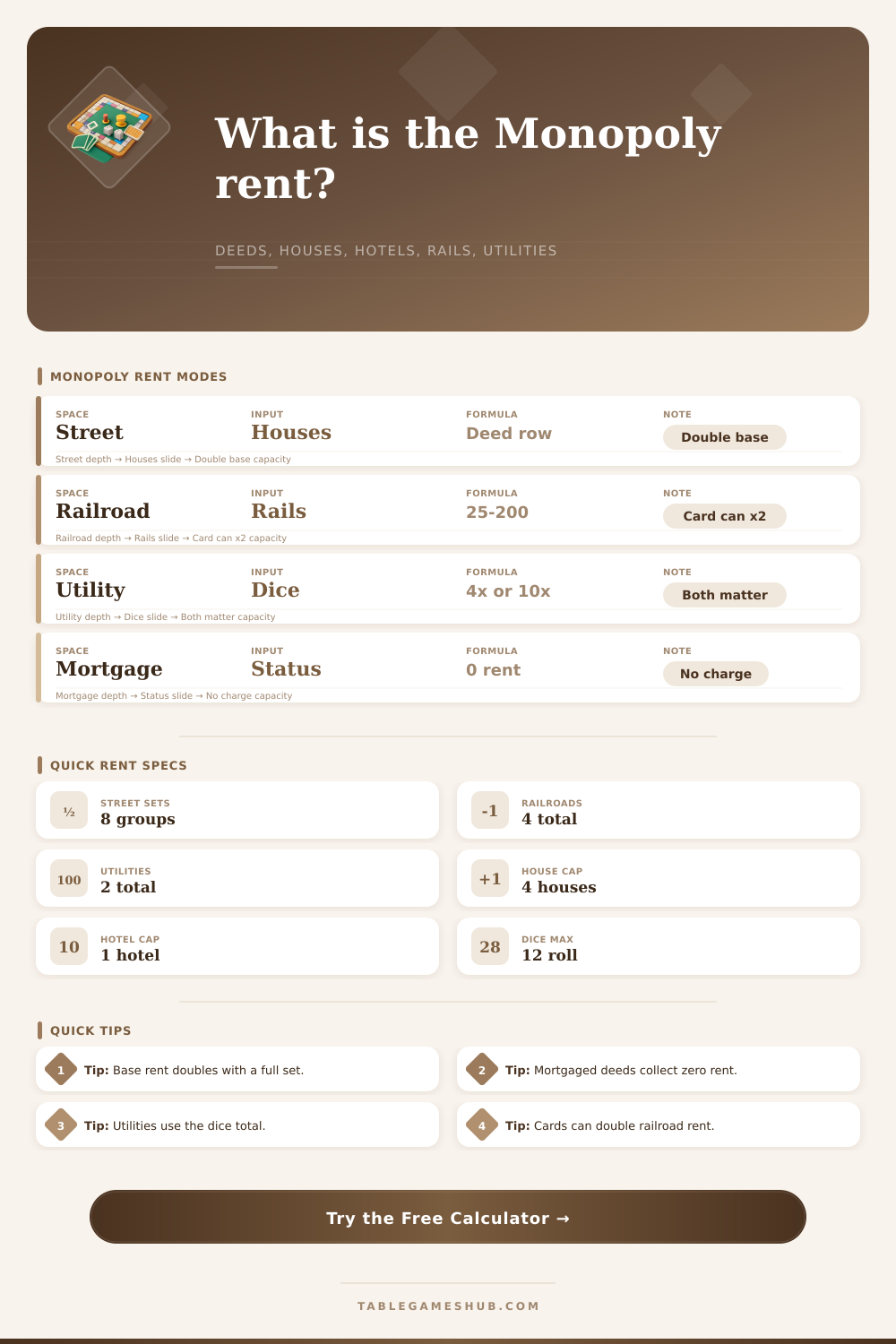
Railroads is additionally managed differently within Monopoly than the streets. The rent for a railroad is related to the number of railroads that a player owns. Should a player own one railroad the rent is twenty-five; should they own two the rent is fifty; three railroads will yield one hundred in rent, and four railroads will earn two hundred in rent.
Any cards that may double the rent for a property will be applied to the rent for a railroad after the calculation has been made, not prior to calculation. Additionally, utilities function different than both the streets and the railroads. For a utility the rent is four times the value of the dice roll if a player owns only one utility; if they own both utilities they will earn ten times the value of the dice roll.
To calculate the rent for a utility a rent calculator must obtain the number of utilities that are owned by a player and the value of the dice roll. Mortgaged property will always yield a rent total of zero. Should a player mortgage any property the rent cannot be collected, and regardless of the number of improvements placed on properties, no rent can be collected by mortgaged properties.
Thus, a rent calculator must include an override for mortgages for this type of rule. When a player enters a property into the rent calculator as being mortgaged the rent total will be displayed as zero; this prevents the players from attempting to collect rent from a player’s mortgaged properties. Within the rent calculator there is an “expected value” for each property.
This value is calculated by multiplying each property’s associated rent by the chance that a player will land on that space during a game, and the number of “orbits” that a player will play during a game. While this value will not guarantee the amount of money that a given player will earn during a game, it can indicate to a player whether or not a given property will earn it’s initial purchase price for that player. Properties with high improvement values will be more valuable for longer games, while the value of railroads and utilities will be reflected in shorter games of Monopoly.
It is common for Monopoly players to apply the rules for streets to the value of the railroads and utilities. Rules for placing houses on streets will not apply to railroads or utilities. Thus, the rent calculator will disable the selection of the number of house for a player if they select either a railroad or a utility; the property types each contain their own logic for calculating rent.
It is also common for Monopoly players to fail to remember that the rule regarding doubling the rent for streets only applies if a player owns all of the properties of that color group, and that if any building are placed on those streets the rent will not be doubled. A rent calculator will apply this rule to ensure that players are aware of when this rule dissapears. Thus, Monopoly players who utilize a rent calculator will understand the disappearing of this rule, as well as understand how to take advantage of it in order to build houses on their owned properties efficient.
The probability of each dice roll can factor into the calculation of the rent that a player must pay for utilities. Should a player roll a seven on the dice the probability of rolling a seven is the highest. Should a player roll a seven while on Electric Company and own only one utility the rent will be twenty-eight; however, should a player roll a seven on their turn and own both utilities the rent will be seventy.
Additionally, using a rent calculator allows players to enter different values for the dice roll to determine the rent for their utility; this allows them to decide whether or not purchasing a second utility would be beneficial for that game of Monopoly. The length of the game can impact the value of each property. While a hotel on Boardwalk is an expensive property, the expected session figure for that player will allow them to determine the amount of money that the hotel will yield during that game.
Additionally, railroads may be more valuable during shorter games of Monopoly due to the fact that once a player owns multiple railroads there is no additional investment required to continue to accrue rent. Similarly, a rent calculator may help players to make a decision regarding whether or not to unmortgage their property; during mortgage they earn zero rent, which a rent calculator will reflect. The rent calculator makes assumptions about the rules that are to be applied during the game of Monopoly.
For instance, the rent calculator will assume that the standard rules are to be applied. Should a group of players create house rules that differ from the standard rules the rent calculator will not be able to reflect those house rules. Thus, the players will have to manually change the rent if they would like to play by their house rules.
Additionally, the rent calculator is provided to provide speed to the players during the game; rather than having players manually calculate the rent that they must provide to another player for their properties the rent calculator allows them to enter the property that they wish to rent, the number of properties that they own, and the value of the roll of the dice to recieve an immediate answer to the question of how much rent should be provided. Thus, when a player receives an immediate answer using the rent calculator the players have eliminated the need for argument regarding the rules of Monopoly.