Michigan Rummy Calculator
Plan board-space chips, poker pool contributions, carryover exposure, payoff-card claim odds, and table space for a Michigan Rummy or Tripoley-style game.
①Real Setup Presets
Choose a realistic table setup, then adjust the chips, claims, and space numbers to match your board.
②Game Inputs
③Component and Spec Grid
④Board Payoff Reference
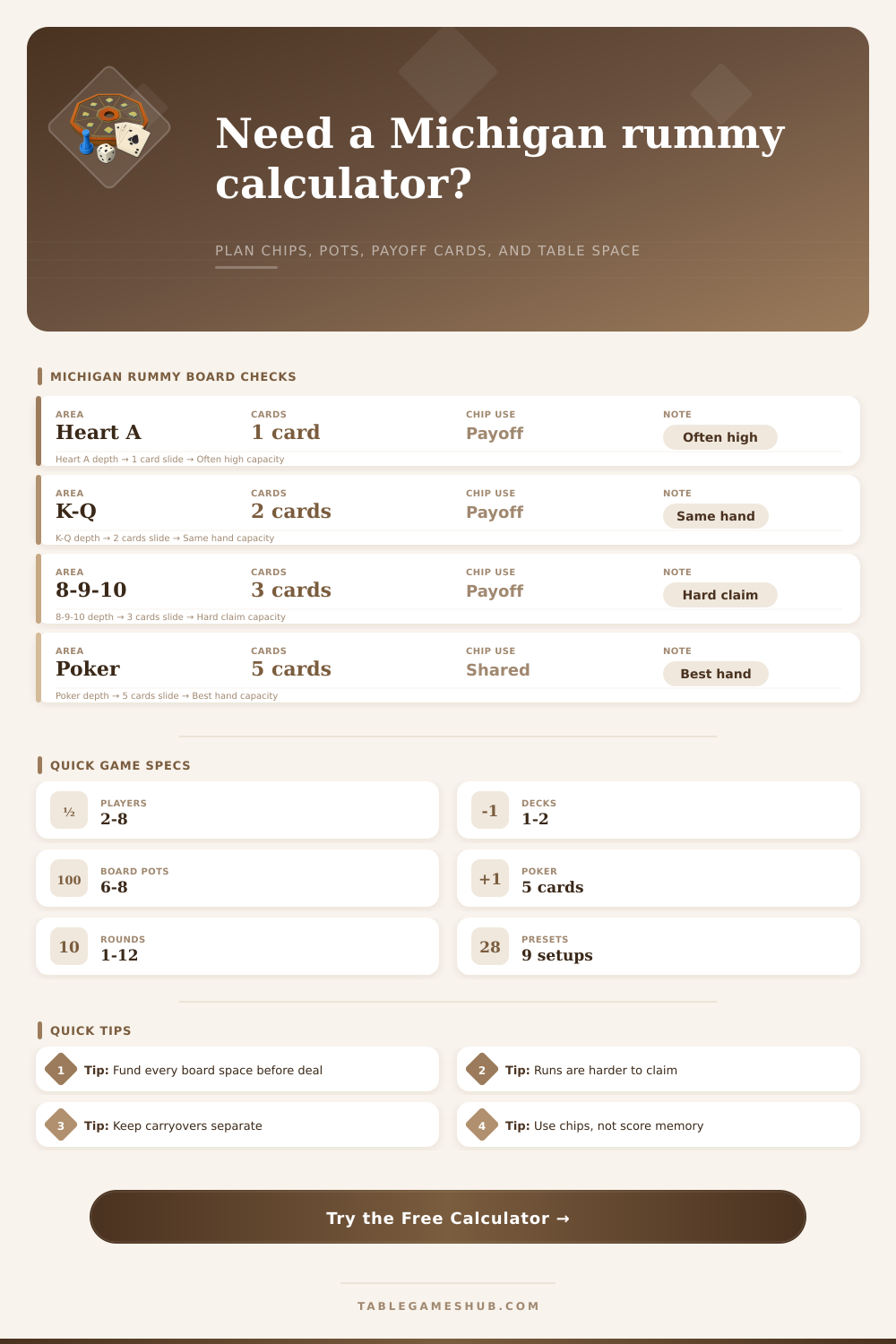
| Board space | Cards needed | Claim pattern | Calculator treatment |
|---|---|---|---|
| 10 of hearts | Single card | Claimed by holder | Uses single-card coverage probability from active dealt cards. |
| Jack, queen, king, or ace of hearts | Single card | Claimed by holder | Counts as individual payoff spaces in classic boards. |
| King-queen of hearts | Two-card set | Same player must hold both | Uses two-card combination odds for an estimated claim rate. |
| 8-9-10 of hearts | Three-card run | Same player must hold all three | Uses three-card combination odds, so carryover risk is higher. |
| Poker pool | Five-card hand | Best poker hand | Separated from board-space carryover because it normally pays each hand. |
⑤Player Bank Planning
| Players | Typical cards each | Suggested starting chips | Comfortable table edge |
|---|---|---|---|
| 2-3 | 13-17 plus dead hand | 40-60 chips each | 24-28 inches each |
| 4 | 13 each | 50-70 chips each | 24 inches each |
| 5-6 | 8-10 each | 60-90 chips each | 22-24 inches each |
| 7-8 | 6-7 each | 80-120 chips each | 20-22 inches each |
⑥Variant Setup Table
| Variant | Deck setup | Payoff spaces | Best use |
|---|---|---|---|
| Classic 8-space board | One deck | 8 spaces | Standard family-table Michigan Rummy accounting. |
| Tripoley-style board | One deck | 8 spaces | Good when poker and rummy phases both matter. |
| Hearts payoff board | One deck | 7 spaces | Useful for boards emphasizing named heart cards. |
| Compact 6-space board | One deck | 6 spaces | Faster chip setup for teaching or short sessions. |
| Double-deck large table | Two decks | 8 spaces | Helps large tables keep more active card coverage. |
⑦Claim Odds and Carryover Table
| Pattern | Example space | Why it matters | Calculator note |
|---|---|---|---|
| Single payoff card | Ace of hearts | Most likely to be claimable if the card is dealt to an active player. | Estimated with active dealt cards divided by deck size. |
| Two-card combination | King-queen hearts | Needs one player to hold both cards, so it carries over more often. | Estimated with player hand combinations over deck combinations. |
| Three-card run | 8-9-10 hearts | Hardest common board claim and often the biggest carryover source. | Estimated with three-card combinations per player. |
| Poker pool | Five-card hand | Usually resolves every hand because all active players compare hands. | Excluded from unclaimed board-space risk. |
⑧Table Tips
Board funding tip: Count the board-space ante separately from the poker pool. This keeps unclaimed payoff spaces visible between hands and prevents the next deal from starting with the wrong chip base.
Carryover tip: Single heart cards clear more often than paired or run spaces. If the 8-9-10 space keeps growing, increase the reserve bank rather than reducing player starting chips.
Have you ever played a card game and it take forever to figure out who owes what or who should of won last round? That’s how Michigan Rummy goes. Deal the cards, throw them down, and let the fight start over the board. There is a way, but without planning your game quickly turns into a mess of unknowns and a pile of chips.
This calculator kills those unknowns before the first card even touches the table. So you can be thinking about strategy not accounting.
Why This Calculator Helps Your Game
The trick with Michigan Rummy is each board position isn’t equal. A single ace of hearts acts totally different than a 3 card run such as 8-9-10. One will likely be played within two hands because someone probably has it. The other one lays there for cycles gathering chips until it either becomes a huge jackpot or point of frustration. Fund those spaces accordingly. Don’t ante only one chip into a difficult spot. It’ll clear up to quick losing the tension.
What happens if you underfund your player bank compared to the potential of boards? Somebody will be outta’ chips at round 3. Use the tool above to calculate this based off the number of rounds expected and the number of players sitting down.
The inputs are intuitive, though do require some understanding of your playing group. An eight-player, serious round of play is going to be different than a four-person, family game night. Thinner hands means less chance of landing that hard-to-hit combination in hearts. More player mean thinner hands but increase the total chip demand on the table.
The calculator takes all of this into account and does so as things change. For example, it knows what your starting bank is, how much ante per space, and how much you’re putting into the poker pool. From there, it tells you whether or not you has sufficient funds to support the game. It also figures out the carryover risk (basically a guess on how many chips won’t get claimed after however many rounds you want to run).
It’s all about space I know what you’re thinking: Any table will do for card games. Wrong. Michigan Rummy is a game that requires some breathing room. As it progresses, the discard pile grows. The board size increases, and hands gets messy. To avoid elbow-to-elbow shuffling and flying cards when someone reaches for the deck, this calculator can figure out how much table edge space each player needs. This allows you to input your personal comfort level and have it convert to inches of space available. A little thing, yes, but it can be the difference between a relaxing night and a scramble.
A frequent error is mixing up the board pots with the poker pool. These are two distinct psychological component. The former builds over time (long game) while the latter restarts per-hand (instant gratification). Maintaining their separation in your head, and, ideally, on the table layout, will help you control expectations. This is reflected in the structure of the calculator: It breaks out those amounts. You know precisely how much you have available now as opposed to what’s stacking up in hopes of getting something back later.
And then there’s the variant you play. Some variants focus on specific combinations of hearts, and others use an eight-space layout (the classic) or something more like Tripoley. You can specify which variant you’re using with this tool. This affects the relative odds of claiming certain points, because some layouts is mathematically easier to achieve than others. For example, if you play on a small board with fewer spaces, the game will move faster, but the jackpots will be smaller. Play on a double-deck set-up and the chances change once more; having duplicates makes it less likely you’ll hold any particular card.
So at the end of the day, that prep work is just part of the fun. Setting up your space and getting the chips ready lets you know that this is going to be a real game. It is not some casual shuffle. You know what the board looks like and you’ve got your starting stacks down. Everybody gets to sit down without any arguments about who has what when the chips start flying.
All that prep work means all that playing time is fun and nothing but fun. Deal ’em up, see the hand develop, and let the math go on autopilot while we enjoy ourselves. That’s how you make a card game truly enjoyable to everyone at the table. It is smooth, fair, and fun.