🃏 Taboo Score Calculator
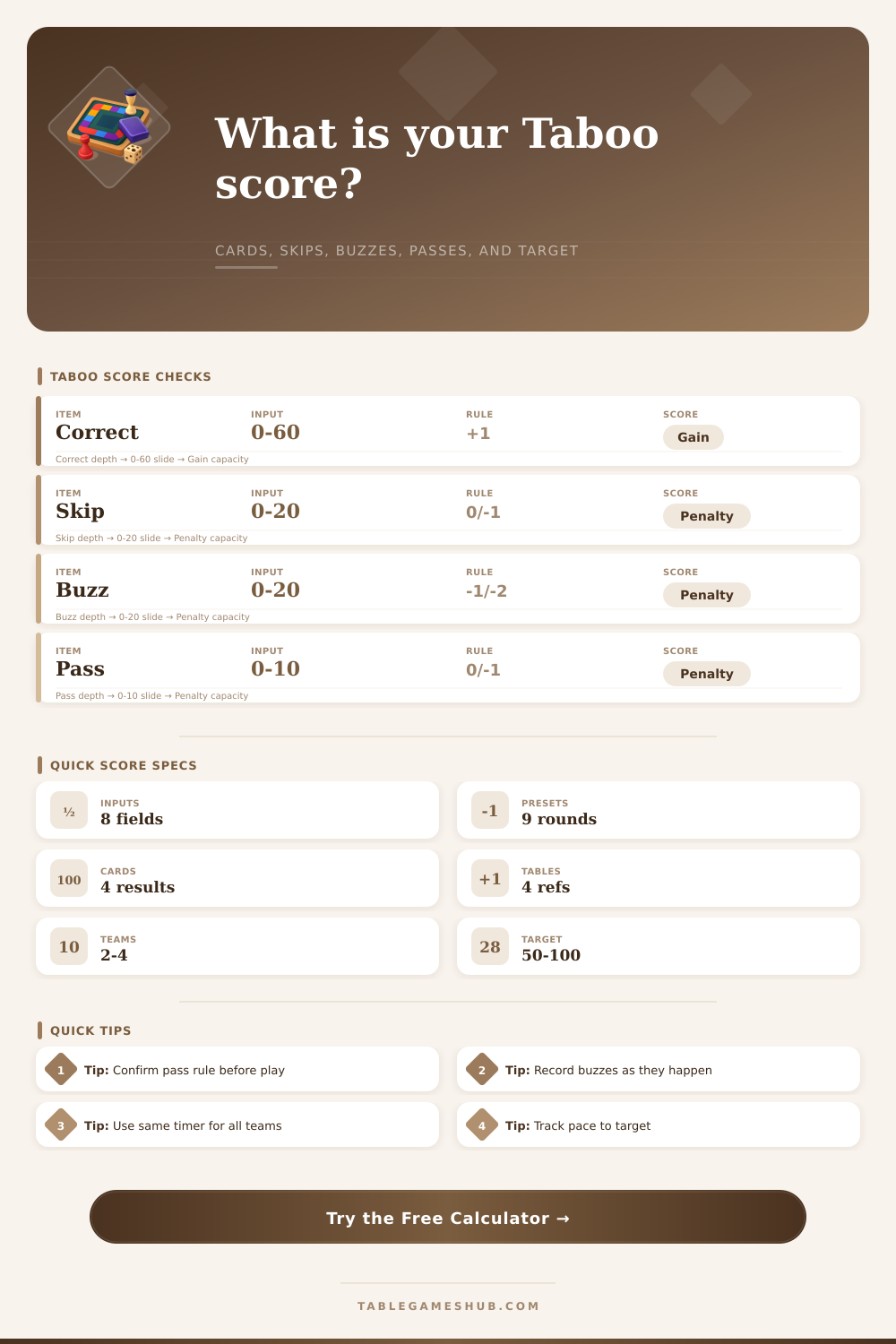
Total a Taboo turn from correct cards, skipped cards, taboo word violations, legal passes, timer length, rounds played, teams, penalty rule, and target score.
This team is on pace but still needs more clean turns to reach the target score.
Live turn score ledger
| Score line | Count | Rate | Subtotal |
|---|---|---|---|
| Correct cards | 9 | +1 | +9 |
Penalty rule profiles
| Profile | Target | Skip rule | Buzz and pass rule |
|---|---|---|---|
| Classic 50 | 50 | -1 per skipped card | -1 per taboo violation; passes free |
| Strict 50 | 50 | -1 per skipped card | -2 per buzz; first pass free, then -1 |
| Friendly 60 | 60 | Skipped cards score 0 | -1 per buzz; passes free |
| Tournament 75 | 75 | -1 per skipped card | -1 per buzz and -1 per pass |
| Marathon 100 | 100 | -1 per skipped card | -2 per buzz; passes free |
Timer pace guide
| Timer | Clean turn | Strong turn | Scoreboard note |
|---|---|---|---|
| 45 seconds | 4 to 6 correct | 7 or more correct | Fast table; penalties swing hard |
| 60 seconds | 6 to 9 correct | 10 or more correct | Standard party pace |
| 75 seconds | 8 to 11 correct | 12 or more correct | Good for mixed ages |
| 90 seconds | 10 to 14 correct | 15 or more correct | Learning table or large teams |
Target score planning
| Target | Average 5 net | Average 7 net | Average 9 net |
|---|---|---|---|
| 50 points | 10 team turns | 8 team turns | 6 team turns |
| 60 points | 12 team turns | 9 team turns | 7 team turns |
| 75 points | 15 team turns | 11 team turns | 9 team turns |
| 100 points | 20 team turns | 15 team turns | 12 team turns |
Then the timer dings and everyone breaks into a scrum of clapping and shouting protests. One team claims they hit target score while the other insists the referee missed a taboo word violation that should of cost them points. And this, my friends, is when all those house rules go right up their asses. Because at its core, Taboo’s a game about keeping things moving. As much about momentum as it is words. So the last thing you need is an argument over someone’s running point total before anyone’s had time to finish a drink.
That’s what the above calculator does for you: enter your card counts and penalty settings and let it crunch the numbers. No more mental math during the middle of a screaming match across the table.
How to Use the Taboo Score Calculator
On the surface scoring appears straightforward: each correct guess earns a point while incorrect answers cost points. It is like a game of math with an added wrinkle: other people are playing they own version of the game. Some tables considers a skip card as a non-event, just sliding it off to the side without disrupting the flow of the game. Others will count these missed opportunities as heavily as other guesses in order to discourage skipping out on clues too soon. With the tool, you can choose a penalty profile that aligns with how your group prefers to play. This way, whatever the final tally is, it reflect what you all agreed was at stake. Little things, sure, but when there are points on the line they matter.
Ultimately, how long your timer runs will alter the feel of the game. With the standard 60 second “hour” glass of sand, players has plenty of time to read through cards and come up with something clever (assuming they’re trying hard). If you want things to be faster and more energetic, go with speed rounds at only 45 seconds. This means people will need to make connections more quickly. You’ll also definitely see more accidental mistakes because there isn’t enough time to weed out forbidden phrases. This, in turn, causes the calculator to adjust it estimate of pacing, so you can better tell if your team’s doing great or not for that particular amount of time. You could rock a round with 90 seconds but fall flat on your face as soon as the pressure cranks up.
The other part of it all is team rotation. Playing head-to-head creates a direct rivalry that heightens the tension during every turn. It’s direct and makes every turn feel more tense. Add a couple teams and suddenly there’s more downtime between your own turns and the game spreads across more player. Since you’ll be sharing the deck with more people, you need fewer points per round than when two team share it evenly. There’s also a clear reference table on the page that explains how the average net scores converts into total rounds required to reach any given target. Knowing that will help you manage expectations around how long the game should last. This prevents it from stretching on endlessly or ending too early while everyone still has unfinished business.
The drama lies in the penalties. If you have a strict penalty for the wrong answer, a perfect turn can be derailed by a single buzz from an opponent. Some groups will let you get away with passing at no penalty so that it encourages social interaction versus aggressive play. Other groups will penalize you when you pass to avoid any kind of stalling tactic. Picking the right profile before you flip the first card avoids arguments during the game about whether this was a valid clue. It turns the game from a simple matter of recall to a test of precision and discipline.
One or two violations and the lead gained through correctly guessing answers gets erased immediately as the math adjusts on the fly. When most people play, they think only of obtaining a correct card, not efficiency. Ten correct cards sound nice, but what if those same number of turns also had five skipped clues and three violations? That’s where the true story of a person or team’s performance lies: their net score. By taking into account all successes AND all errors, it’s much better at measuring team strength than simply counting guesses. It encourages accuracy above volume, because it rewards people who can explain the concept without treading on forbidden territory.
You want to complete the deck; no question. But you also want to do it correctly and in style. Less buzzing and discarding of cards equals better scores (and cleaner turns). Keeping track of this rhythm lets the team know whether they need to speed up for quantity or slow down for accuracy. Based off your rate of play, the calculator shows an estimate of what’s left until your desired score; and how many rounds it will be. No more guessing, and everybody knows where they’re going.
But it’s important for good games to have fair scores and clear expectations. Knowing what number wins and understanding penalties means we can keep playing uninterrupted. Boiling all that information down into one easy equation makes it even easier. There is less arguing over rules and more giggles at terrible clues. That blend of spontaneous fun mixed with structure really makes Taboo stand out as a classic go-to for parties. Trusting the process lets the laughs take center stage while the score sorts itself out.