🎲 D&D 5e Ability Score Calculator
Calculate modifiers, skill bonuses, saving throws & simulate 4d6 drop-lowest rolls
Simulates rolling 4d6, dropping the lowest die, for each of the 6 ability scores. Results are sorted highest to lowest.
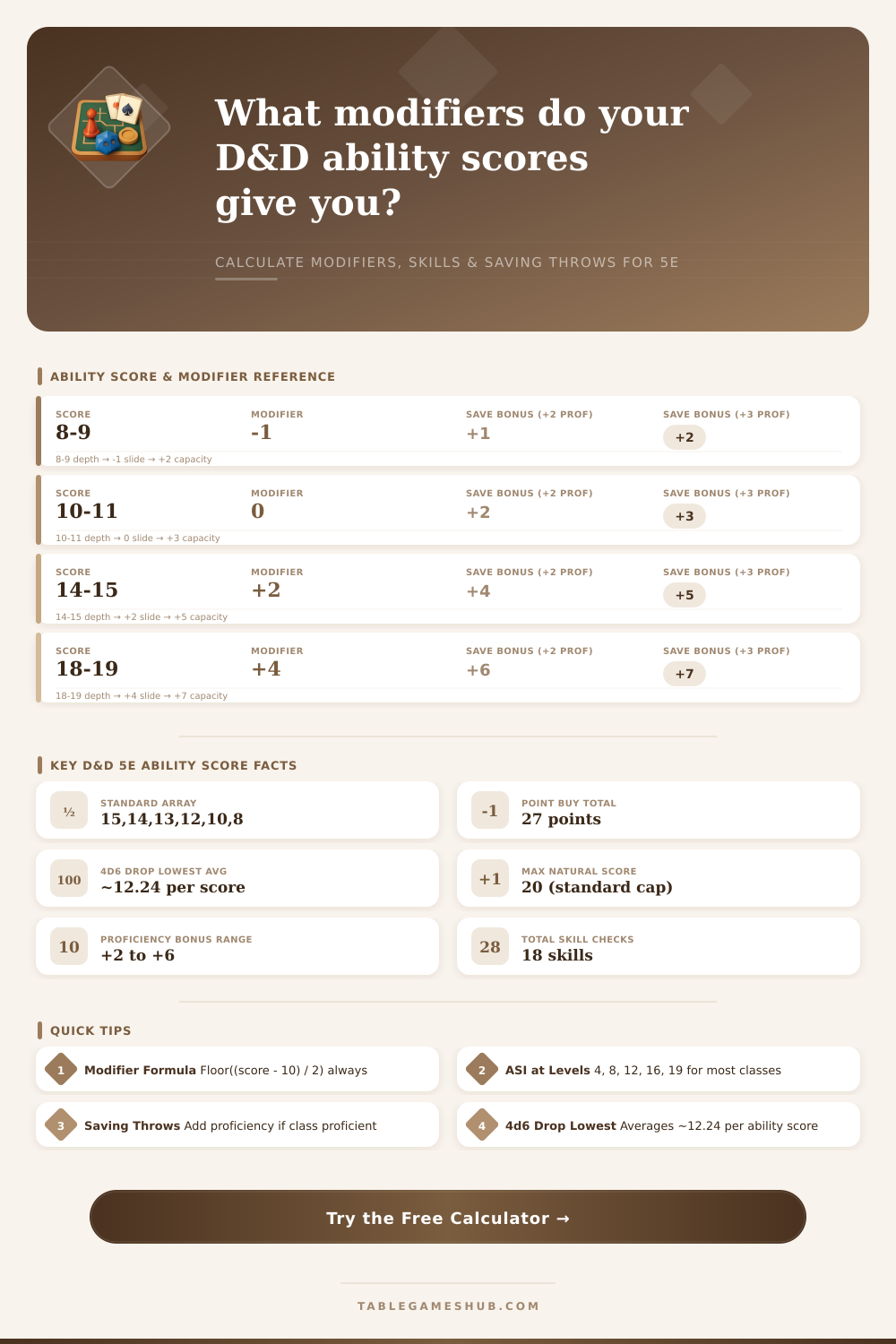
| Score | Modifier | Save (+2 Prof) | Save (+3 Prof) | Save (+4 Prof) | Save (+5 Prof) | Save (+6 Prof) |
|---|
| Skill | Governing Ability | Skill | Governing Ability |
|---|---|---|---|
| Acrobatics | Dexterity | Medicine | Wisdom |
| Animal Handling | Wisdom | Nature | Intelligence |
| Arcana | Intelligence | Perception | Wisdom |
| Athletics | Strength | Performance | Charisma |
| Deception | Charisma | Persuasion | Charisma |
| History | Intelligence | Religion | Intelligence |
| Insight | Wisdom | Sleight of Hand | Dexterity |
| Intimidation | Charisma | Stealth | Dexterity |
| Investigation | Intelligence | Survival | Wisdom |
Every character in Dungeons & Dragons has six ability scores: Strength, Dexterity, Constitution, Intelligence, Wisdom and Charisma. These values define the physical or mental skills of a player, monster or non-player character. An ability score does not measure only innate gifts but also includes training and skill in certain actions.
They represent raw talent, and although you rarely roll a check using only the basic score these values and their modifiers affect almost every part of the character.
All About Ability Scores in Dungeons & Dragons
Dexterity covers the motor skills, balance and control over the own body. Characters with high Dexterity are usually agile, flexible and fast. Players commonly want to be very good in some fields, but weaker in others.
Which ability scores to prioritize entirely depends on the type of character you build. Dexterity is commonly called the most important stat of 5e, while Intelligence is occasionally considered the dump stat. Because almost all classes use medium armor, Dexterity 14 is commonly more important even than the magic skils.
There are several ways to create these scores. The main method in the Player’s Handbook is rolling 4d6 and dropping the lowest result. That gives a range of 3 to 18.

Roll the three remaining dice and repeat that six times, then assign the numbers to the six abilities. This is the most random way, which can create very powerful or totally uneven characters. Another method is the “down the line” roll, where players roll 3d6 following the order of Strength, Dexterity, Constitution, Intelligence, Wisdom and Charisma.
Point buy is another option. It gives 27 points initially, that you spend to improve individual abilities, although increases above 13 cost more. For instance, spending 9 points you buy Dexterity of 15, 7 points give Constitution of 14, and 5 points give Wisdom of 13.
The standard array scores are 15, 14, 13, 12, 10, 8. Without racial bonus or a feat as a Variant Human, there is no way for an ability score to be 19 for a starting character.
Ability score modifiers are used to alter the result of a d20 roll during checks. The bonus is counted by subtracting 10 from the score and then dividing by 2. For every two points above 10, you receive +1.

So, a score of 14 gives +2. A score of 9 gives -0.5, which rounds to -1. The maximum value now is 20, although some suggest that at level 19 it could reach 22.
Permanent improvement happens when you take feats or improve abilities at certain levels. Monsters also receive modifiers according to what is written in their stat-blocks.