🎲 Mexican Train Dominoes Score Calculator
Total pips left in hand, apply open-train and double-blank house rules, rank cumulative standings, and keep the round double schedule moving cleanly.
Player 1
Player 2
Player 3
Player 4
Player 5
Player 6
Player 7
Player 8
| Metric | Value | Formula | Scorekeeping note |
|---|
| Rank | Player | Pips left | Open penalty | Blank penalty | Round add-on | New total | Status |
|---|
| Set type | Tile count | Usual rounds | Common player range |
|---|---|---|---|
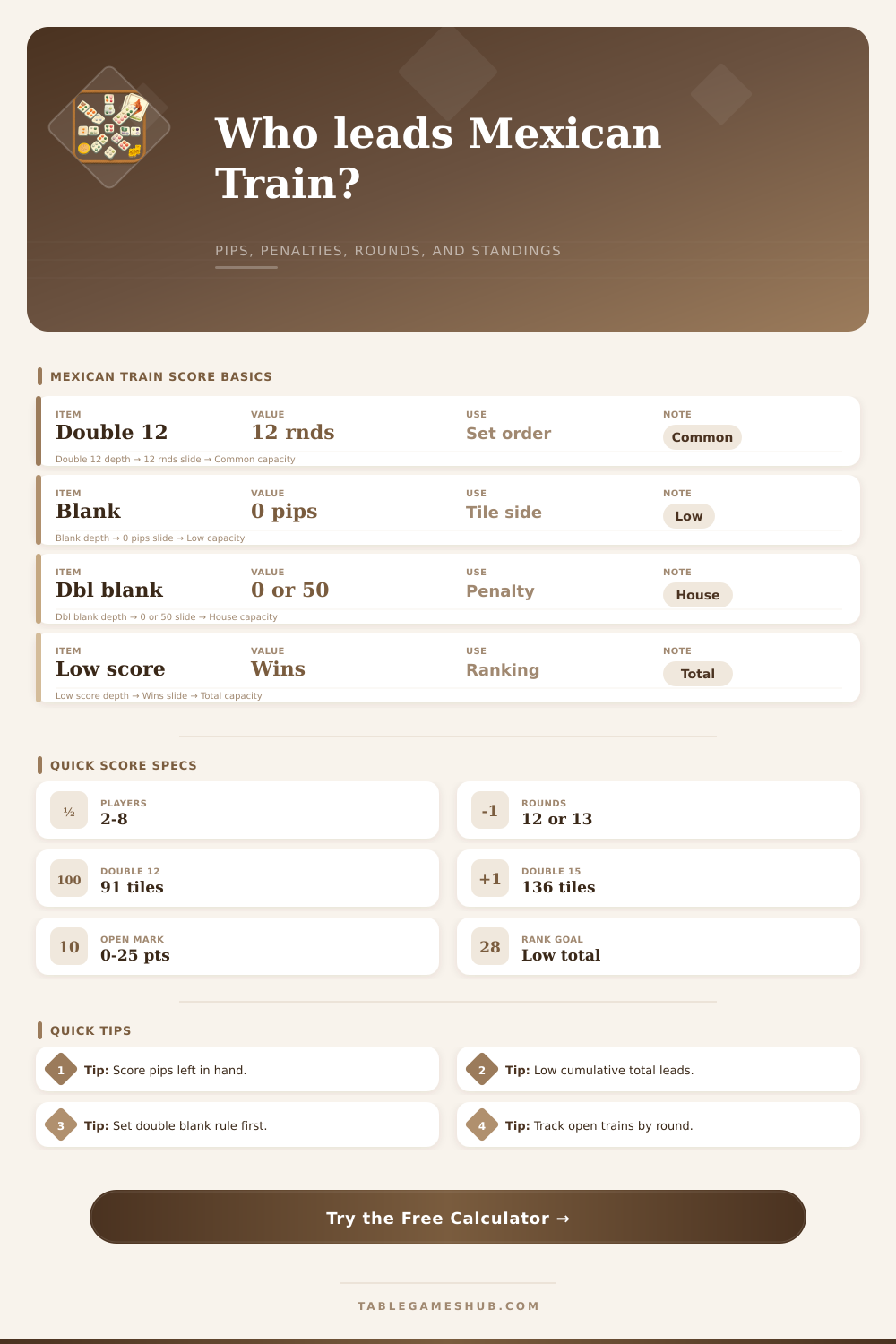
| Double-9 | 55 tiles | 10 rounds, double 9 to blank | 2 to 4 players |
| Double-12 | 91 tiles | 13 rounds, double 12 to blank | 2 to 8 players |
| Double-15 | 136 tiles | 16 rounds, double 15 to blank | 6 to 10 players |
| Double-18 | 190 tiles | 19 rounds, double 18 to blank | 8 or more players |
| Round block | Starting double | Score pressure | Score sheet check |
|---|---|---|---|
| Opening high doubles | Double 12, 11, 10 | Large pip totals can remain in hands | Confirm the round number matches descending order |
| Middle doubles | Double 9 through 5 | Moderate hands and frequent open markers | Track pips and open trains separately |
| Low doubles | Double 4 through 1 | Lower pip ceilings but standings matter | Watch leader spread and comeback range |
| Final blank round | Double blank | Blank handling must be agreed in advance | Use the double blank rule selector |
| Rule item | Standard score sheet | Optional house scoring | Calculator field |
|---|---|---|---|
| Pips remaining | Every tile side in hand is totaled | No change; this is the core score | Pips left |
| Open personal train | Usually no extra points | 0, 5, 10, or 25 points per marker | Open train marker penalty |
| Double blank | Zero pips by tile face value | 25 or 50 points if held | Double blank scoring rule |
| Round winner | Player who emptied first scores zero pips | Went-out flag can break ties | Went out selector |
| Standing metric | Formula | Best value | Use during match |
|---|---|---|---|
| Round add-on | Pips + open penalties + blank penalty | Lowest | Enter into the current round column |
| Cumulative total | Prior total + round add-on | Lowest | Sorts the leaderboard after each round |
| Leader spread | Second-lowest total - lowest total | Wider is safer | Shows how close the table is |
| Round average | All active round add-ons / players | Lower is cleaner | Flags a heavy round with many stranded pips |
Separate pips from penalties
Keep the raw pips-left column visible even when using open-train or double-blank house penalties. It makes disputes easier to audit later.
Confirm the blank rule early
The double blank can count as zero by face value, but many home sheets score it as a penalty tile. Pick the rule before round one.
Mexican Train is a game in which the players must keep track of many different numbers. One tool that is useful to the players in tracking these numbers is a score calculator. Score calculators are useful in that it perform the arithmetic for the players, and prevents the players from having arguments over who won which round of Mexican Train.
After each round of Mexican Train has concluded, each player must count the number of pips on each of the tiles that remain in their hand, and each player must apply any house rules that the group of players have established for the evening. The most important number in the game of Mexican Train is the number of pips that remain in a player’s hand after each round. Each side of a tile contains a certain number of pips that count towards that total; however, a blank (zero pip) tile count as zero pips unless the group of players have established otherwise.
Why Use a Score Calculator for Mexican Train
Any player who has played their last tile in a round will have no tiles remaining in their hand; in such a case, those player will score zero pips for that round. In addition to scoring zero pips, some groups establish house rules that penalize players for having open train marker, or who has the valuable double-blank tile. These house rules can be established in a score calculator in advance, and will be automatically applied to each round of Mexican Train.
In addition to being a tool for calculating scores, players also use score calculators to keep track of the order in which each round of Mexican Train are to occur. Each round begins with a double tile, and the order of those doubles range in descending order from the highest (double twelve) to the lowest (double blank). After the players complete each round, the score calculator can show the players the number of rounds that remain in the game.
Thus, score calculators help the players to understand the length of the game, and the way in which the players are meant to progress throughout the game of Mexican Train. The standings between each player in a game of Mexican Train are established based off the total number of pips that each player collected throughout all of the rounds of the game. The player with the lowest total is the winner of the game of Mexican Train.
However, it is possible for a player to score zero in one round yet still have a high total when compared to other players’ totals. Score calculators allow each player to view each player’s total score for each round, as well as automatically re-ranking the players after each round. Thus, score calculators help each player to understand who is currently winning the game of Mexican Train, as well as the score gap between the winning player and others in the game.
In some groups of players, different house rules are applied regarding the value of the double blank tile, as well as the value of any open train markers. For instance, some groups may establish that the double blank tile is score is zero pips, while other groups may give it a value of fifty pips. Additionally, some groups may establish that any open train marker is penalized, while others may state that any such marker has no effect upon the player’s score.
These rules are recorded in the score calculator before the game begins. Score calculators apply these rules only to the relevant player that is holding the relevant tile. By automating this process, the players’ conversation stay focused on the game of Mexican Train.
The number of rounds that will occur in a game of Mexican Train is established based upon the size of the set of tiles that will be used in the game. For instance, a set that contains double nine tiles will contain ten rounds of Mexican Train, while a set that contains double twelve tiles will contain thirteen rounds of Mexican Train. Score calculators are useful for allowing the players to see how many rounds still remain in the game.
For instance, early rounds will contain more pips in each player’s hand than the later rounds. Thus, the score calculator helps the players to prepare for the remaining rounds of the game. A common mistake in the game of Mexican Train is to confuse the score that was earned within a single round with the total score that each player accumulated throughout the game.
Additionally, another common mistake is to forget which player played their last tile in each round. Mistakes that can lead to incorrectly scoring other players with the same number of pips in their hand. Score calculators include features that help players to avoid these mistake.
For instance, the score calculator can highlight any error in the game, as well as provide an indication of the current standings of each player. Scorekeeping for each round of Mexican Train becomes more difficult as the number of players increases. Score calculators can handle scorekeeping for two, three, six, or eight players.
Score calculators can be labeled with a name or date for each game of Mexican Train. Thus, the score calculator helps to eliminate the mental math that each player is required to perform, and eliminates any error that players may make while tired during the course of the game.