Tiddlywinks Distance Calculator
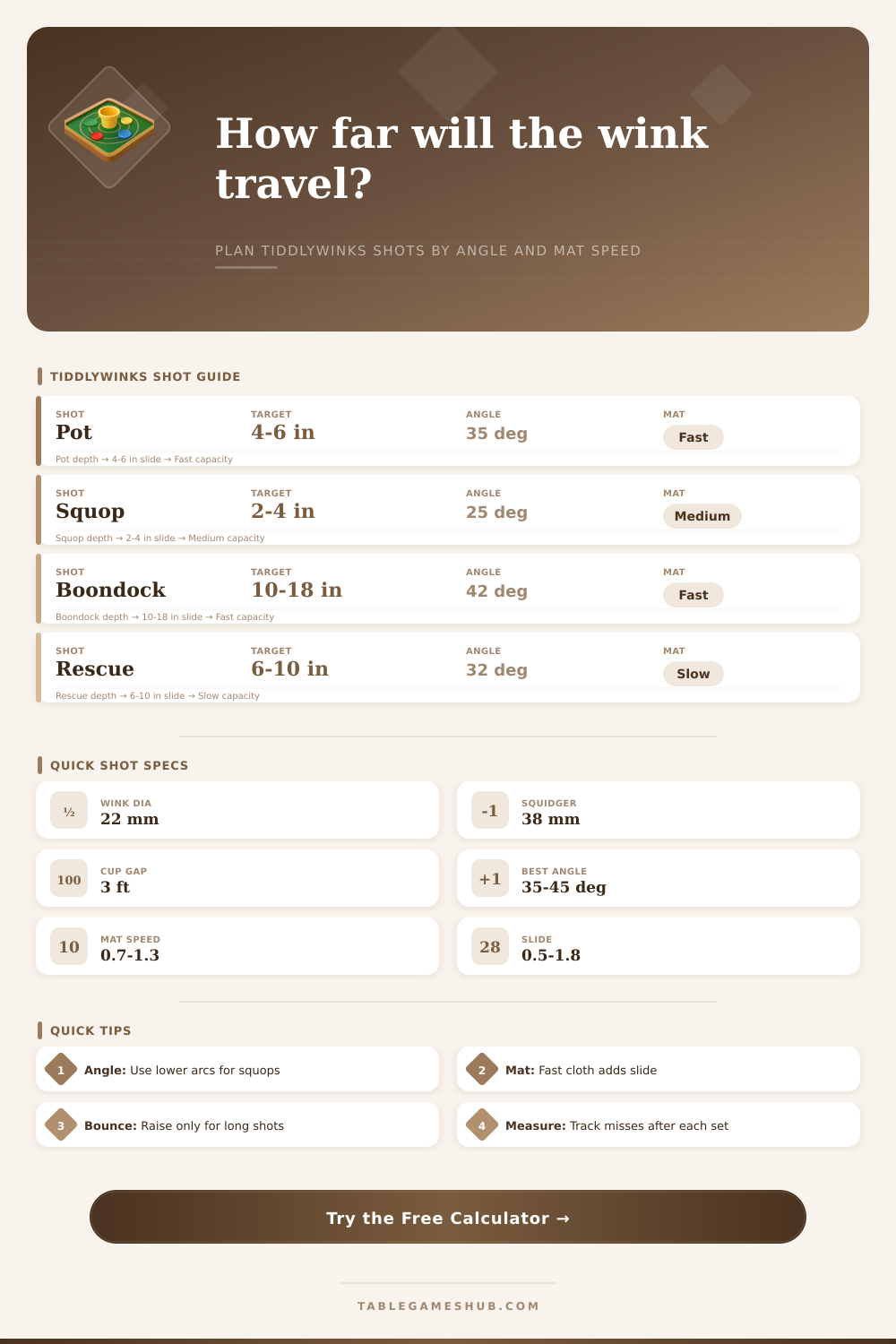
Estimate wink travel from squidger size, wink diameter, launch angle, mat speed, target distance, bounce, and slide.
| Scenario | Target | Angle | Mat speed | Best use |
|---|---|---|---|---|
| Cup pot from 4 inches | 4 in | 35 deg | 1.10 | Controlled pot line |
| Cup pot from 6 inches | 6 in | 38 deg | 1.05 | Standard practice shot |
| Near squop control | 3 in | 24 deg | 0.90 | Short cover placement |
| Long boondock to corner | 18 in | 44 deg | 1.20 | Clearing a free wink |
| Mat speed | Factor range | Typical effect | Slide setting | Planning note |
|---|---|---|---|---|
| Slow felt | 0.65-0.85 | Shorter roll-out | 0.55-0.90 | Add force before angle |
| Medium mat | 0.90-1.10 | Balanced carry | 0.90-1.20 | Use as baseline |
| Fast cloth | 1.15-1.35 | Longer slide | 1.20-1.80 | Reduce force first |
| Very slick | 1.35-1.50 | Overshoot risk | 1.60-2.20 | Keep launch low |
| Launch angle | Arc style | Carry share | Good for | Caution |
|---|---|---|---|---|
| 15-24 deg | Low skim | Low | Squops and nudges | May dig into felt |
| 25-34 deg | Soft hop | Medium | Approach placement | Needs clean edge |
| 35-45 deg | Full travel | High | Pots and clears | Watch overshoot |
| 46-60 deg | Steep lift | Medium | Pack rescue | Less predictable |
| Result gap | Meaning | Force tweak | Angle tweak | Mat tweak |
|---|---|---|---|---|
| Under 0.5 in | Match ready | Keep | Keep | Record setting |
| 0.5-2 in short | Needs more travel | Add 0.3-0.8 | Add 2 deg | Check nap |
| 0.5-2 in long | Likely overshoot | Drop 0.3-0.8 | Drop 2 deg | Lower slide |
| Over 2 in | Rebuild shot | Reset force | Pick new arc | Retest mat |
Tiddlywinks is a game of flicking small plastic discs called winks with a larger plastic tool called a squidger. The goal is to get the winks into the cup or to cover the winks of the opponent. Although it may seem like distance in the game of tiddlywinks is only the distance that the wink travels on the mat, distance is actualy affected by the height of which the wink is flicked off the mat, the distance that the wink slides on the mat after it lands on the mat, and the way the cloth of the mat can change the distance that the wink travels.
Because the cloth can change the distance that the wink travels, the player must understand how the mat can behave. Many players will spend alot of time adjusting the way that they flick the winks when they miss a shot. However, players who notice the patterns in which their shots travel will find that they are able to improve at the game of tiddlywinks faster then players who do not notice those patterns.
What Affects How Far a Wink Travels
For instance, players can notice that using a lower launch angle will allow the wink to remain on the mat longer after it is flicked, while a steeper launch angle will allow the wink to travel farther. Additionally, the same squidger will produce different results on a slow felt mat compared to a fast felt mat. The calculator that is provided to players will help the players to perform the required math once the player enters the variables for the game of tiddlywinks.
The variables that a player enters into the calculator are the same variables that impact the game of tiddlywinks. Each of the variables impact the distance that the wink will travel. For instance, the diameter of the squidger will change the amount of surface area that the player has to apply force to the wink.
Additionally, the size of the wink impacts how the wink will interact with the felt mat. The launch angle impacts the distance that the wink will travel both on the mat and in the air. The force scale of the flick is the variable that most players will adjust when playing the game.
The mat speed affects the surface upon which the player will be flicking the winks. Additionally, the bounce and slide factors allow the player to account for the way that the cloth of the mat may behave. When the player changes any of the values of the calculator, the calculator will provide two separate pieces of information to that player.
The calculator will display the distance that the winks will travel, as well as the distance that the winks will travel in the air compared to the distance that the winks will travel while sliding on the mat. These two distances will allow the player to correct their flicks if they find that their shots landed short (by increasing the force with which they flick the winks) or if their shots landed in the target but the winks traveled too far (by decreasing the value of the slide factor). Thus, the player will not make the wrong adjustments to there flicks.
Many tiddlywinks players will have a sense of each of these variables without having ever measured each of them. For instance, in situations in which the squop (the player who flicks the winks to the opponent’s cup) needs to stop the winks quickly, a low launch angle and a mat speed that limits the roll of the winks will be used. In situations in which the boondock (the player who must land the winks in their own cup or to cover the opponent’s winks) needs to get the winks to travel a distance to clear a free wink from the opponent, a high launch angle and fast mat will allow the winks to travel those distances.
Finally, when performing a rescue shot (where a winks must travel through other winks to land in the target), a steep launch angle will allow the winks to drop straight down onto the mat after clearing the other winks. Each of these instances the calculator can account for. The reference tables included with the calculator allow players to understand the different scenarios for which the same variables will produce the same results.
Although these tables are not a replacement for the practice required to become skilled at the game, the reference tables will allow the player to have a starting point for the game of tiddlywinks. For instance, using the reference tables, a player can determine the launch angle and mat speed that will be used for attempting to pot a single wink. Once the player feels the mat with their wink, the player can adjust the force and slide variable to account for any inconsistencies in the mat felt by the player.
With practice, players will find the patterns represented in the tables to be more important than the numbers themselves. In addition to understanding how each of the variables impact the game of tiddlywinks, a player must also learn to read the mat upon which they will be flicking the winks. For instance, due to the way in which many tiddlywinks players use the mat, one end of the mat may be faster than the other end of the mat.
Additionally, there may be a slight nap to the mat that will cause the winks to travel to one side of the mat compared to the other. Although the calculator does not have the ability to read the mat, the player can use the calculator to record the observations that they make about the mat. Thus, if the player observes through the calculator that a certain input for the winks will cause the winks to travel a longer distance on one side of the mat than on the other side of the mat, the player will know to use one side of the mat for certain types of shots compared to the other side of the mat.
One of the variables that many players overcorrect is the force with which they flick the winks. This is because force is one of the easiest variables to adjust. For instance, increasing the force with which the player flicks the winks on a fast mat will result in the winks traveling a further distance on the mat than if the same amount of force is used on a slow mat.
Thus, the calculator allows the player to become aware of this interaction between the force that is used to flick the winks and the speed of the mat. The same principle can be used to understand the use of different squidgers. For instance, larger squidgers will distribute the force that is used to flick the winks over a larger area, which may reduce the extra bounce of the winks.
Additionally, smaller squidgers will allow for more of the force to be applied to the winks by concentrating that force in a smaller area, which allows the player to achieve a higher launch of the winks using the same amount of pressure on the squidger with the thumb. Thus, the calculator can help a player decide which squidger will achieve the same distance to the target when compared to the other squidger. The calculator has the ability to calculate the distance that the winks will travel, but it does not have the ability to calculate the feel of the shot that is being flicked with the squidger, the give of the felt mat, how the squidger sits upon the winks, or the timing of when the player flicks the winks with the squidger.
Each of these aspects of the game belongs to the player when flicking the winks with the squidger. However, the calculator will help to remove the guesswork that the player has to use in determining the interaction of the various variables in the game. Thus, by removing the guesswork for the players, the player will be able to make adjustments to their flicks to increase their effectiveness, and with time the relationship between the different variables will become second nature to the player.