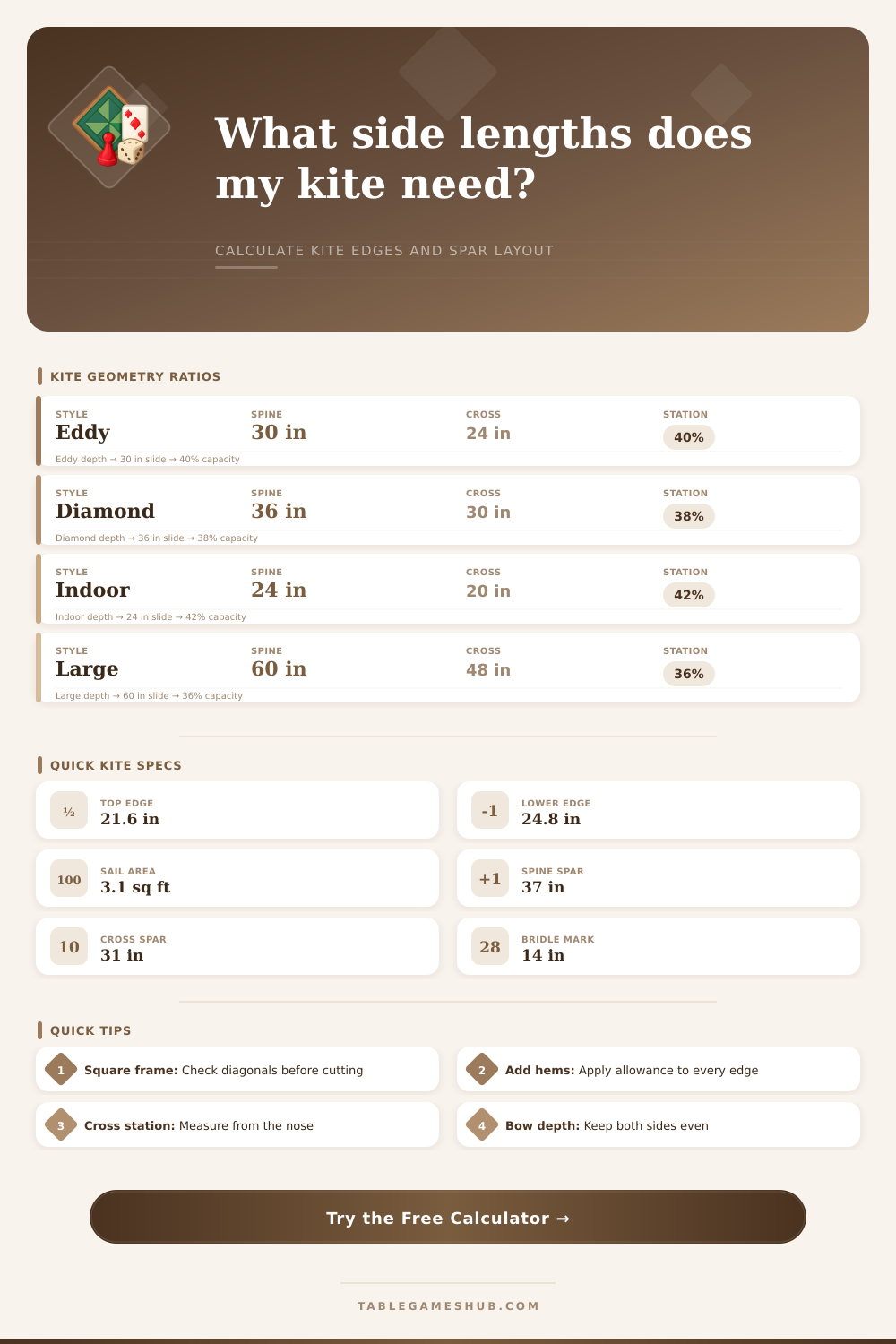
🪁 Kite Side Length Calculator
Convert spine, cross-spar, station, bow, allowance, and bridle marks into cut lengths for a classic four-point kite sail.
| Kite Style | Cross Station | Width Ratio | Layout Note |
|---|---|---|---|
| Classic diamond | 35% to 40% of spine | 75% to 85% of spine | Stable general shape |
| Eddy bowed diamond | 38% to 42% of spine | 75% to 90% of spine | Bow helps dihedral |
| Indoor light-wind | 40% to 45% of spine | 80% to 95% of spine | Wide and light |
| Narrow trainer | 34% to 39% of spine | 55% to 70% of spine | Less wing area |
| Spine Length | Typical Cross Spar | Area Range | Common Use |
|---|---|---|---|
| 18 to 24 in | 15 to 21 in | 1.0 to 1.8 sq ft | Indoor or model |
| 30 to 36 in | 24 to 31 in | 2.5 to 3.9 sq ft | Small field kite |
| 42 to 48 in | 34 to 42 in | 5.0 to 7.0 sq ft | Yard flyer |
| 54 to 60 in | 43 to 52 in | 8.0 to 11.0 sq ft | Large single-line |
| Cut Item | Geometry Source | Allowance Usually Added | Check Before Cutting |
|---|---|---|---|
| Upper leading edges | Station plus half span | Hem on each edge | Left and right match |
| Lower trailing edges | Lower segment plus half span | Hem on each edge | Tail point centered |
| Spine spar | Full spine length | Top and tail pockets | Straight centerline |
| Cross spar | Wingtip span | Pockets plus bow depth | Equal wing halves |
| Bow Depth | Percent of Span | Frame Effect | Layout Reminder |
|---|---|---|---|
| Flat | 0% | No added curve | Best for templates |
| Light bow | 4% to 6% | Mild dihedral | Good first build |
| Medium bow | 7% to 10% | More stability | Keep both sides even |
| Deep bow | 11% to 14% | Shorter projected span | Recheck sail fit |
Tip 1: Mark the cross station first
The upper and lower side lengths depend on the cross-spar joint, so mark that station on the spine before drawing the sail outline.
Tip 2: Keep bow allowance separate
Bow depth changes spar preparation more than flat sail geometry. Cut the sail from the flat diagonals, then prepare the cross spar for the chosen bow.
Building a kite requires an understanding of geometries so that the dimensions of the fabric accounts for the diagonal lengths of the kite. Many peoples make the mistake of using the length of the spars of the kite to determine the length of the fabric. The edges of a kite are not made of the length of the spars of the kite, but of the diagonals of the kite.
These diagonals are longer than the length of the spars due to the fact that they are measuring the distance between two points without any middle connection. If the builder cuts the fabric to the length of the spars, then there wont be enough of it to cover the length of the spars. In order to avoid this problem, the builder should calculate the diagonals of the kite to ensure that the fabric is long enough to cover the kite frame.
How to Measure and Build a Kite
In order to calculate the length of the outer edges of a kite, the builder must know the distance from the nose to the cross spar of the kite, as well as the distance from the center of the kite to the wingtip. By changing the position of the cross spar of the kite, it is also possible to change the length of the outer edges of the kite. This is due to the change in the dimensions of the triangle that make up the kite.
The builder can calculate these measurements with a calculator to save the effort of having to calculate these measurements with trigonometry. Choosing a type of planform to utilize when building a kite is a necessary process. One of the most common type of planforms is that of a diamond shape.
An Eddy kite, however, use a curved cross spar. This curved cross spar creates a dihedral angle in the kite that provides stability in the wind. It also prevents the kite from spinning in different directions in the air.
The curved cross spar must be longer than the flat width of the kite. This is to allow the cross spar to fit into the pocket of the kite fabric. In addition to determining the size of the sail that will be used for the kite, it is also necessary to provide allowances for the fabric.
Allowances must be made for the hem of the kite. If no allowance is made for the hem, the sail will be too small once it is hemmed. Allowances must also be made for the length of the spar pockets into which the spars of the kite will fit.
These allowances should be made before the kite is constructed to ensure that there will be enough fabric to assemble the kite. The position of the cross spar is one of the most critical variable in kite construction. If the builder positions the cross spar too high on the spine of the kite, the kite will be nose heavy and will tend to dive.
If the cross spar is positioned too low on the spine, the kite will be too unstable or too sluggish in its movements. The best position for the cross spar is forty percent of the length of the spine. This position create the best balance for the kite in relation to its movement.
The builder should balance the surface area of the sail against the tension of the frame of the kite to create a kite that will correctly fly in the wind. The bridle is the name given to the string system that allow the kite to remain in an angle to the wind. The position of the bridle attachment point will determine how the kite moves in the wind.
If the bridle attachment point is too high on the kite, it wont be able to catch the wind properly. If the point is too low, the kite will begin to loop and crash into the ground. The attachment point for the bridle should be near the cross spar.
However, the builder should make allowances for adjustments to the angle of the bridle to allow the kite to find the angle at which it will correctly and steady fly in the wind. Finally, the tail that is attached to the kite serves to provide drag for the kite. This drag keeps the kite from nosing over and prevents erratic movements of the kite.
If the kite begins to exhibit erratic movement, a longer or a heavier tail can be used to increase the drag of the object. The tail acts as a stabilizer for the kite. When cutting the fabric for the sail of the kite, it is important to make mark along the fabric to indicate the centerlines of the sail.
A ruler can be used to determine the center of the fabric. These marks will allow for the marking of the spine and the cross spar of the kite. If the lines are not marked, the resulting kite may not be symmetric.
A kite that is not symmetric will tend to pull to one side of the kite. A symmetric kite is more stable than an asymmetrical kite. Additionally, if the builder calculates the dimensions of the kite precisely, less fabric will be required for the kites construction.