Cribbage Go Count Calculator
Check a pegging count event for running total, legal play, go, 31, last card, fifteens, pairs, and runs.
Breakdown
| Score check | What the calculator checks | Points | Logistics note |
|---|---|---|---|
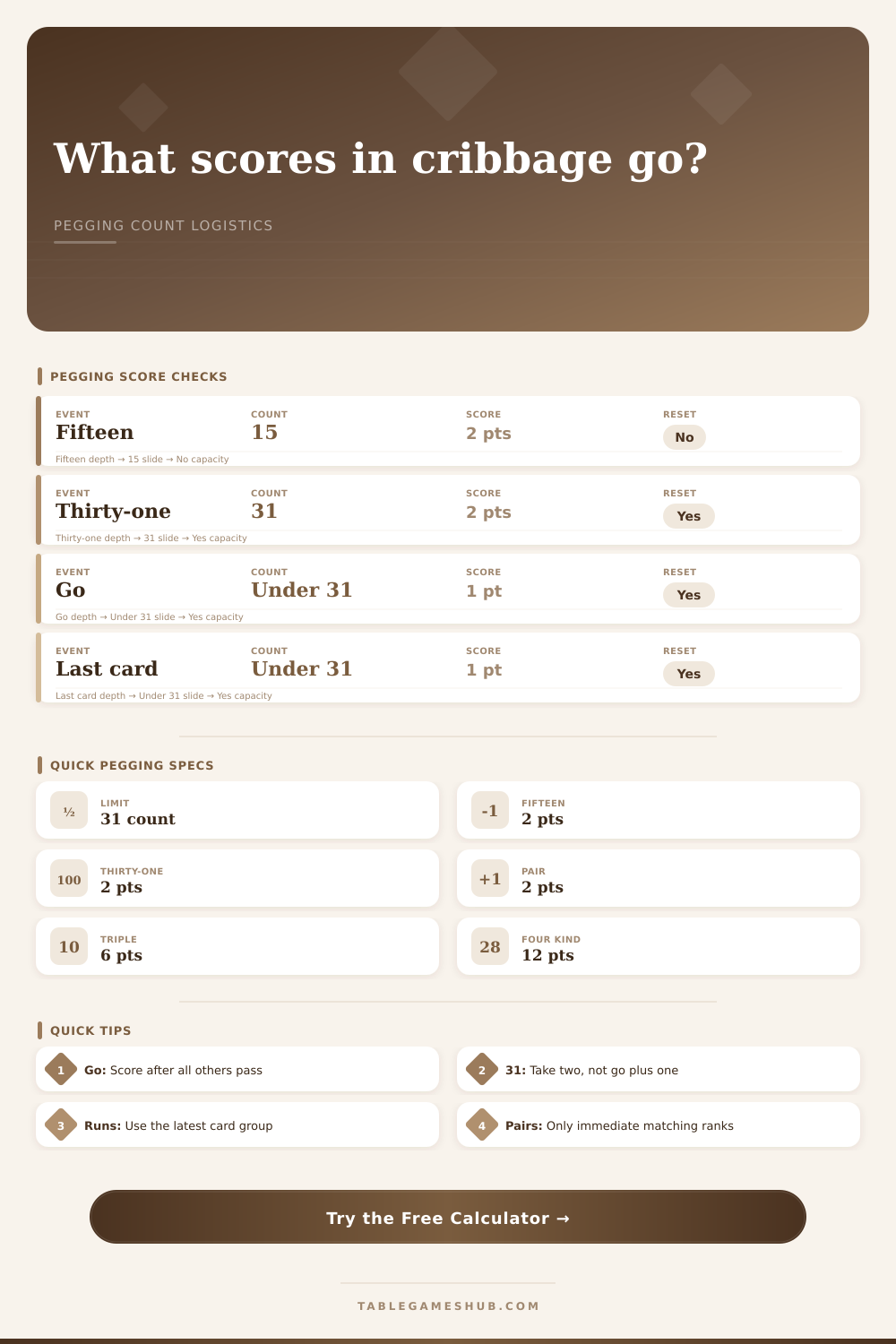
| Fifteen | New running count equals exactly 15 after a played card. | 2 | Can combine with pair or run points from the same card. |
| Thirty-one | New running count equals exactly 31 after a played card. | 2 | Ends the count immediately and resets the next count to zero. |
| Pair | Latest card matches the immediately previous rank only. | 2 | Only consecutive matching ranks count as pair family points. |
| Pair royal | Latest three cards are the same rank with no interruption. | 6 | This replaces the simple pair value for that event. |
| Double pair royal | Latest four cards are the same rank with no interruption. | 12 | This is the four-of-a-kind pegging score. |
| Run | Latest card completes a consecutive rank group of at least three. | Run length | Order can be scrambled; duplicates break that run window. |
| Situation | Running count | Point award | Next count state |
|---|---|---|---|
| Player says go | Under 31 | No point until all other active seats are unable to play. | Count remains with the last player able to play. |
| All others blocked | Under 31 | Last player to play scores 1 for go. | Reset to zero for the next lead. |
| Exact 31 | 31 | Card player scores 2 for 31. | Reset to zero; do not add a separate go point. |
| Final card of hand | Under 31 | Last card scores 1 if no 31 was just made. | Deal pegging is complete. |
| Rank group | Count value | Run order value | Accepted input examples |
|---|---|---|---|
| Ace | 1 | 1 | A, Ace, AH |
| Number cards | Printed number | Printed number | 2, 7, 10, 10S |
| Jack | 10 | 11 | J, Jack, JD |
| Queen | 10 | 12 | Q, Queen, QC |
| King | 10 | 13 | K, King, KH |
Count score
Fifteen and 31 use the numeric running count after the event.
Pattern score
Pairs and runs use the latest consecutive card trail, ending with the new card.
Pass score
Go is a closure award after the remaining seats are unable to play.
Deal cleanup
Last-card point closes the hand when the final card did not make 31.
They say Cribbage is one of those games you can play with a few cards, but to me, it’s more like a high-speed game of arithmetic chess. There’s always the story being told through the arrangement of the cards and the run or pair you’re trying to make, all while keeping a mental count of your hand. As you approach thirty-one, though, that’s when the trouble begins. That’s the spot where most people will mess up… The simplicity of fifteen makes us comfortable, but we fumble over go math.
This cribbage calculator is perfect for those difficult at-the-end-of-the-hand counts and totals. Numbers aside, pegging is all about juggling a collective resource, the running count… With the goal of getting more points out of any patterns found.
How to Score Points in Cribbage
So as each card gets played, there are two factors in view: How does it affect the sum? (It may score points right away if it brings total to fifteen or thirty-one.) And how does it affect the sequence? (Does it continue a pair or complete a run?) The calculator above take care of that math when you plug in the cards and count currently held. That frees up some brainpower, letting you worry less about pattern overlap and coefficient calculations, and concentrate on strategy itself.
Most people misunderstand what go means in pegging. They believe it’s just saying “stop,” but in reality, it’s a scoring event based on being unable to play a card. If you play a card that leaves the count at twenty-eight and your opponent has no card low enough to bring them to thirty-one, they must call go. You get one point. However, if your opponent does have a three, which allows her or him to play it and thus come up to thirty-one, then instead of getting one point, they’ll score two points.
So why does this matter? A go will end the count and reset it back to zero. A thirty-one will also end the count, but it rewards you with additional points. This is a key tactical decision about whether to go for a clean thirty-one or force the other player into calling go.
This gets laid out nicely on the tool, which you will find here. Try any combination… Say a complicated hand with a pair royal, or just a straight up go at twenty eight. It wants to know how many cards has been played so far and what your running count was prior to it happening. That’s key, as what’s relevant to a run is what happened in the immediate card trail.
So a run of four, five, or even three counts as a run. But if there’s a duplicate that spoils the flow then no dice. The calculator looks only at most recent cards you choose as the window, and won’t credit a busted run that occured early.
The second is the pair scoring ladder. Two points make up a simple pair. Three of a kind (a pair royal) is worth six points. Four of a kind (double pair royal) scores twelve. They’re not additive. The third card doesn’t add another two points to existing pair, it replaces the two points with a higher number. This makes sense, but it’s not what we’d expect. The calculator displays this: the total points for the event, as opposed to simply adding separate point values together. It ensures that you don’t fall into the trap of double counting. That happens when you play a king on top of two other kings. You’re not worth four points, you’re worth six.
Keeping score this way means less argumentation, and more accuracy. If you play out a hand and you have to play your last card, which isn’t up to thirty-one points, then the person playing the last card gets a point. And this is separate from a go. With a go the count ends because somebody is blocked before the end of the hand. The last card point is an award of points for cleaning up the deal.
There is no such thing as a go and a thirty-one together on the same hand. Either it is a go or it is thirty-one but not both, and that clears things up for when you’re trying to explain the score to someone new or review a hand at some later time. The reference table in the tool makes the distinction clear, too.
How do you learn to peg well? You get good by applying these rules so well that they become instinctive. At first, you think it out, does this extend my run? Does it make me fifteen? Does it force me to go? As time goes on, the arithmetic recedes into the background and you see the board as a pattern of opportunities.
For a while, the calculator is still a bridge across the learning curve, where you can test your instincts against what the rules actualy say. It’s a sandbox for trying out edge cases: complex go situations in three-player games, scrambled runs, etc.
So in conclusion, cribbage comes down to little things. One point here, one there. Miss a few royal pairs or a go, and you have a tight contest. And that’s when a counting tool becomes useful. It frees up mental space for other aspects of the game, like strategy and remembering cards, all without having to worry about simple math.
Eventually you want to get to a place where you trust your count as much as you trust your hand. When it gets to that level, you have yourself a real game, with honest scores and smooth-flowing pegs. The next time you’re at twenty-eight and second guess yourself, you’ll be able to exactly call out what the count requires.