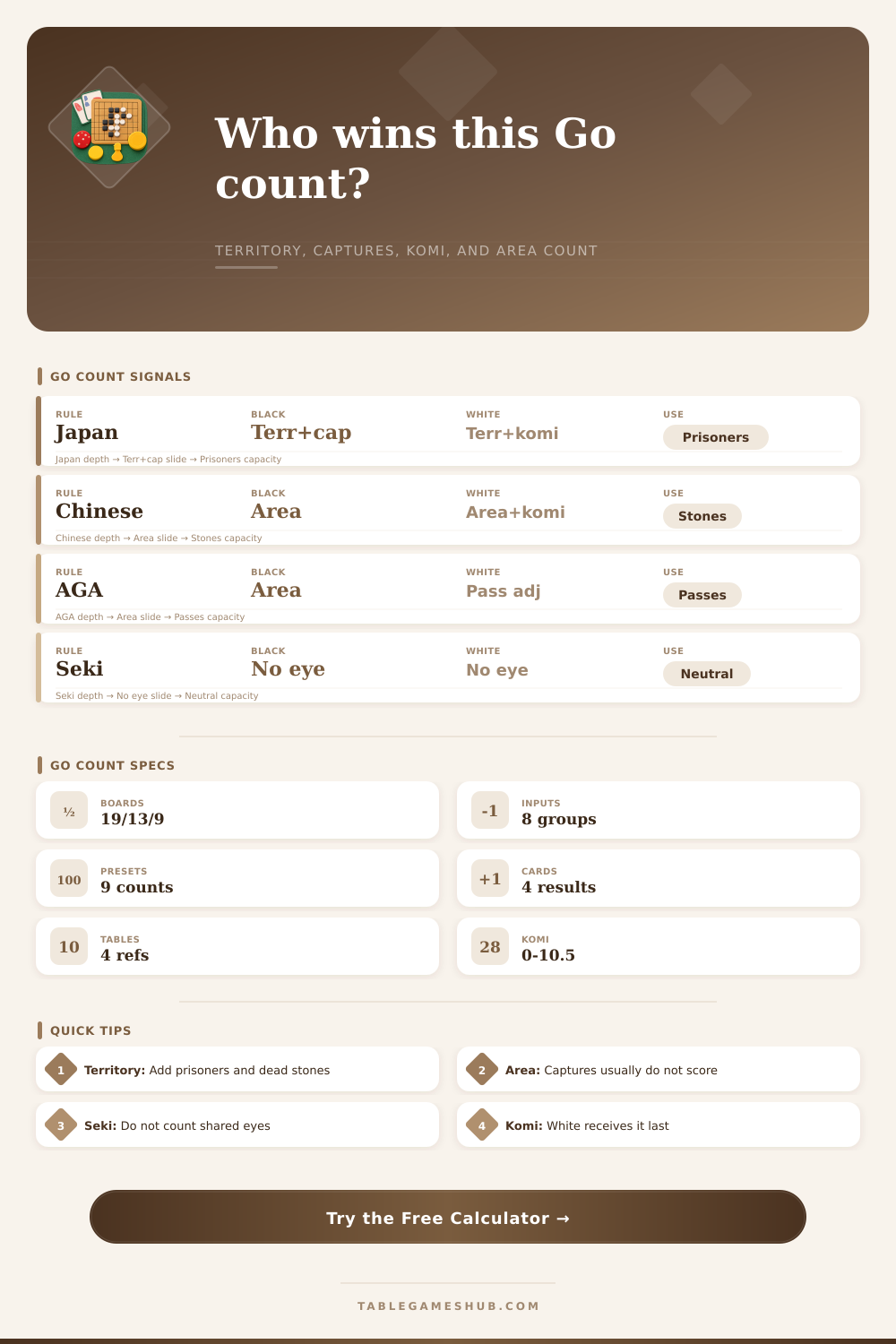
Go Territory Counting Calculator
Audit a finished Go position with territory, prisoners, dead stones, komi, handicap stones, dame, seki, and the scoring rule used at the board.
| Rule family | Black score core | White score core | Calculator treatment |
|---|---|---|---|
| Japanese or Korean territory | Territory + prisoners + dead White | Territory + prisoners + dead Black + komi | Captures and dead stones are direct points. |
| Chinese area | Territory + estimated live Black stones | Territory + estimated live White stones + komi | Prisoners are displayed but not scored. |
| AGA area | Area count with pass-stone awareness | Area count + komi, with pass-stone check | Pass-stone note appears when captures are uneven. |
| New Zealand area | Area count after dead stones are removed | Area count after dead stones are removed + komi | Neutral policy controls disputed empty points. |
| Board | Total intersections | Common komi | Best use |
|---|---|---|---|
| 19x19 | 361 | 6.5 or 7.5 | Full game endgame counting. |
| 13x13 | 169 | 5.5 or 6.5 | Club ladder and teaching games. |
| 9x9 | 81 | 5.5 or 6.5 | Fast games with small margins. |
| Handicap 19x19 | 361 | 0.5 to 6.5 | Review handicap balance separately. |
| Category | Black entry | White entry | Counting note |
|---|---|---|---|
| Territory | Empty points controlled by Black | Empty points controlled by White | Do not include dame or neutral shared liberties. |
| Captures | White stones captured by Black | Black stones captured by White | Important in territory scoring only. |
| Dead stones | Dead White stones removed | Dead Black stones removed | Adds as prisoners under territory rules. |
| Komi | No direct entry | Added to White score | Usually breaks ties and offsets first move. |
| Item | When it matters | Calculator setting | Review cue |
|---|---|---|---|
| Dame | Neutral points not surrounded by either player | Neutral pts with exclude or split | Finish dame before counting when rules require it. |
| Seki | Shared life where neither side captures | Exclude shared eyes unless local rule says otherwise | Do not count false territory in seki. |
| Handicap | Black starts with extra stones | Handicap stones field | Area estimate uses it as a Black stone-balance cue. |
| Komi | White compensation | Komi to White field | Confirm 6.5, 7.5, or handicap komi before result. |
In Go, once two players each has passed twice, something happens: There’s a certain kind of silence that descends upon the board. The game have ended, but the score remains undetermined. And this is when things get interesting, this is where tournaments are decided, and friendships are forged (or broken), not necessarily by some masterful stroke in the center of the board, but by a wrong count on one corner or another.
It seems easy enough; it turns out that actualy calculating who won the game can be done in any one of two utterly distinct manners. In one method, we tally up empty points; in the other, we sums up the number of stones together with their associated territories. Get these confused, and you’re guaranteed to lose a game that you might otherwise have won.
How to Count Your Go Score
So after plugging in your board state into the calculator above, it does all this math for you (and spares you from having to do the conversion/coefficients math between these different rule sets). However, before trusting the results, you should of know what each input means.
These inputs include: Territory consists of empty intersection that are fully enclosed by your own stones. These are by far the majority of your score in Japanese/Korean rules, where they’re called empty points, followed by prisoners (enemy stones you capture during the game). Dead stones can also be considered territory. If your opponent leaves a dead group on the board for aesthetic purposes, it’s considered territory for him/her. You have to either physically or mentally take those out of consideration in order to come up with an accurate count. That’s where people mess up; they look at empty spots and think they belong to them without accounting for a dead stone that nullifies the entire point value.
Scoring in Chinese rules (the way they do it in China) isn’t like that. Each stone on the board score an equal amount. Your points are just your territory plus however many live stones you still own. Captures do not add to that total because a captured stone is removed from the board and no longer counts toward anything. You can switch between the two territory counting rules with the tool. However, you’ll need to know which rule your game uses before pressing “calculate.” If you’re playing by Japanese rules but using Chinese, you’re going to get a big chunk of score added on. While it’s a small thing, it will matter if your games is close.
White, as the second player, has an offsetting advantage: a value called the komi… Most moddern games use 6.5 or 7.5 points, to compensate for Black’s first move. The calculator automatically adds this to White’s overall score, along with any other points that prevent a draw. Most contemporary games play for 6.5 or 7.5 points.
In addition, the inclusion of handicap stones alters things still further: they cut back on the komi and award Black additional pieces at the beginning of the game. Be sure to account for this in your input data if handicap stone have been laid down initially.
The dame, or neutral points remaining between the boundaries when they’re closed off, ordinarily go to neither side. Some rule sets simply disregard them; others apportion them. You can tell the calculator what happens with such undecided spots.
On the other hand, Seki is more difficult (since you can’t kill each other; both sides are alive). Seki is neutral ground, according to most rules. The eyes of seki does not count toward either player’s territory. Counting them means that you’re cheating yourself. However, the page has a neat reference table laying this all out, so you can see if your assumptions line up with standard conventions. For example, you may assume a shared eye belongs to you since it’s closer to your group. Unless you can capture the opponent there, however, it will yield no points.
The audit feature checks to see if you’ve made sense of your numbers (if your stones + territory exceeds the size of the board, then something’s off). It also catches double counting errors faster than a human reviewer. But there’s no way for any tool to judge the shape of your groups, that requires eyes on the board. You still need to figure out if that corner group is really dead or just looks vulnerable. The calculator doesn’t assume that you’ve made any of those judgment calls; it only does the arithmetic.
Clear thinking matters as much as calculations do in go scoring, and misinterpretations of what constitutes area versus territory can lead to arguments that were simply avoidable with another second’s thought. Take the time to fill out the spaces and check the count again, including any dead stones in your territory count. Then don’t count them towards prisoners, too, consistency beats speed every time.
And when that final margin pops up on screen, W+1, or B+3.5, whatever it may be. You’ll realize how well-understood every element was that contributed to it, and you’ll know it’s the real deal. There will be no sound at the table, only the quiet that comes from having settled a score, not wondering about one.