🎯 Ladder Toss Score Calculator
Total top, middle, and bottom rung bolas, apply cancellation and bonus house rules, then update a race to 21 with bust options.
| Step | Value | Calculation | Note |
|---|
| Rung | Common value | Input field | Scoring note |
|---|---|---|---|
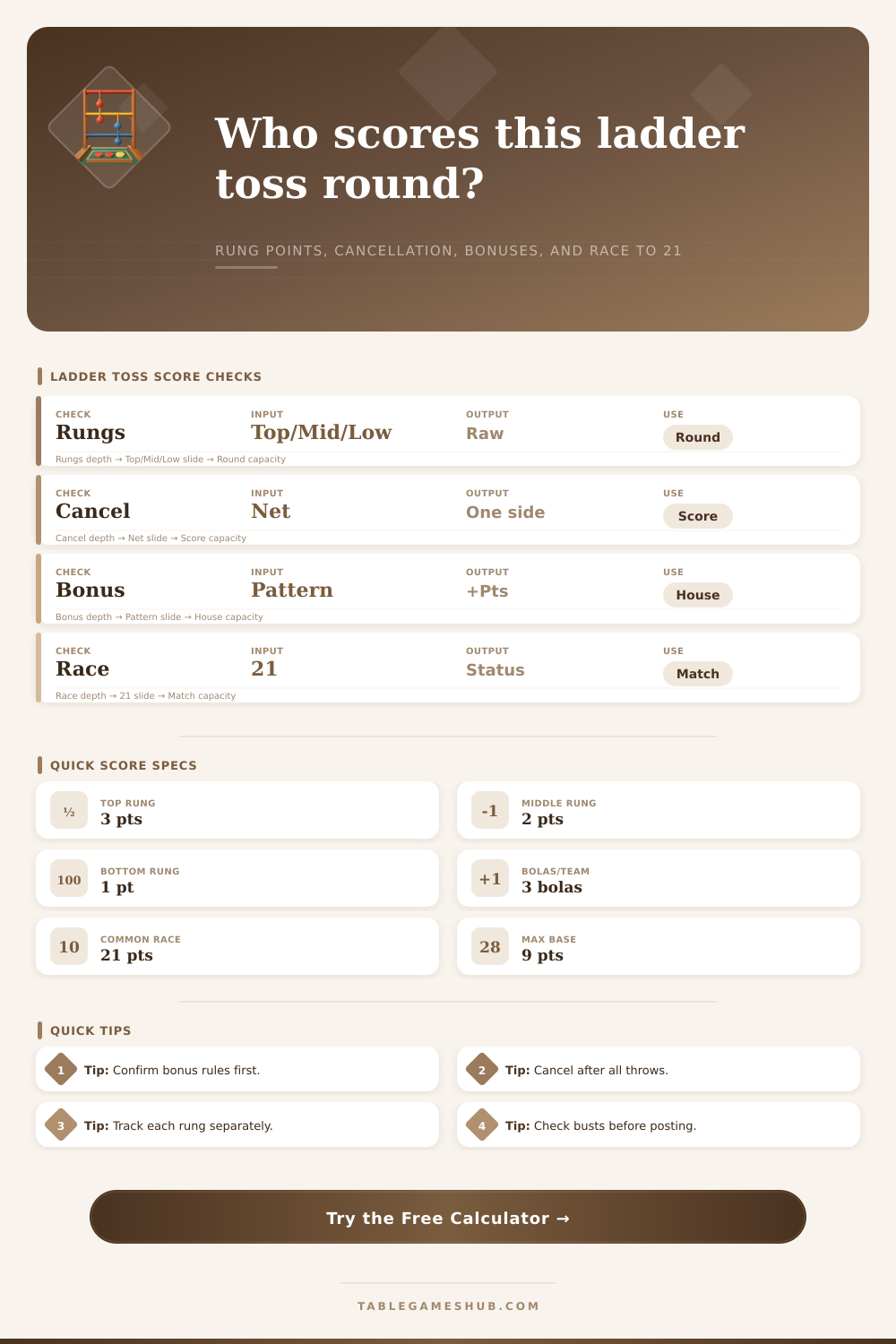
| Top rung | 3 points | Top rung points | Highest standard value; three top bolas make a 9-point base round. |
| Middle rung | 2 points | Middle rung points | Often used to build steady rounds when top rung misses. |
| Bottom rung | 1 point | Bottom rung points | Lowest standard value, but it can complete a one-each bonus. |
| Miss or drop | 0 points | Do not enter | Only bolas hanging on a rung at round end are scored. |
| Cancellation mode | How it scores | Best use | Example |
|---|---|---|---|
| Total raw cancellation | Team totals cancel after raw rung value | Common simple scoring | 7 raw vs 4 raw gives Team A 3. |
| Per-rung cancellation | Each rung nets separately before adding | Detailed score sheets | Top cancels top, middle cancels middle, bottom cancels bottom. |
| No cancellation | Both teams keep their points | Practice or custom play | 7 raw and 4 raw both post to the match. |
| Bonus before total cancel | Pattern bonuses enter the raw total first | Bonus-heavy house rules | One-each bonus can change the net round winner. |
| Bonus rule | Trigger | Calculator action | House-rule note |
|---|---|---|---|
| No bonus | Rung values only | Adds top, middle, and bottom points | Cleanest option for mixed groups. |
| One on each rung | At least one top, middle, and bottom | Adds 1 bonus point | Rewards a spread across all three rungs. |
| All three same rung | Three bolas on one rung | Adds 1 bonus point | Often called a hat trick or triple bonus. |
| Both bonuses | Either pattern qualifies | Adds every qualifying pattern point | Use only when the group allows stacked bonuses. |
| Finish rule | Target behavior | Calculator action | Score sheet effect |
|---|---|---|---|
| Target or more | Score can pass the target | Declares a winner at target or above | Fastest casual race ending. |
| Exact target | Over target is a bust | Uses your custom bust-back score | Common for race-to-21 backyard games. |
| Bust back 15 or 13 | Over target resets the score | Applies the selected reset value | Good when the group has a fixed house reset. |
| Win by 2 | Target plus margin required | Checks score and lead together | Keeps tight matches alive near 21. |
| Round pattern | Typical raw value | Bonus chance | Read |
|---|---|---|---|
| Three top rung | 9 points | Same-rung bonus | Highest normal base round with 3-2-1 scoring. |
| One on each rung | 6 points | Spread bonus | Balanced round that may beat a two-top round under bonus rules. |
| Two middle, one bottom | 5 points | No default bonus | Solid round, often vulnerable to top-rung swings. |
| All misses | 0 points | No bonus | Can still wash the round if the opponent also misses. |
Choose cancellation before the first throw
Total cancellation and per-rung cancellation can produce different winners from the same bola positions, especially when each team owns different rungs.
Post bust rules after bonuses
Apply rung values, add any allowed bonus, cancel the round, then check exact-score or bust-back rules before updating the scoreboard.
Jump to the reference tables and use this ladder toss score calculator to score rung points, cancellation, bonuses, race status, bust rules, and round pace.
Ladder toss is a game that involve throwing bolas at a ladder to earn points; however, it can become difficult to manage ladder toss if a player dont have a scoring system for the game. When playing ladder toss, many groups of players can get confused during the game due to the arguments that occur between individuals regarding who has earned the most points, and why some players score more than others. A clear scoring system for the game are necessary in order to avoid such arguments between players.
In the game of ladder toss, points is awarded based on which rungs of the ladder the players land there bolas. Players can earn three points for landing a bola on the top rung of the ladder, two points for landing a bola on the middle rung of the ladder, and one point for landing a bola on the bottom rung of the ladder. It is important for players to scoring points for each round of the game; scoring points allows individuals to accumulate points over the game.
How to Score in Ladder Toss
The rules that is established for ladder toss will also determine in what way that each player decides to play the game; players can either play conservative to earn points each round, or they can play aggressively with the intention of scoring a large number of points each round. One of the common rules for ladder toss is the rule of cancellation. The rule of cancellation states that if both teams land a bola on the same rung of the ladder, the score of the team that earned the less points on that round is canceled out, and the difference between the two scores is the score awarded to the team.
For instance, if one team scores three points on a rung and the other team scores one point with there bola, the point earned by the other team is canceled out. Thus, only the one team receives the two points for that round. This type of rule rewards players for watching where their opponent is throwing there bolas, because with the knowledge of where they opponent will score, a player can use the rule of cancellation to cancel out the points earned by the opponent.
Another aspect to ladder toss that can vary from group to group is the use of bonuses. Bonuses are additional points that can be awarded to a teams score; however the bonus rule will depend upon the rules that the group establishes. One bonus that is common among groups is the “one-each” bonus; this bonus is given to a team if they land at least one bola on each of the rungs of the ladder; the “one-each” bonus awards an additional point to the score of the team.
A second bonus that is common among groups is the single rung bonus; this bonus is given to the team that lands all three of their bolas on the same rung of the ladder. In this case, each team also earns an additional point to there score. Some groups have rules that state that bonuses may be awarded to players in each round, while other groups may have rules that state that only one bonus can be awarded to a player during a ladder toss game.
The goal of ladder toss is to earn twenty-one points; however, the rules regarding how a player can score twenty-one points may vary between groups. For instance, some groups may award the winner of the game to the player who first scores twenty-one points, while others may require a score difference of two points to be awarded to the winner. In addition to these rules, some groups may use “bust” rules; “bust” rules are applied to players if their score exceed the winning score of twenty-one points.
For instance, bust rules may award each player a score of fifteen points if their score goes over twenty-one points. In order to play ladder toss correctly, there must be an establishment of the rules for the game prior to the beginning of the game. Such rules may include the method for canceling points, bonuses for each round of the game, and the rules regarding how to win the game (exact score required to win).
Each of these rules must be decided prior to the first throw of the game. After the rules are established, the points for each round must be recorded. A calculator may be of assistance in determining the score of each round, as the calculator may calculate the points for each player after the application of cancellation rules, calculate the bonus points for each team, and determine if each team has met the requirements for winning the game.
Understanding the scoring system for ladder toss is important; the scoring system will change the way in which the players decide to play the game. For instance, if the rules state that a score must be exactly attained to win the game, the players will not take any risk in there attempts to throw bolas on the ladder. Additionally, if the rules state that bonuses are provided to teams for certain conditions, the players may choose to take risks to earn those bonus points.
Thus, while the calculator will help to ensure that there are no mathematical error in scoring each round, the players must also pay attention to the ladder to score points honestely for each round of the game. They should of practiced the throwing motion to avoid any mistakes. Youll find that ladder toss is alot of fun once you get the hang of it.