Kitesurfing Kite Size Calculator
Estimate kite area from rider weight, wind speed, board efficiency, skill level, kite style, water state, gust spread, and session intent.
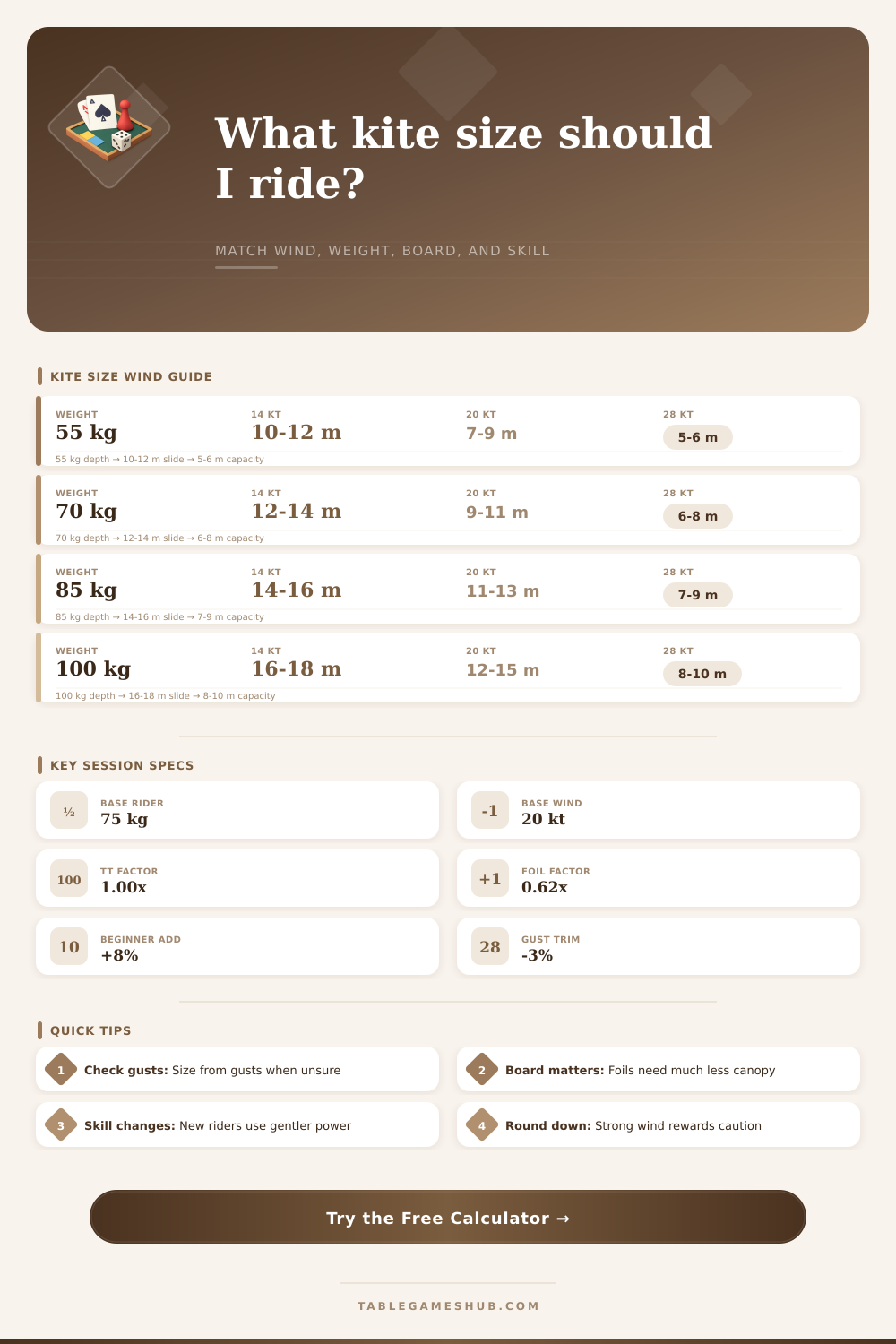
| Rider weight | 12-15 kt | 16-20 kt | 21-27 kt | 28-35 kt |
|---|---|---|---|---|
| 55-65 kg twin tip | 10-13 m² | 8-10 m² | 6-8 m² | 4-6 m² |
| 66-80 kg twin tip | 12-15 m² | 9-12 m² | 7-9 m² | 5-7 m² |
| 81-95 kg twin tip | 14-17 m² | 11-14 m² | 8-11 m² | 6-8 m² |
| 96-110 kg twin tip | 16-19 m² | 12-15 m² | 9-12 m² | 7-10 m² |
| Board type | Efficiency factor | Typical use | Sizing effect |
|---|---|---|---|
| Small high-wind twin tip | 1.08 | Strong wind control | Needs more pull to plane |
| Standard twin tip | 1.00 | Freeride baseline | Neutral reference |
| Light-wind door board | 0.78 | Early planing | Reduces kite size |
| Directional surfboard | 0.88 | Wave and strapless | Less canopy than twin tip |
| Hydrofoil freeride | 0.62 | Low-drag cruising | Much smaller kite |
| Kite type | Pull factor | Depower feel | Calculator note |
|---|---|---|---|
| Bow/SLE inflatable | 1.00 | Broad range | General freeride baseline |
| Delta inflatable | 0.97 | Easy relaunch | Slightly efficient low end |
| C-kite/wakestyle | 1.08 | Less sheet range | Often ridden powered |
| Wave kite | 1.03 | Drift focused | Round down in gusty surf |
| Closed-cell foil | 0.85 | High efficiency | More pull per meter |
| Gust spread | Condition label | Sizing trim | Practical response |
|---|---|---|---|
| 0-3 kt | Steady | 0% | Use average wind |
| 4-6 kt | Variable | -3% | Check gust handling |
| 7-10 kt | Gusty | -7% | Favor smaller kite |
| 11+ kt | Very gusty | -12% | Use local caution |
Choosing the correct size for you’re kite as a kiteboarder is an important process. The correct size for the kite will ensure that the kite provide you with an appropriate amount of power based off the wind conditions that you will encounter. If you choose a kite that is too large for the wind conditions that you will encounter, you can struggle to control the kite and may encounter dangerous lofting condition.
Conversely, if the kite that you choose is too small for the wind conditions that you will encounter, you will struggle to plane your board across the water, and you will drift backward on the water. Thus, there are a variety of variable that you should consider when you choose your kite size to ensure that you can ride your board as safely and efficient as possible. One of the main variable to consider is your body mass.
How to Choose the Right Kite Size
Your body mass will impact the amount of lift that you require to overcome the force of gravity and to push your body and board across the water. Thus, the higher your body mass, the more lift that you will need. However, the equipment that you use will impact the amount of lift that you require.
For example, if you are using a hydrofoil to propel yourself forward, you will require less lift than if you were using a twintip board. Another variable is the type of board that you select for your body. The larger of your board and the amount of surface area that it present to the water will create more lift than a smaller board.
Thus, a large light-wind board will allow you to plane in conditions of low wind because of the lift that it will produce. However, a small high-wind board will require more pull from the kite to allow your body and board to plane across the water. Therefore, your type of board is a critical component to setting your kite size.
The design of the kite also has some effect upon the size of your kite. For example, a c-kite is designed for more aggressive movement than a bow kite. Additionally, the bow kite will provide a different range of depower compared to a c-kite.
Additionally, if you use a foil kite instead of a conventional kite, you will find that the foil kite is more efficient in moving your body forward. Thus, if you use a foil kite, you will require a smaller sized kite canopy. Your level of skill with kiteboarding is another variable.
For example, if you are an expert kiteboarder, you can edge your board more aggressive than an inexperienced rider. Thus, an expert rider will require a smaller kite than an inexperienced rider because they can more efficient use their body weight to resist the pull of the kite. Wind gusts are another major safety variable.
Your kite size should be based upon the strength of the wind gusts in your area, not the average wind speed. For example, if the average wind speed in your area is 20 knots, but the wind gusts to 27 knots, your kite will create more power during those gusts. Thus, if you size your kite for the lulls in the wind, it may become too powerful when a gust of wind rolls over you.
Therefore, sizing your kite for the upper range of wind speeds is the safer choice. In addition to the strength of the wind gusts, the conditions of the water will also impact the amount of pull that you require from the kite. For example, if you are riding on flat water you will encounter less drag than if you are riding on choppy water.
Thus, the kite will require more pull if the chop increases in your area. Additionally, the amount of friction that snow on the ground have is distinctly different than the friction of saltwater. Thus, snowkiting will require a different consideration of kite sizing than kitesurfing.
Finally, the calculated estimate of the appropriate size for your kite is a logical starting point for the sizing process.