Ganz Schon Clever Calculator
Total a Ganz Schon Clever or That's Pretty Clever score sheet from colored section states, foxes, bonus chains, used dice pace, and penalty boxes.
| Section | What the calculator reads | Score method | Common swing |
|---|---|---|---|
| Yellow | Grid pattern state | Rows, columns, and diagonals convert to fixed pattern points. | Completing one extra line can jump 7 to 10 points. |
| Blue | Number of blue boxes marked | Marked boxes use the blue count table from 0 through 66. | Late blue boxes are much more valuable than early boxes. |
| Green | Farthest crossed threshold | Track depth converts to a rising cumulative score. | Finishing the last two spaces is usually a major lift. |
| Orange | Pips after multiplier slots | Orange values are summed, including doubled and tripled cells. | High dice on multiplier slots can define the sheet. |
| Purple | Increasing row total | Purple values are summed as long as the rising row stays open. | Late sixes can add score and trigger chain bonuses. |
| Item | How it is counted | Calculator effect | Practical check |
|---|---|---|---|
| Fox count | Visible fox bonuses earned on the sheet | Fox count multiplied by the lowest colored section score. | Raising the weakest color raises every fox. |
| Bonus chain count | Triggered extra crosses, marks, or dice boxes | Feeds the combo estimate at about 3 points per chain. | Long chains matter most when no color is neglected. |
| Used dice per round | Active dice plus useful passive selections | Tempo over 4.5 improves the finish forecast. | Low tempo warns that boxes may be stranded. |
| Penalty boxes | Missed rounds or house-tracked crossed penalties | Subtracts 5 points each from the final score. | Keep penalties separate from the five color sections. |
| Preset | Main strength | Weakest risk | Typical use |
|---|---|---|---|
| Learning First Game | Small marks across colors | Low fox floor | Check first finished sheet. |
| Yellow Grid Rush | Yellow line completion | Blue lag | Compare grid-heavy sheets. |
| Blue Bonus Engine | Late blue count table | Orange tempo | Audit blue-led combo scoring. |
| Orange Multiplier Run | High orange pips | Green depth | Test multiplier-heavy results. |
| Expert 300 Chase | Balanced high colors | Penalty sensitivity | Estimate top-table finishes. |
| Final score | Band | What usually caused it | Calculator signal |
|---|---|---|---|
| Under 100 | Learning sheet | Few chains and one or two very low colors. | Fox floor below 10. |
| 100 to 169 | Solid casual sheet | Several colors built but incomplete engines. | One color still far behind. |
| 170 to 239 | Strong sheet | Good fox count, clean blue or orange progress. | Weakest color near 20. |
| 240 to 299 | High combo sheet | Multiple late chains and balanced color totals. | Combo estimate over 30. |
| 300 plus | Expert finish | High fox floor, few penalties, and strong tempo. | All five colors are productive. |
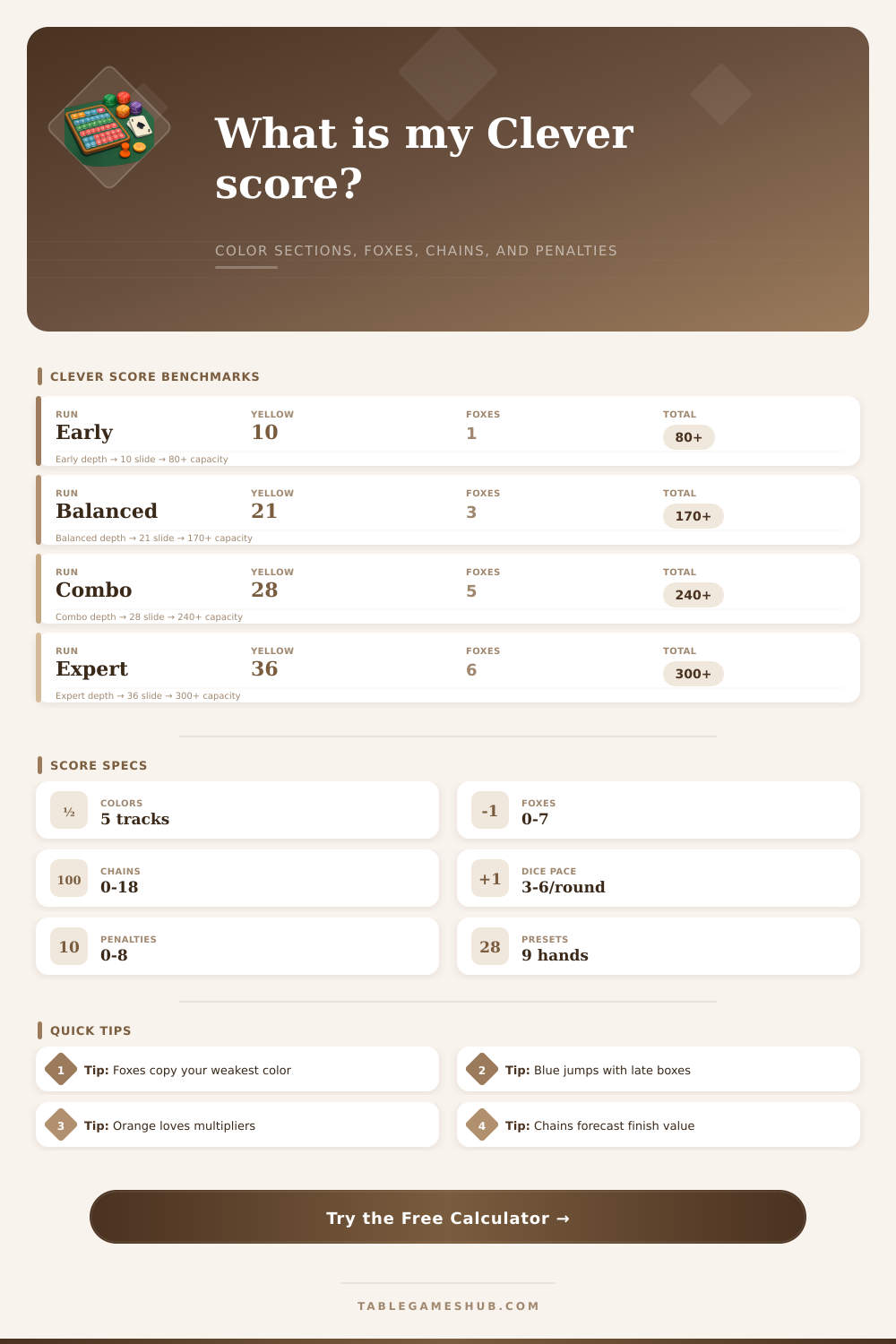
Ganz Schon Clever’s grid appears straightforward, but its math is rigid. One color you don’t pay attention to will cost you points. It doesn’t care how pretty your result look. Total up the colored squares (5 of them), add on the fox bonus, deduct penalties, and estimate combo potential based off dice tempo and chain length. Suddenly that puzzling sheet become an easy-to-understand number.
It’s chaotic. There are so many thing to manage and the game seems chaotic as a result. You’re trying for purple stability, orange pips, green depth, blue box, yellow lines. Not only do you have to add points, but you need to get them balanced to score. The fox punishes imbalance heavily. It take your weakest scoring color and makes all of the foxes copy it. Your weak purple? All the fox bonuses reflect that weakness. Most player don’t even realize this. They go after high scores on something while their floor crumbles beneath them.
How to Play Ganz Schon Clever
For each color, plug in your grid states into the tool above. When you do so, it will score rows and columns (yellow), because that’s what grids reward. Geometry count, but also filling in the spaces. If you get to lines, even partial completion can net some good points. Full completion provides a solid base while any amount of progress still gives you some points.
Blue scoring follow a rising table. The first boxes is cheap, but the later boxes are expensive. These values read straight from the box you mark out. Orange and green are two of the riskier ones. Green is on a threshold track that awards you points for crossing steps. Orange adds up pips, with some slot applying multipliers. Get high on the dice in those multiplier slots and your whole sheet might depends on them. And purple’s all about building up rows. A late six can add to your score. You can even get bonus points for chain bonuses, but only if it doesn’t close the row.
Each section have its own logic. You enter your stats into the calculator and it figures out the maths for you so there is no need to do any head scratching while playing. The Bonus Fox show what is working and what is not. Raising your weakest color raise every fox bonus. This little trick changes so much in the end result. And you can change each chain of foxes/bonuses independently, and then each one feed into a combo estimate that projects out how much more you might get at your current pace. Use lots of dice per round and this gets better. A low tempo suggests some box might be left behind.
Penalties drag on your final score because they remove five points each. Three penalties will eliminate twenty points of your total, which could mean the difference between a win or loss. I know, you’re thinking one missed box isn’t that bad. However, when they hit you in the penalty column, those three penalties will knock 20 points off your score. That’s why this calculator breaks the penalties out from the color section. So many people forget about them until the end, and then it’s too late.
So what does it mean? How do you plan to approach the board? Rush yellow? Or do you balance it out across all colors? Look at the preset profiles in the tool and see how they demonstrate various strategies. Rushing yellow may leave blue lagging far behind. Balancing all the colors keep them all moving together. Keeping any one color too low won’t get you high scores. Where’s your vulnerability? That’s told to you by the fox floor. If that number is low, don’t count on your foxes helping much.
Afterwards when you finish playing, use it as an analyzer. What color cost you the most? Why did you neglect that color? Did it get away from you due to poor luck, or did you choose to abandon it? Sometimes abandoning one color is a good idea, sometimes it’s a lack of planning. This calculator will tell you if your game plan paid off or not. Adjust the input and see what might of been. How much higher could your score be with better purple results?
Adaptability and precision pay off big on Ganz Schon Clever. Read the board and adjust accordingly. Use this tool to help you do that clearly. It removes the noise and reveals what the score could realy be. Next time you play remember that balance. Protect those fox bonuses and watch your weakest color. Every penalty box is a lost opportunity. And the game is indeed clever, but only if you are too.