Merv Score Calculator
Total a Merv score sheet across city presence, palace favour spending, mosque progress, library scrolls, trade goods, walls, contracts, influence, and caravanserai end-game sets.
Pick a board state, then adjust every category to match the player before resolving year-end or final scoring.
City Presence
Walls And Influence
Mosque Track
Library And Breakthroughs
Palace Courtiers
Trade Routes And Wares
Caravanserai Cards
| Hall | Calculator input | Scoring rate | Useful audit |
|---|---|---|---|
| Knowledge | Scrolls owned or committed | 1 VP per scroll per paid courtier | Committed scrolls still count for palace scoring. |
| Spice | Total caravan cards | 1 VP per card per paid courtier | Separate from end-game caravan set points. |
| Trade | Common goods plus rare goods | 1 VP per good per paid courtier | Goods committed to contracts still count. |
| Faith | Mosque spaces advanced | 1 VP per space per paid courtier | Pairs well with a deep mosque track run. |
| Set size | Cards in set | VP per set | Calculator method |
|---|---|---|---|
| One spice | 1 card | 1 VP | Leftover singles are counted after larger sets. |
| Two spices | 2 different cards | 3 VP | Cards are grouped to maximize final VP. |
| Three spices | 3 different cards | 6 VP | Counts ginger, juniper, cinnamon, and pepper. |
| Four spices | 4 different cards | 10 VP | Each full spice set is the strongest end score. |
| Area | What to count | Scoring or impact | Common miss |
|---|---|---|---|
| Buildings | Buildings left after invasion | 1 VP each during scoring | Destroyed buildings do not score presence. |
| Scoring tile | Buildings with chosen action symbol | 3 VP per matching building | Only if the mosque tile was claimed. |
| Mosque finish | Mosque-symbol buildings | 4 VP each if final space reached | This is separate from hall of faith. |
| Walls | Own and rival buildings near new walls | Influence gain during wall action | Influence VP is usually already recorded. |
| Trade goods | Common and rare wares | Palace trade hall value | Goods on contracts still count. |
| Contracts | Fulfilled contract cards | Immediate VP and boons | Add only if not already on score track. |
Palace order: When favour is short, compare each hall value before spending. A single high-value knowledge, spice, trade, or faith courtier can beat scoring several low-value halls.
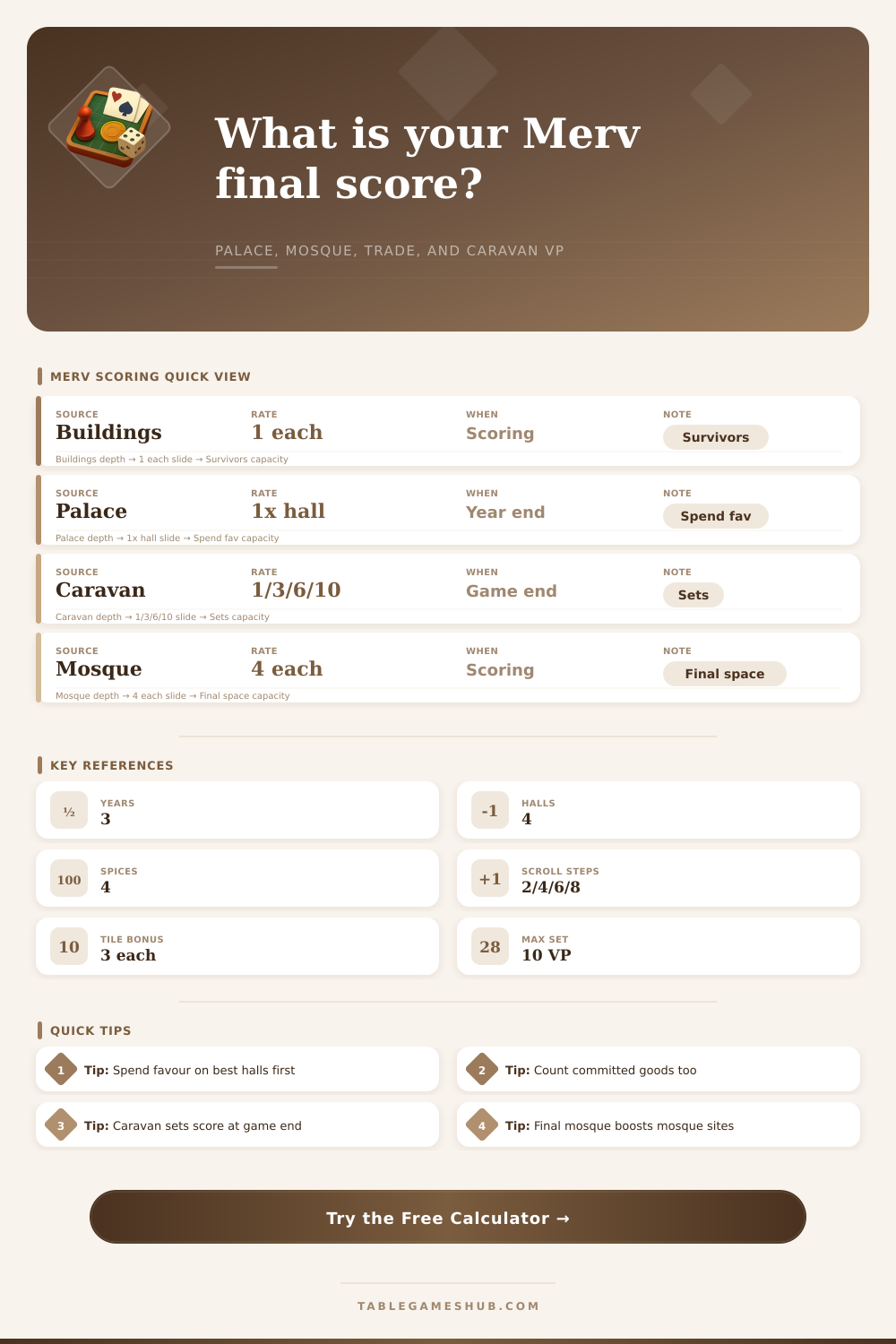
End scoring: Caravan cards score both through the palace during scoring phases and again as spice sets at game end, so keep those two lines separate.
It’s at this point that Merv gets into a particular flavor of quiet panic. For three years, the game’s been an unfolding sprawl of resource management, spatial reasoning, and opportunistic maneuvering. And then boom: all of that compress into arithmetic. There are buildings sitting around the board, scroll cards hiding in the library, caravan cards stashed in your tableau, and influence points that you might or might not has written down properly on score track. Use the calculator up top to crunch numbers, but knowing which bits adds up where, from all these different sources of victory points, is difference between winning by luck and winning with strategy.
I think it mostly comes down to realizing there isn’t just one set of rules, but four different scoring engines running side-by-side. Currency changes from goods to favor, which is where many players trip up initialy. Favor are spent to awaken each courtier in the halls of trade, spice, faith, and knowledge. Those halls scores one of four types of assets: the Hall of Trade values your rare and common wares, the Hall of Spice favors your spices, the Hall of Faith rewards your holy artifacts, and the Hall of Knowledge awards your library scrolls.
How to Score Points in Merv
Seems simple enough, except when you recognize that any goods locked into contracts continue to be counted towards your trade score, regardless of being unavailable for play. Most people miss that point. They look at their empty hand and think they’ve got no value, ignoring fact that game keeps track of what you’ve traded away. To help with that, the tool lets you enter your current stock in addition to immediate points already on the track so nothing falls between the cracks.
The city is different than before. The city stays in one place and focuses on defense. If any building survive on your turn, you get one point for each building plus extra points for having finished mosque track or holding scoring tile. Finishing a mosque gives you four points for each building with a mosque symbol. That’s a powerful bonus that alone could of win a tight game.
And here is where things becomes interesting: there is a conflict between defense and expansion. To build means both more structure and more vulnerability when an opponent invades in a phase where he may raid your city. You protect yourself from raids by building walls (which generate influence and also guard a number of slots). But you do so at the price of using up actions that could otherwise go towards expanding further.
Should I build now? Or should I wait and put the wall up first? Do I feel safer behind a wall? Or am I just procrastinating?
The set collecting aspect of Caravan cards resolve late in the game. There are pepper, cinnamon, ginger, and juniper cards that makes sets. Each card by itself doesn’t amount to much; however, if you have four different spices, you get a huge point bonus for having variety of types rather than many of the same kind. That creates an incentive to hold onto some variety over depth in some rounds.
To avoid players doubling up on these cards, the calculator keeps them separate from spice scoring within each palace so they aren’t counted twice. While you may be scoring your cards throughout the year via the Hall of Spice, their real value often comes when the game ends and they group up.
In short: Merv requires that players manage several paths of progress while keeping an eye on end state. That’s a lot to juggle. That is why we’ve built in the calculator, which audits these complicated interactions by breaking everything down by phase and adding up bonus points at the end.
Where did your victory come from? What engine helped you get there? Did you over-invest in one area more than another? Whether you are looking back on a past playthrough or planning for year two, knowing how much each part. Caravans, trade, cities, and palaces, contributed will turn guesswork into strategy.
The numbers don’t lie, but they won’t tell you their own story if you don’t interpret them carefuly. Each decision you make to build, protect, trade and influence the ancient city adds to its final score.