🎲 Catan Dice Probability Calculator
Compare settlement spots by roll odds, pip strength, and expected output over future turns.
| Measure | Spot A | Spot B | Combined |
|---|
| Roll | Ways | Chance | Board note |
|---|---|---|---|
| 2 | 1 | 2.8% | Rare |
| 3 | 2 | 5.6% | Weak |
| 4 | 3 | 8.3% | Fair |
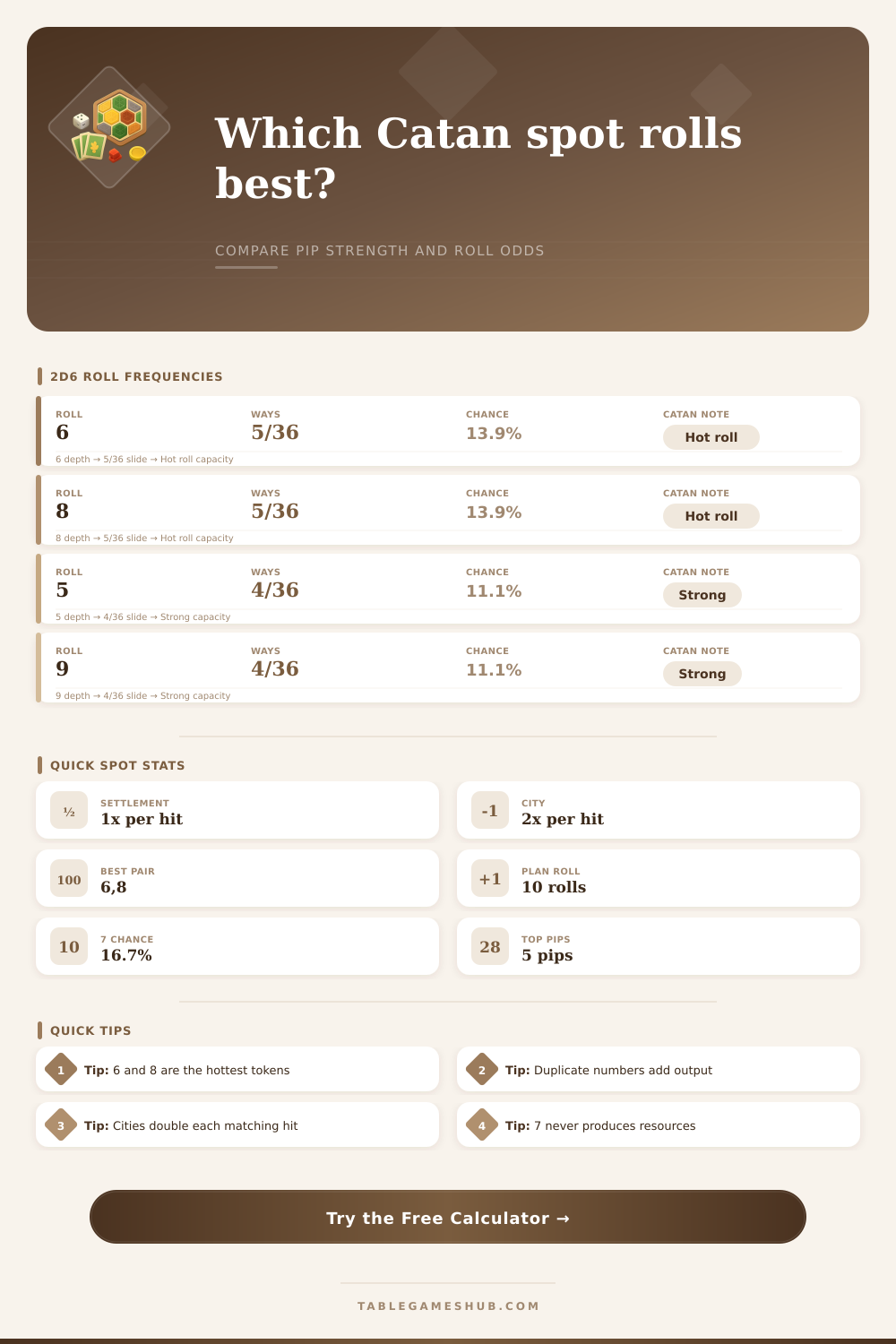
| 5 | 4 | 11.1% | Strong |
| 6 | 5 | 13.9% | Hot |
| 7 | 6 | 16.7% | Robber |
| 8 | 5 | 13.9% | Hot |
| 9 | 4 | 11.1% | Strong |
| 10 | 3 | 8.3% | Fair |
| 11 | 2 | 5.6% | Weak |
| 12 | 1 | 2.8% | Rare |
| Token | Pips | Hit rate | Common role |
|---|---|---|---|
| 2 or 12 | 1 | 2.8% | Low output |
| 3 or 11 | 2 | 5.6% | Light output |
| 4 or 10 | 3 | 8.3% | Steady output |
| 5 or 9 | 4 | 11.1% | Strong output |
| 6 or 8 | 5 | 13.9% | Best output |
| 7 | 0 | 16.7% | Robber only |
| Total pips | Per-roll rate | Use case | Comment |
|---|---|---|---|
| 4-6 | 11.1%-16.7% | Backup spot | Safe but slow |
| 7-9 | 19.4%-25.0% | Balanced | Solid midboard |
| 10-12 | 27.8%-33.3% | Strong | Usually worth it |
| 13+ | 36.1%+ | Premium | Excellent anchor |
| Pair | Total pips | Focus | Comment |
|---|---|---|---|
| 6 + 8 | 10 | Best pair | Fastest start |
| 5 + 9 | 8 | Very strong | Great balance |
| 4 + 10 | 6 | Steady | Middle speed |
| 3 + 11 | 4 | Light | Safer, slower |
Hit rate first
Use the pips total to spot the faster intersection before you think about resource type.
Duplicate numbers matter
Two matching tokens can raise output even if they do not raise the unique hit chance.
Compare Catan settlement spots by pip strength, duplicate number coverage, and expected rolls so you can place pieces where the dice are most likely to pay off.
When you begin an game of Catan, you must choose an intersection where you will place your settlement. The placement of your settlement is an important decision to make, as the placement of your settlement will determine the resource that you will recieve from each of your settlements. Each settlement will collect one resource from each of the adjacent resource hexagons whenever the dice rolls a number that matches a number on that hexagon.
If you upgrade that settlement to a city, that city will collect two resource from each of the adjacent resource hexagons whenever the dice roll a number that matches a number on that hexagon. The probability of a number being rolled with the two six-sided dice in Catan is determine through the number of ways in which that number can be produced by the two dice. Each die has six sides, so there are 36 possible outcome when two dice are rolled.
Where to Place Your Settlement in Catan
Because 1+6=7, 2+5=7, 3+4=7, 4+3=7, 5+2=7, and 6+1=7, the number seven can be rolled in six different way. Similarly, eight can be rolled by rolling a 2 and a 6 (2+6), 3 and 5 (3+5), 4 and 4 (4+4), 5 and 3 (5+3), 6 and 2 (6+2), and 1 and 7 (but 7 is not a side of a die). Thus, eight can be rolled in five different ways.
However, two can only be rolled in the event of rolling a 1 on each die, as can 12. Thus, two and 12 can each be rolled in only one way. Because six and eight can be rolled more frequent than two and twelve, six and eight are more valuable than two and twelve.
One way of measuring the value of each of the resources of Catan is by using the pips on the resource tokens. The number of pips on each token represent the number of ways in which that number can be rolled by the two dice. For instance, since six and eight can each be rolled in five different ways, each of those two resource tokens will have five pips.
Similarly, since two and twelve can each be rolled in only one way, each of those two resource tokens will have only one pip. Each of the intersections on the Catan board can have resource tokens of various values touching it. Intersections that contains many high-pip tokens will produce more resources for the players than
The total pip value of a settlement is one of the most common ways to evaluate the settlement of players.
Many players look for the total pip value of their settlement to be 13 or higher, as this represents a high frequency of resource production from the settlement. However, the quality of those numbers are also important. For instance, a settlement on a 6, 8, and a 5 will have a total of 13 pips, but will produce resources frequent.
Additionally, if a player places their settlement on two different hexes that contains a 6, they will produce two resources every turn. The robber is another component of Catan that can decrease the resource a player produces. The robber can be moved when a 7 is rolled on the dice.
If a player places their settlement on a resource hex, they may receive the resources that that hex produce, but they are also potentially a target for the robber to block their resources from that settlement. The robber will appear in many games of Catan because the number 7 is the most common number to roll on the game dice. Therefore, players must find a balance between selecting high-pip numbers for their resources and protect them from the robber.
When players play a game of Catan, they should consider how many turns will last one game. For short games, selecting high-pip resources will help the player gain the resources that they need quick. However, for longer games, it is better for a player to have a diversity of resources.
If a player builds a city, it will increase the resources a player receive from their game. Additionally, cities make the high-pip numbers even more valuable because the city will double the resources that is produced from the settlement. Players should consider these factor when deciding when to upgrade their settlement to a city.