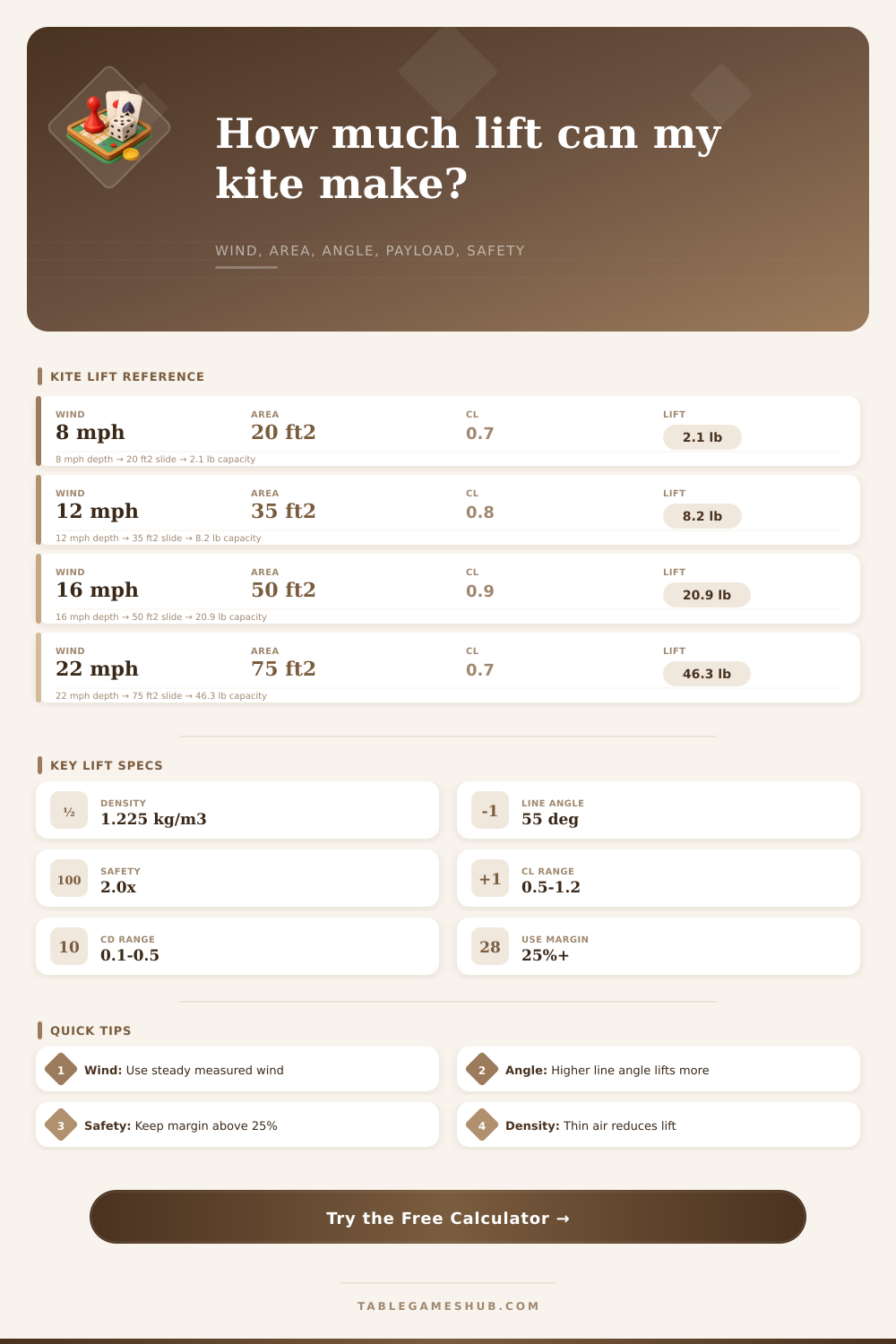
Kite Lift Calculator
Estimate aerodynamic lift, usable vertical support, payload margin, and line tension from wind speed, sail area, coefficients, density, angle, and safety factor.
| Kite configuration | Typical CL | Typical CD | Planning note |
|---|---|---|---|
| Delta single-line kite | 0.45 to 0.75 | 0.12 to 0.28 | Stable but modest lifter |
| Rokkaku or bowed sail | 0.60 to 0.95 | 0.18 to 0.35 | Good vertical angle when tuned |
| Sled or flowform lifter | 0.65 to 1.05 | 0.25 to 0.50 | Strong pull with more drag |
| Parafoil soft kite | 0.70 to 1.20 | 0.18 to 0.42 | Efficient projected area |
| Traction or power kite | 0.80 to 1.40 | 0.20 to 0.55 | High pull; de-rate for gusts |
| Wind speed | Approx m/s | Dynamic pressure | Lift planning note |
|---|---|---|---|
| 6 mph | 2.7 m/s | 4 Pa | Only large, light sails lift well |
| 10 mph | 4.5 m/s | 12 Pa | Useful for gentle lifter checks |
| 15 mph | 6.7 m/s | 28 Pa | Lift rises quickly with wind squared |
| 20 mph | 8.9 m/s | 49 Pa | Check line limit and safety factor |
| 25 mph | 11.2 m/s | 77 Pa | Gust de-rating becomes important |
| Condition | Density kg/m3 | Lift vs sea level | When to use it |
|---|---|---|---|
| Cold sea-level air | 1.29 | 105% | Cool dense conditions |
| Standard sea level | 1.225 | 100% | Default calculator value |
| Hot humid lowland | 1.16 | 95% | Warm summer field |
| 1000 m elevation | 1.11 | 91% | Moderate altitude launch |
| 2000 m elevation | 1.01 | 82% | Mountain or plateau flying |
| Line angle | Vertical factor | Horizontal pull | Payload interpretation |
|---|---|---|---|
| 25° | 0.42 | High | Most pull is sideways |
| 35° | 0.57 | Moderate high | Marginal for payload lifting |
| 45° | 0.71 | Balanced | Common conservative planning point |
| 55° | 0.82 | Moderate | Good single-line lift angle |
| 65° | 0.91 | Lower | Excellent vertical support |
When lifting a payload with a kite, there are several physical variables to account for. The main consideration are producing enough lift to overcome the force of gravity that weighs down the payload. Lift is the force that allows a kite to rise.
The amount of lift a kite can produce is calculate with the speed of the wind, the design of the kite, and the density of air. If these variables isnt calculate correctly, the kite might not be able to lift the payload that the kite are intended to be lift, or the line may break from the tension the kite create. The first variable to consider is the speed of the wind.
What Affects a Kite When Lifting a Load
Wind speed is important to the generation of lift by the kite, but the two variable do not have a linear relationship. If the speed of the wind are doubled, the lift that the kite generates does not double. The lift increase with the square of the velocity of the wind.
For instance, if the wind increases from 10 mph to 15 mph, the amount of lift will increase by a much more greater number. As such, people must plan for sudden increase in wind speed. The design of the kite impact the amount of lift that the kite creates.
Every design of kite create a specific coefficient of lift. For instance, a flat delta kite will have a different coefficient of lift than a pressurized parafoil kite. Additionally, each kite will create a different amount of drag.
Drag is the force that work against the movement of the kite and works against the lift that the kite generates. An excessive amount of drag will cause the kite to fall toward the horizon. Another important variable is the angle of the kite line.
The line does not create a force on the kite that pulls it straight upward. Instead, the line have an axis along which the kite pulls. If the kite is at a shallow angle to the horizon, such as 30 degrees, the tension on the line will be directed more toward horizontal movement than vertical lift.
To increase the vertical lift of the kite, the kite line should be increase. However, this will require an increased amount of force to be used in the ground anchor of the kite. Another variable that must be accounted for is the density of the air.
Air density is the number of air molecule within a specific volume of air. At sea level and in cooler temperatures, the air is dense with molecules. However, the thinner air at high altitudes and with hot temperatures will provide less lift for the same amount of force from the wind.
As such, the kite may struggle to lift the payload that the kite is intended to be lift in thin air. The total weight that the kite must lift include its own weight. If the payload that is to be lifted weighs 2 lbs, and the kite itself weigh 2 lbs, the total lift that is required from the kite is 4 lbs.
Additionally, it is important to include a safety margin for the lift that the kite will generate. This is to ensure that the kite will remain in the air even if the wind decrease. Another physical variable to consider is the tension on the kite line.
The lift and drag forces on the kite create the tension on the line. This variable is usually higher than the weight of the payload. The tension on the line should not be too close to the absolute breaking strength of the line.
Otherwise, even a gust of wind may snap the line. By taking control of these variables, the kite will successfully lift the payload.